73 LinkedIn Citation Statistics for B2B AI Search
LinkedIn citation statistics to decide whether AI search justifies executive posts or work on the listicles your buyers see.
On this page
- Highlights
- How Often ChatGPT Cites LinkedIn in 2026
- How LinkedIn Compares With Reddit in AI Answers
- How Google AI Mode’s LinkedIn Rate Varies by Question
- Which LinkedIn Pages AI Engines Cite
- Whether Personal Profiles or Company Pages Get Cited More
- What Cited LinkedIn Posts and Authors Have in Common
- How Often a Listicle’s Publisher Is Named in AI Answers
- What the LinkedIn Citation Data Does Not Show
- Frequently Asked Questions
Empact Newsletter
One email a month on what is working in AI search and SaaS go-to-market.
On the B2B marketing questions we put to AI engines in October 2026, Google AI Mode cited LinkedIn in 31.19% of its sourced answers, the ones that cite at least one page. ChatGPT’s figure was 0.1%.1 The rate changes with the engine and the question, so one average for AI search cannot tell you whether an executive’s posting time will reach the engine your buyers use.
Across the buying questions Empact Partners tracked, Google AI Mode’s LinkedIn citations went mostly to listicles ranking vendors. We get SaaS companies recommended in ChatGPT, Google AI Mode and Claude, and we would check those listicles before anyone books an executive’s posting time.
We tracked them with the Empact Panel, our own tool, which sends a partner’s buyer questions to those three engines each week and stores every reply with the pages it cites. For the figures below, it asked 500 questions about buying B2B marketing services, our own market. ChatGPT and Google AI Mode answered each one four times between 4 and 23 October 2026. Claude answered 50 of them, also four times, for 4,200 answers in all.1
Highlights
- 14.3% of ChatGPT Search responses cited LinkedIn in Semrush’s winter study.2 On other prompts in October, cloro measured 1.8% of ChatGPT’s answers.3 The two studies used different prompts, so neither gives a benchmark a LinkedIn budget can rely on.
- 41.09% to 11.92%: Google AI Mode’s LinkedIn rate on AI-visibility questions against SaaS go-to-market questions in our set, and 216 of the 500 questions never drew LinkedIn.1 Whether LinkedIn matters depends on which of your questions you count.
- 86.46% of LinkedIn’s citations on our questions went to listicles, and only 3.5% of sourced answers cited LinkedIn without one.1 So on these buying questions, the LinkedIn pages worth checking first are the vendor rankings.
- 5 of the 8 most-cited listicles put their own publisher first, and those five carry 55.17% of LinkedIn’s citations.4 More than half of what this engine cited from LinkedIn was a company ranking itself first.
- 41.05% against 6.32%: how often a publisher was named in answers citing its listicle, and in answers to the same questions that did not.4 The gap shows which listicles to read first and says nothing about cause.
Taken together, LinkedIn reached AI answers on these buying questions mostly through vendor rankings on one engine, Google AI Mode. Before funding posts, a budget owner needs to know which of those rankings name the company.
How Often ChatGPT Cites LinkedIn in 2026
The LinkedIn figures most often quoted come from two studies that closed in February. Semrush, working with LinkedIn, read 325,000 prompts across 12 industries in January and February 2026. It found LinkedIn in 14.3% of ChatGPT Search responses, 13.5% of Google AI Mode’s and 5.3% of Perplexity’s.2 Its average of 11% of AI responses made LinkedIn the second most cited domain in its data, which is where the “1 in 9” comes from.2
Profound tracked ChatGPT from 15 November 2025 to 15 February 2026. LinkedIn ranked #1 on a basket of professional prompts its researchers wrote, and rose from about #11 to about #5 on real ChatGPT prompts.5 Both studies describe the winter, before the readings below.
After February, ChatGPT cited far fewer pages overall. seoClarity found ChatGPT’s citation volumes fell 86% to 94% between February and late April across five markets, in a series it later extended to May.6 That total covers every site, so it cannot show LinkedIn’s share. For LinkedIn itself, the monitoring company cloro tracked prompts of its own:
- With the same 116 prompts on four engines, LinkedIn fell from 13.8% to 4.83% of answers between February and July, the four engines counted together.3
- ChatGPT alone then rose, from 0.57% of answers in the 30 days to 7 August to 1.8% in the 30 days to 12 October.3
Otterly reports LinkedIn’s share of social citations rising from 7.8% to 11.7% between January and May across six engines. 43.3% of its LinkedIn citations came from Perplexity, so that trend leans on an engine our Panel does not ask.7 Its 245,352 LinkedIn citations on ChatGPT span the months before and after March, so they give no rate for either period.7
The table puts the dated readings for the two engines side by side, after one caution:
Scroll horizontally to see all columns when the table is wider than this page.
| Who measured, and when | Divides by | ChatGPT | Google AI Mode |
|---|---|---|---|
| Semrush, Jan to Feb 2026 | Every response | 14.3%2 | 13.5%2 |
| cloro, 30 days to 7 Aug 2026 | Every answer | 0.57%3 | 6.2%3 |
| cloro, 30 days to 12 Oct 2026 | Every answer | 1.8%3 | 1.96%3 |
| Empact Panel, our category, 4 to 23 Oct 2026 | Answers citing a page | 0.1%1 | 31.19%1 |
Since the spring, every ChatGPT reading has come in under 2%, against about 14% in the winter, but the studies asked very different questions, so the gap is not a measured decline. For a budget, the useful point is that no single figure transfers to your buyers’ questions. The Google AI Mode column moves with the questions asked. Vlad Shvets, founder of Empact Partners, reads the ChatGPT side this way:
The 14.3% ChatGPT figure describes January and February. Later readings on different instruments sit under 2%, so I would not build a LinkedIn business case on ChatGPT until your own questions show it citing LinkedIn again.
 Vlad Shvets on LinkedInOpens in a new tab
How LinkedIn Compares With Reddit in AI Answers
On our questions in October, Google AI Mode cited Reddit in 34.84% of sourced answers and LinkedIn in 31.19%, and 219 answers cited both, so on AI Mode the two often sit side by side.1 ChatGPT cited Reddit in 12.07% and LinkedIn in 0.1%.1
Claude, asked 50 of the questions, cited LinkedIn in 0 of its 196 sourced answers and Reddit in none, so on these 50 questions neither site reached a Claude answer.1 The two engines that did cite them split this way:
LinkedIn and Reddit by Engine, on Our Questions
Sourced answers citing each domain, B2B marketing services questions, 4 to 23 Oct 2026
View the data
| Label | ||
|---|---|---|
| Google AI Mode | 31.2% | 34.8% |
| ChatGPT | 0.1% | 12.1% |
Reddit’s totals on both engines lean on one question group. On ChatGPT, Reddit reached 74.92% on Reddit-marketing questions and 0.82% to 1.53% on every other group.1 On Google AI Mode, Reddit’s rate was 63.42% on those questions, against 38.66% on AI visibility, 17.62% on SaaS go-to-market and 16.63% on content and SEO.1 Questions about Reddit itself pull Reddit’s average up on both engines.
Without our Reddit-marketing questions, Google AI Mode cited LinkedIn more often than Reddit in October, 33.21% against 29.75%.1 We have no earlier reading on these questions, so that is one month’s order and shows nothing about LinkedIn passing Reddit. Other instruments order the two differently:
- On cloro’s fixed prompts, Reddit went from 30.43% to 18.18% between February and July, still far above LinkedIn’s 4.83%.3
- On Meltwater’s B2B prompts across six platforms, LinkedIn held 0.53% of all citations against Reddit’s 0.44%, a share of citations where the other readings count answers.8
Which of the two leads depends on the engine and the questions, so check both on your own buyers’ questions.
How Google AI Mode’s LinkedIn Rate Varies by Question
Even inside our one market, over one month, Google AI Mode’s LinkedIn rate varied more than three to one between question groups. It ran from 41.09% on AI-visibility questions to 25.76% on content and SEO, 19.8% on Reddit marketing and 11.92% on SaaS go-to-market.1 It held at 28.11% to 33.87% across the four weekly runs, so one odd week does not explain the spread.1
Each question ran four times. 216 of the 500 drew LinkedIn in no run, and only 40 drew it in all four:1
How Many of Four Weekly Runs Drew LinkedIn, per Question
500 questions by Google AI Mode runs citing LinkedIn, four runs, 4 to 23 Oct 2026
View the data
| Label | Value |
|---|---|
| No run | 216 |
| One run | 100 |
| Two runs | 77 |
| Three runs | 67 |
| All four runs | 40 |
So on about four questions in ten, Google AI Mode cited no LinkedIn page in any of four runs, whatever anyone had posted.
On cloro’s prompts the rate ran far lower, at 6.2% of Google AI Mode answers in August and 1.96% in October.3 That fall came after the engine cut the sources it shows per cited answer from about 14 to about 5, for every site.3
cloro’s prompts lean to retail, travel, consumer goods and software. cloro itself writes that B2B questions would very likely place LinkedIn higher.3 No published average sets your budget, ours included, so Vlad’s advice starts with your own questions:
Google AI Mode’s 31.19% on our questions is not a number to copy into a plan for another category. First sort your buyer questions by whether LinkedIn shows up in the answers at all. Only then decide who should write what.
Vlad Shvets on LinkedInOpens in a new tabWhich LinkedIn Pages AI Engines Cite
You can tell a LinkedIn page’s type from its address, by the word right after linkedin.com, such as /pulse/ for an article or /in/ for a profile. Google AI Mode’s 687 LinkedIn citations on our questions went 87.63% to articles, 5.97% to company pages, 5.53% to feed posts, 0.73% to profiles and 0.15% to job listings.1 Feed posts, the output of a posting schedule, drew about one citation in twenty:
Google AI Mode’s LinkedIn Citations by Page Type
Share of 687 LinkedIn citations, B2B marketing services questions, 4 to 23 Oct 2026
View the data
| Label | Articles | Company pages | Feed posts | Profiles and job listings |
|---|---|---|---|---|
| 687 LinkedIn citations | 87.63% | 5.97% | 5.53% | 0.88% |
Those 687 citations point to 115 distinct addresses, and a handful of them took most of the citations:1
So reading ten pages shows most of what this engine drew from LinkedIn on these questions. Of the 115 addresses, 50 were articles. 42 of those were listicles ranking or counting companies or tools, and between them they drew 86.46% of LinkedIn’s citations.1
On our buying questions, Google AI Mode took 86.46% of its LinkedIn citations from articles ranking vendors and 5.53% from feed posts.
Only 3.5% of sourced answers cited LinkedIn without a listicle. And 41.34% of LinkedIn’s citations were the first source in their answer, so AI Mode often placed a cited LinkedIn page at the top of its sources.1
Our question set leans to buying questions, with 472 of 500 using words like best, which, compare or alternatives.1 On those, citations gathered on pages that had already made a pick, and anyone can publish such a page on LinkedIn. Other instruments, with other questions, read the mix differently:
Scroll horizontally to see all columns when the table is wider than this page.
| Study | Engines | What is counted | Articles | Feed posts |
|---|---|---|---|---|
| Semrush | Several, each separately | Cited LinkedIn content | 50% to 66%2 | 15% to 28%2 |
| Otterly | Google AI Mode and Copilot | LinkedIn citations (articles are long-form posts) | 71.3% and 90.2%7 | not given |
| cloro | Six engines, October | Answers citing LinkedIn | 35.9%3 | 51.8%3 |
Questions about how to do the work may draw more posts and long-form articles by practitioners. Our figures do not show the page mix for those questions.
Whatever the mix in your category, the cited pages worth finding first mention your competitors and skip you. The free AI Citation Gap Report finds them for you. It takes your website address and emails you up to 15 such pages, sorted by page type, after 100 buyer questions go to ChatGPT and Google AI Mode. It is one run of an agent that works every week for our partners, picking up each new page the engines start citing:
Each page in the report shows which engines cited it, which matters because each engine cites different pages.
Whether Personal Profiles or Company Pages Get Cited More
Then there is whose account should post. A common rule says executives’ own profiles, because company pages supposedly do not get cited. Company pages do get cited. Semrush found them behind 59% of Perplexity’s LinkedIn citations, while individual members made up 59% on ChatGPT Search and on Google AI Mode.2 Meltwater counted 75% member content against 25% Company Pages on B2B prompts across six platforms, the source of the 75% going around.8
These shares say who published the cited pages. No study here puts the same post on both kinds of account, so none shows whether a personal account raises a post’s chance of citation. In our own reading, 2 of the 8 LinkedIn listicles Google AI Mode cited most came from a company’s own account,4 so a company page can publish exactly the kind of page this engine favors.
Profound measured something narrower: which kinds of LinkedIn page ChatGPT cited, where a profile is a person’s own page rather than anything they posted. From November 2025 to February 2026, profile pages fell from 33.9% to 14.5% of its LinkedIn citations, feed posts rose from 20.9% to 26% and articles from 6% to 8.9%:5
ChatGPT’s LinkedIn Mix, November 2025 to February 2026
Share of LinkedIn’s ChatGPT citations by URL type, 15 Nov 2025 against 15 Feb 2026
View the data
| Label | 15 Nov 2025 | 15 Feb 2026 |
|---|---|---|
| Profiles | 33.9% | 14.5% |
| Feed posts | 20.9% | 26% |
| Long-form articles | 6% | 8.9% |
A plan to get executives’ profile pages cited, sized on the November mix, would chase a page type whose share of ChatGPT’s LinkedIn citations fell by more than half in three months, and that was before ChatGPT’s citations fell overall.
What Cited LinkedIn Posts and Authors Have in Common
Posting advice leans on Semrush’s profile of cited posts and authors. It describes only people who were cited, never those who post as often and are not, so it cannot say what a schedule buys:
Otterly found likes and comments correlate near zero with citations, on data holding only addresses already cited.7 Across our four runs, 27 of 32 cited posts appeared once and 5 twice, while 10 of 50 articles appeared in all four.1 Cited posts came and went within the month, while one cited article in five stayed in the answers all month.
How Often a Listicle’s Publisher Is Named in AI Answers
If posts come and go and listicles carry the citations, the question for a budget is whether being on a cited listicle gets a company named.
We read the eight LinkedIn listicles cited most, which took 76.42% of the citations.4 5 of the 8 put their own publisher first, by their own disclosure or by coming from that company’s account, and those five carry 55.17% of LinkedIn’s citations.4 The other three give no sign of who stands behind them, so we did not count them as self-ranking.
Answers that cite a listicle can be set against answers to the same questions that do not:
Take one listicle and one company our Panel tracks in this market, and compare how often answers citing that listicle name the company with how often answers to the same questions that skip it do. The table adds those pairs up by kind of company, with the number of pairs in each row.
Of 363 answers citing their listicles, 149 named the publisher. Of 348 that did not cite the listicle, 22 did.4 The most-cited listicle’s own company was named in 39.54% of answers citing it and in 7.14% of those that did not,4 so the biggest single listicle shows the same gap as the pool.
Scroll horizontally to see all columns when the table is wider than this page.
| Who gets named | Named in answers citing the listicle | Named in answers to the same questions not citing it |
|---|---|---|
| The publisher, first on its own listicle (4 pairs) | 41.05%4 | 6.32%4 |
| Other companies on the listicle (44 pairs) | 28.12%4 | 15.85%4 |
| Tracked companies not on the listicle (1,262 pairs) | 1.33%4 | 1.56%4 |
Companies absent from a listicle were named no more often when the answer cited it, so a citing answer did not name more companies across the board. The four publishers’ own rates run from 2.94% to 73.91%,4 so the pooled 41.05% covers a publisher named in almost three answers in four and another named in about three in a hundred.
The same gap shows up beyond LinkedIn, in one SaaS partner’s Empact Panel, where the partner appears as “Partner”. Its Mention Lift card compares how often Google AI Mode recommends the partner when a cited listicle names it and when none does. Over 90 days to mid-November 2026, 5,585 AI Mode answers cited a listicle, and the two rates were 24.9% against 6.5%:
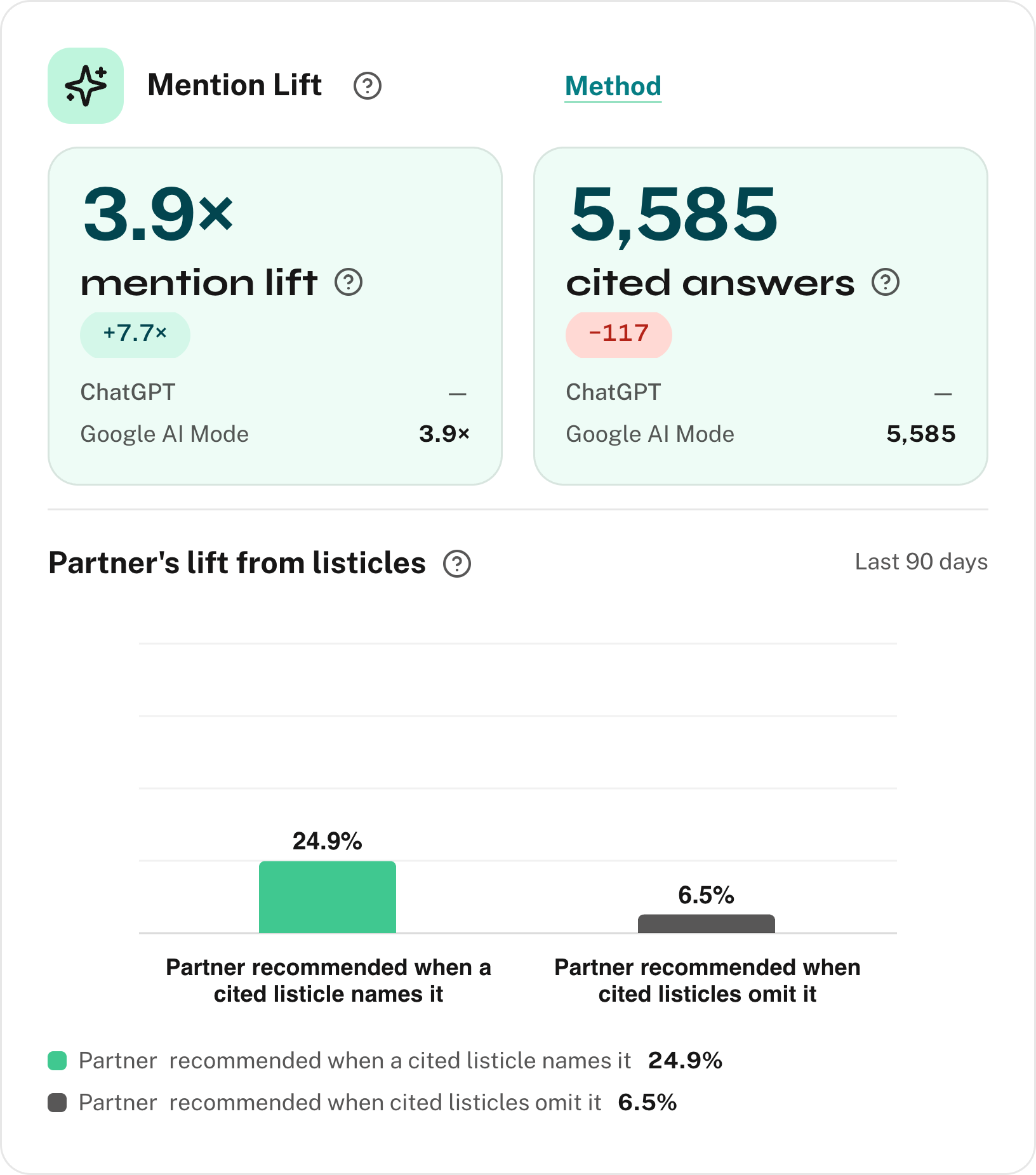
Neither comparison can prove cause. An answer may take the name from another page and cite the listicle too, or reach the listicle because it already had the name. Both still point to the listicles worth reading first, the cited ones that rank a rival first and leave you out.
Before any executive posts for AI search, we would start with those listicles, on LinkedIn and anywhere else your buyers’ engines cite, since listicles took most of LinkedIn’s citations on these questions. We get SaaS products named on them by pitching each listicle’s editor on why your product deserves a place. A placement does not promise a recommendation, and the weekly record is how you would see whether one followed. You would get four things:
Getting named on the listicles your buyers’ engines cite
- Each week, the pages cited when your buyers’ questions go to ChatGPT, Google AI Mode and Claude, LinkedIn’s among them
- Every cited listicle that ranks your competitors without you, and who publishes it
- A message to each of those editors on why their readers should see your product
- Every placement on record, checked each week against the answers your buyers get
A team that wants to write to those editors itself can use our playbook on getting onto the roundups, comparisons and reviews ChatGPT and Google AI Mode cite, beginning where your name is absent:
What the LinkedIn Citation Data Does Not Show
None of these figures ties a LinkedIn citation to pipeline, ours or anyone else’s. A citation is a link under an answer, and a named company comes closer to a recommendation, but neither is a booked call. Between a citation and revenue sit three more steps:
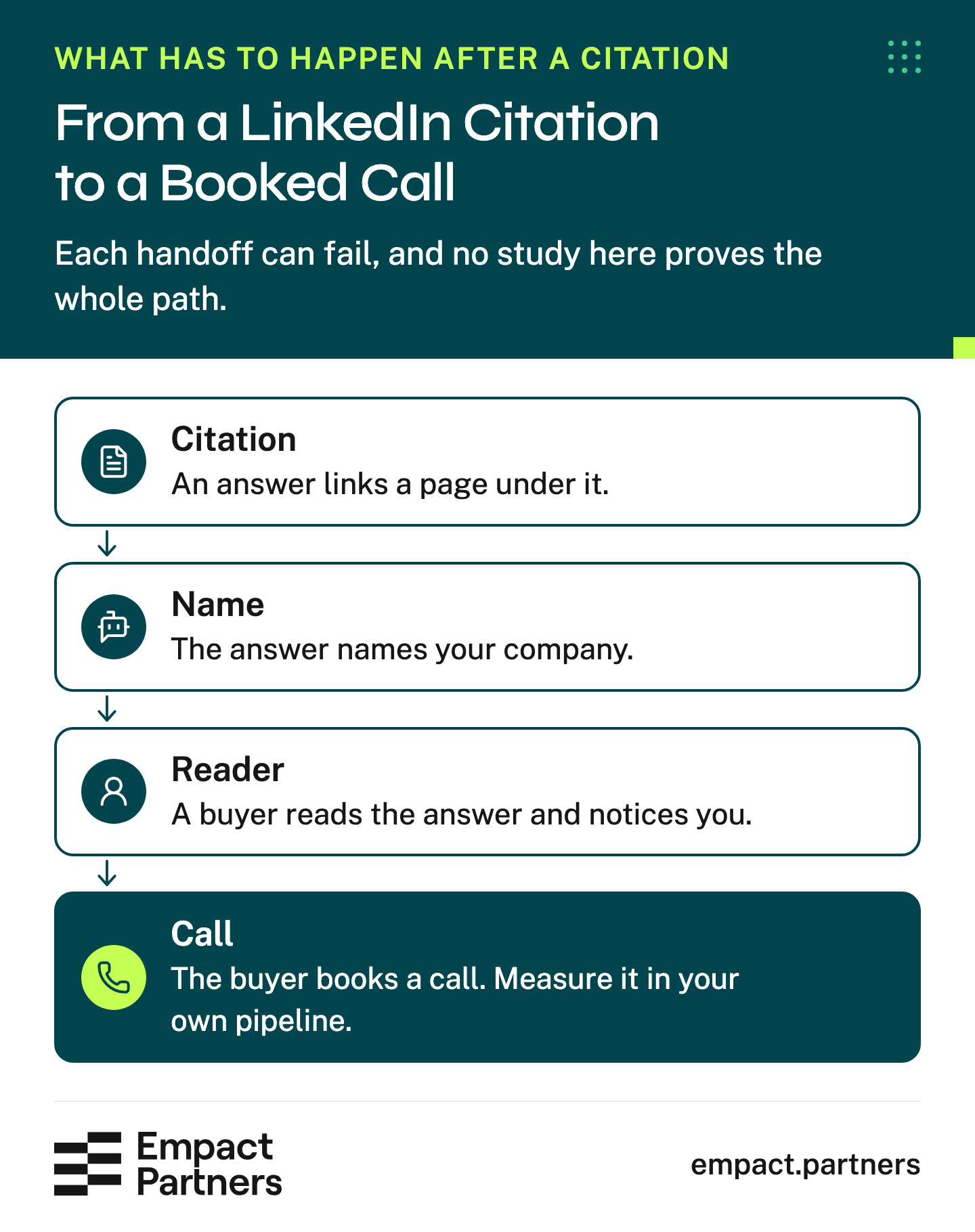
Trackers, ours included, see only the first two, the citation and the name. In an r/SEO thread asking whether anyone had traced a real B2B lead back to ChatGPT, the marketers who had did it outside the answer data, in their signup forms and in branded search:
Tips from Reddit
How B2B marketers trace an AI answer to a lead
We tracked it through self-attribution as leads state how they found us as the last step of the signup process.
Make the field free text rather than a dropdown, because a dropdown without a ChatGPT option hides every one of these. And put branded impressions from Search Console next to the month the citations started. Most people who get a name from an answer never click it. They search it a day later, and that curve moves before the lead form does.
Our own run has limits too. It covers one market in one month, and LinkedIn’s rate may run high there because the companies writing about these services on LinkedIn are often the ones selling them. It asked ChatGPT and Google AI Mode all 500 questions and Claude 50 of them, and no other engine.
For the engines it skipped, cloro’s 30 days to 12 October is the reading to use. Perplexity cited LinkedIn in 3.91% of answers, Copilot in 0.36% and Gemini in 0.01%,3 so on cloro’s prompts, Copilot and Gemini offered almost no LinkedIn citation to win.
Those gaps between engines are why the engine comes first among the checks to make before anyone asks for posting time:
Before an executive’s LinkedIn calendar is filled for AI search
- You know which engine your buyers use to research a purchase
- You have seen LinkedIn cited on your own buyer questions, engine by engine, over several runs
- You know which LinkedIn page types those answers cite
- You know whether the cited listicles name you, and who publishes each
LinkedIn may still earn its budget by reaching people directly, a different case with a different number. For AI search, read what each engine cites on your own questions first.
Frequently Asked Questions
Does LinkedIn content get cited by ChatGPT?
LinkedIn did get cited in the winter studies, and later readings on other prompts find much less. Semrush’s study found LinkedIn cited in about one ChatGPT Search response in seven. In cloro’s October window it was 1.8% of ChatGPT answers, and on our B2B marketing questions 0.1% of sourced answers. Since each study asks different questions, put your own buyer questions to ChatGPT before you budget for it.
Does Google AI Mode cite LinkedIn more than ChatGPT does?
On our questions, by a wide margin. LinkedIn appeared in 31.19% of Google AI Mode’s sourced answers and in 0.1% of ChatGPT’s, a base that leaves out answers citing no page at all. In cloro’s October reading the two engines sit close together, at 1.96% and 1.8% of all answers, on prompts weighted toward retail, travel and consumer goods. The gap you see depends on the questions you ask, so compare engines only on one fixed question set.
Should we fund executive LinkedIn posting for AI search?
Only when your own buyer questions back it up. No study here follows a company that posted more and then watched its citations rise, and on our buying questions feed posts drew 5.53% of Google AI Mode’s LinkedIn citations. If your executives already post for reach or hiring, judge that case on its own numbers. For AI search, first check whether your buyers’ engine cites LinkedIn posts on the questions you compete for.
What kind of LinkedIn page gets cited most?
In our own category, articles took 87.63% of Google AI Mode’s LinkedIn citations, most of them listicles ranking vendors, so read the cited listicles first. Broader prompt sets found more feed posts, about half of the answers citing LinkedIn in cloro’s October count. If your buyers ask other kinds of questions, check your own mix, since only 28 of our questions lacked buying words like best or compare.
Has LinkedIn overtaken Reddit in AI answers?
No study here shows LinkedIn moving ahead of Reddit over time. cloro tracked both on fixed prompts from February to July, and Reddit stayed well ahead. In October, on our questions without the Reddit-marketing group, Google AI Mode cited LinkedIn in 33.21% of sourced answers and Reddit in 29.75%. That is a single month’s ordering on one engine and one question set, so read a headline about LinkedIn passing Reddit as a claim about one set of prompts.
Should a person or the company page publish on LinkedIn?
The shares do not settle it. Semrush found individuals behind most LinkedIn citations on ChatGPT Search and Google AI Mode, and Company Pages behind most on Perplexity. Meltwater put Company Pages behind a quarter of LinkedIn citations. Those shares show who wrote the cited pages, and no study measures one post published from both accounts. Publish from whichever account your buyers already follow, then judge it on your own answers.
How often should we post on LinkedIn to get cited?
No study here gives a frequency that works. Semrush’s figure of more than five posts in four weeks describes authors who were cited, and nobody counted the frequent posters who never were. In our Panel, each cited post showed up in two of the four weekly runs at most. Post at a rhythm your audience can bear, and when a post gets cited, check that it holds across runs before you copy its format.
Should we publish our own listicle or ask to be added to existing ones?
Start with the listicles your buyers’ engine already cites. On our questions, eight listicles carried 76.42% of Google AI Mode’s LinkedIn citations, so reading a few pages shows where the citations sit. A new listicle starts with no citations and has to earn them, while an existing one already appears in answers. In our view, ask to be added first where a cited listicle leaves you out, and consider publishing your own where none covers your category.
What does a LinkedIn citation prove?
Only that an engine linked a LinkedIn page beneath its answer. It does not prove the answer named your company, recommended it or sent anyone to your site. A named mention is the stronger signal, which is why our listicle comparison counts names. Revenue has to be traced in your own analytics and CRM, from AI-referred visits to demos to closed deals. Report citations, names and pipeline on separate lines, so a rise in the first is never read as the last.
How do we check where LinkedIn shows up for our buyers?
Write down the questions buyers type before they shortlist, and ask each engine separately. Repeat the same set for several weeks, since answers shift from run to run. Record every LinkedIn address cited and read its page type from the address. For each cited listicle, note which company publishes it and whether it names you. That leaves you with the questions, the pages and the listicles to work on, in that order.
Sources (8)
- Empact Partners, "Empact Panel, our own category" (2026)Empact Partners' own data↩1↩2↩3↩4↩5↩6↩7↩8↩9↩10↩11↩12↩13↩14↩15↩16↩17↩18↩19↩20↩21↩22↩23↩24↩25500 questions about B2B marketing services and AI visibility, each asked four times of ChatGPT and Google AI Mode, 50 of them also of Claude; 4,200 answers collected 4 to 23 October 2026. Sourced answers cite at least one page. Re-checked 12 November 2026.
- Semrush (Margarita Loktionova), "We Analyzed 89K LinkedIn URLs Cited in AI Search: Here’s What Drives Visibility" (2026)↩1↩2↩3↩4↩5↩6↩7↩8↩910 March 2026. 325,000 prompts across 12 industries on ChatGPT Search, Google AI Mode and Perplexity, January to February 2026, with LinkedIn. Read 13 November 2026.
- cloro, "LinkedIn Articles vs Posts: AI Citations Fell 65%" (2026)↩1↩2↩3↩4↩5↩6↩7↩8↩9↩10↩11↩12↩13↩14with its October 2026 update. A fixed 116-prompt cohort, February to July 2026, and six engines in the 30 days to 7 August and to 12 October 2026. Read 13 November 2026.
- Empact Partners, "our reading of the eight LinkedIn listicles Google AI Mode cited most in the Panel, on the public pages, 30 October 2026" (2026)Empact Partners' own data↩1↩2↩3↩4↩5↩6↩7↩8↩9↩10↩11↩12↩13↩14and the comparison of named companies against the Panel’s tracked companies, 4 to 23 October 2026. Re-checked 12 November 2026.
- Profound (Davis McCain), "LinkedIn is the most-cited domain for professional queries in AI search" (2026)↩1↩2↩39 March 2026. Real ChatGPT prompts and a researcher-written professional prompt basket, 15 November 2025 to 15 February 2026. Read 13 November 2026.
- seoClarity, "Tracking the Decline of ChatGPT’s Citations: A Global Trend Analysis" (2026)↩1The US, UK, Canada, Germany and Italy, February to May 2026. Read 13 November 2026.
- Otterly, "LinkedIn AI Search Citations Study" (2026)↩1↩2↩3↩41,310,455 LinkedIn citations on six platforms, January to June 2026. Read 13 November 2026.
- Meltwater (Chris Hackney), "9.5M AI citations analyzed: How LinkedIn content wins AI search" (2026)↩1↩212 May 2026. B2B prompts on six platforms over four weeks, with LinkedIn. Read 13 November 2026.
Keep reading
Statistics 44 Perplexity Citation Statistics
Perplexity citation statistics to help B2B SaaS teams decide what to measure and which search work to fund.

Statistics 45 Gemini Citation Statistics for B2B Software Teams
Gemini citation data for SaaS teams on which pages it cites, how its answers shift and how to count your category before funding work.
Statistics 70 Software Listicle Statistics for AI Search
See which software listicles AI answers cite on each engine, what being on one goes with, and where a placement budget goes first.