70 Software Listicle Statistics for AI Search
See which software listicles AI answers cite on each engine, what being on one goes with, and where a placement budget goes first.
 Leon ClaassenWith
 Vlad Shvets
On this page
- Highlights
- How Often AI Answers Cite Software Listicles, by Engine
- Which Buyer Questions Make AI Answers Cite Listicles
- How ChatGPT Uses Listicles and Vendors’ Own Pages
- Which Listicles Carry Most Citations Week After Week
- How Often AI Names a Vendor That a Cited Listicle Includes or Leaves Out
- Who Writes the Listicles AI Engines Cite
- What to Measure Before Paying for Listicle Placements
- Frequently Asked Questions
Empact Newsletter
One email a month on what is working in AI search and SaaS go-to-market.
Listicles are pages that rank or compare several products, and a pitch for a listicle budget often calls them the most cited content in AI search. A SaaS team that funds placements on that claim can pay for pages its buyers’ answers rarely use. It can also mistake a citation for a recommendation.
In one B2B software category, listicles took 14.16% of ChatGPT’s citations, about one in seven, across the 150,300 buying answers we collected between 2 September and 21 October 2026.1 On Google AI Mode they took 27.63%, about one in four. Listicles matter, then, but they are far from most of what either engine cites.
Empact Partners writes to listicle editors on behalf of SaaS companies, making the case for adding their product to the pages AI answers cite. That work is called mention building, and the figures below show how to tell which listicles in your category deserve it.
Highlights
- 14.16% of ChatGPT’s citations went to listicles in one B2B software category, against 27.63% of Google AI Mode’s and 74.02% of Claude’s. A listicle entry weighs differently on each engine.1
- 66.78% against 43.86%: the share of ChatGPT answers with sources that cited a listicle when the question said “best” or “top”, and when it said neither. Those buying questions are where an entry can matter most.1
- 76.26% of ChatGPT’s listicle citations went to the most-cited tenth of listicles, roughly 320 of the 3,198 it cited, which lets outreach start with a few hundred pages rather than thousands.1
- 50 of the 50 listicles ChatGPT cited most on 2 September were cited again on 7 October. The top of an outreach plan does not need rebuilding every week.2
- 50.34% against 9.37%: how often ChatGPT named a vendor when a cited listicle included it, and when the cited listicles left it out, so the listicles that skip you are the first ones to count.1
- 34% to 47% of the listicles cited on “alternatives to X” software questions were a vendor’s own, which is why you check who wrote a listicle before approaching it.3
How Often AI Answers Cite Software Listicles, by Engine
Those 150,300 answers are eight weeks of one partner’s Empact Panel. We built it to ask a partner’s buyer questions weekly on Claude, Google AI Mode and ChatGPT and keep each answer with its sources. The partner and its category stay unnamed here. We counted the cited pages the Panel classes as listicles in two ways:
- Citation share: 14.16% on ChatGPT, 27.63% on Google AI Mode and 74.02% on Claude.1
- Answer share, the answers with sources that cited at least one listicle: 46.18% on ChatGPT, 63.7% on Google AI Mode and 97.6% on Claude.1
The two numbers differ because they count different things. A citation share says how much of the evidence an engine shows is listicles. The answer share says how often a buyer meets at least one listicle behind the answer. On ChatGPT, listicles are a seventh of what it cites. Yet nearly half its answers with sources cite at least one listicle, and on Claude nearly every answer does:
Software Buying Answers That Cited at Least One Listicle
Answers with sources, one B2B software category, 2 Sep to 21 Oct 2026, read as floors
View the data
| Label | Value |
|---|---|
| ChatGPT | 46.18% |
| Google AI Mode | 63.7% |
| Claude | 97.6% |
Each share is a floor. The Panel counts only the pages it is sure are listicles, and on Google AI Mode about a third of citations went to pages it could not sort by type with confidence.
In a consumer finance software category we also track, listicles sat under 45.62% of ChatGPT’s answers with sources, against 46.18% in this category.4 A second category shows the rate is not peculiar to the first, though it cannot show the rate holds everywhere.
The published shares run from 16.6% to 63%, and the studies divide by different things, so they are not directly comparable:
Scroll horizontally to see all columns when the table is wider than this page.
| Study | What it counted | Listicles’ share |
|---|---|---|
| Seer Interactive | 2 million ChatGPT citations on fixed prompts, a URL containing “best” or “top”, November 2025 to February 2026 | 16.6% of citations5 |
| Wix Studio AI Search Lab | 1,056,727 citations from ChatGPT, Google AI Mode and Perplexity | 21.88% of citations6 |
| Scrunch | About 8,000 classified AI-cited pages, a broader comparison and evaluation class, May to June 2026 | 33% of pages7 |
| Ahrefs | 750 ChatGPT prompts in software, products and services | 43.8% of page types8 |
| Evertune | The 6,000 most-cited URLs per model across six models, nearly 400 million citations | 63% of citations9 |
Evertune also found listicles made up 40% to 65% of each model’s most-cited URLs.9 A study of the most-cited pages finds what engines reuse most. A study of every citation also counts the long tail of product pages, documentation and forum threads. Shares built on bases this different cannot set a spending percentage.
Leon Claassen, this article’s author and a senior GTM consultant at Empact Partners, would plan on a different number:
A share of all citations, a share of the most-cited pages and a share of one engine’s prompts are three different numbers. I would plan on the share of answers that cite a listicle in your own category, read engine by engine, because that is how often your buyers meet one.
 Leon Claassen on LinkedInOpens in a new tab
If your own count shows listicles matter on your buyers’ engines, the four-page playbook below covers getting a product onto the ones ChatGPT and Google AI Mode cite for tool recommendations:
Which Buyer Questions Make AI Answers Cite Listicles
In our category the listicle share moved with the buyer’s wording. On ChatGPT, 66.78% of answers with sources cited a listicle when the question said “best” or “top”, against 43.86% when it said neither. On Google AI Mode the split was 74.59% against 62.48%.1
The Panel also labels each question by intent. Comparison and best-product questions drew a listicle in 54.92% of ChatGPT’s answers with sources, and questions asking whether a product meets one specific need drew one in 31.81% (Google AI Mode: 73.97% against 56.99%).1 Every other intent fell between those two:
Answers Citing a Listicle, by What the Buyer Asked
One B2B software category, sourced answers by the question’s intent, Sep to Oct 2026
View the data
| Label | ChatGPT | Google AI Mode |
|---|---|---|
| Comparison or best | 54.92% | 73.97% |
| Shortlist | 54.34% | 61.02% |
| Discovery | 51.22% | 62.71% |
| Price | 51.16% | 69.58% |
| Solution search | 50.24% | 69.72% |
| Problem | 41.89% | 58.51% |
| Specific need | 31.81% | 56.99% |
For a marketing team, the split shows which questions a listicle entry can reach. A question with “best” or “top” in it, or one that compares products, is where an entry can put you in front of the buyer. A question about one specific need draws the fewest listicles, so an entry reaches fewer of those buyers.
Outside studies compare other question groups, each in its own way:
- 40.86% against 5.36%: listicles’ share of citations on commercial queries, where people research a purchase, and on navigational queries, which look for one brand or site, in Wix Studio’s data.6
- 85.6% of ChatGPT’s citations on “best” questions went to URLs containing words such as best, top, vs, review or guide, in a four-brand study by The HOTH, an SEO firm, which sorted URLs by pattern.10
- 69.6% against 1.3%: responses citing the brand’s own domain on brand-name questions, and on “best” questions, in the same study.10
In those studies, buying questions drew more listicles than navigational ones, and questions naming a brand drew more citations of the brand’s own site than “best” questions did. The engines themselves differ as well. Minuttia asked six search platforms 11,525 “alternatives to X” software questions in August 2026, and listicles’ share of the citations ran from 84% on Claude to 32% on ChatGPT:3
Listicles’ Share of Citations on “Alternatives to X” Software Questions
Six search platforms, 11,525 questions, Minuttia, August 2026
View the data
| Label | Value |
|---|---|
| Claude | 84% |
| Perplexity | 82% |
| Gemini | 81% |
| Google AI Overviews | 63% |
| Google Search | 55% |
| ChatGPT | 32% |
ChatGPT sent 42% of its citations on those questions to software companies’ own websites, more than to all listicles together.3 On those ChatGPT answers, vendors’ own websites carried more of the evidence than listicles did, so a team selling against a named rival should treat its own pages as part of the answer.
An AI answer can also name a brand without linking to the brand’s own site. In BuzzStream’s prompt study, only 7.2% of brand mentions on prompts asking for the best tools in a category came with a citation of the brand’s own page.11 So judge listicle work by how often the answers name you, because a mention rarely comes with a link to follow.
How ChatGPT Uses Listicles and Vendors’ Own Pages
ChatGPT’s lean on listicles can shift fast. Our eight weeks cannot show a trend, because the way two engines’ answers were collected changed inside the window. Seer Interactive asked ChatGPT fixed prompts over several months instead. Across 2 million ChatGPT citations, listicles were 16.6%, and from December 2025 to January 2026 ChatGPT’s listicle citations fell 30% while all its citations fell 22.7%.5
The listicle rate fell in 13 of the 16 industries Seer tracks. That is one month on one engine. It shows the listicle share can drop fast, though not that the drop continued, so a share you measured once is worth measuring again.
Minuttia found ChatGPT checking vendors directly. 71% of its web searches named exactly one product, and 92% of its “site:” searches, which look inside one website, went to the vendor’s own site.3 In Chen and Koudas’s 158,099 answers, ChatGPT consulted listicles often and cited them rarely. At equal rank in its search results, a listicle had 0.54 times the odds of being cited, about half those of the study’s baseline page type.12
If that holds for your buyers, the product and comparison pages ChatGPT reaches on your site have to answer what it checks. Getting those pages right is a content marketing job on your own site, and it belongs in the same plan as the listicle work.
Which Listicles Carry Most Citations Week After Week
Over eight weeks ChatGPT cited 3,198 different listicles in our category, and a small share of them carried most of its listicle citations:1
The once-cited listicles, a third of those ChatGPT cited, carried 1.3% of its listicle citations between them.1 So before any outreach, sort the listicles by how many answers cite them, because a third of the ones a team might find barely show up in the answers at all.
Most of the heavily cited listicles also stayed in place from week to week. We compared the first and last week each engine was collected the same way (the span differs by engine), and about half the listicles came back, carrying most of the first week’s listicle citations:2
Listicles That Came Back, and the Citations They Carried
First and last week of each engine’s stable collection window, one B2B software category, 2026
View the data
| Label | Listicles cited again | Their share of the first week’s listicle citations |
|---|---|---|
| ChatGPT | 52.3% | 87.89% |
| Google AI Mode | 52.59% | 73.44% |
| Claude | 67.4% | 91.06% |
On ChatGPT, all 50 of the most-cited listicles of 2 September were cited again on 7 October, and 61.4% of the later week’s listicle citations went to listicles already cited five weeks before.2 Outreach planned in September was still aimed at cited pages in October.
Week to week, listicles that came back the following week had carried 92.37% of the earlier week’s listicle citations, averaged over five pairs of consecutive weeks.2 You only know that figure once the weeks have passed. For planning, use the listicles that held between two weeks you have already seen, because those are the ones you can name in advance.
The engines also share part of that set:
A placement on one of those shared listicles sits behind answers on more than one engine, which makes them the first ones to check.
Coming back is one measure, and how fast a page’s citations fade from their peak is another. In Profound’s seven-engine study, a comparison, listicle or review page that kept being cited took a median of 29 days to fall to half its peak citation rate. Across all page types, 78% of page-engine pairs fell to half within two weeks.13 So plan to revisit each entry you win every month or two.
Single listicles can also gain while the total falls. During Seer’s 30% decline, 78 listicle URLs grew their ChatGPT citations.5 A falling average says little about the one listicle you want to be on, which is why Leon would order the outreach by each page’s own record:
Put the listicles that turn up in your answers week after week ahead of every new listicle idea. A page that turned up in one answer in eight weeks gives little evidence of sustained citation, whatever its domain authority, so it goes lower in the outreach plan. A page cited week after week is a target worth working on, and its value still has to show in your own answers.
Leon Claassen on LinkedInOpens in a new tabHow Often AI Names a Vendor That a Cited Listicle Includes or Leaves Out
In the B2B software category behind most of these figures, the Panel opened the cited listicles and recorded which tracked vendors each one names. The unit here is a vendor-answer pair: one answer with sources, and one tracked vendor in the question’s product line.
We checked whether each answer named the vendor and grouped the pairs by what the cited listicles did. An engine may cite listicles that include a vendor because the answer was already heading toward it, so these rates are associations inside our answers:
How Often an Answer Named a Vendor, by What the Cited Listicles Did
Vendor-answer pairs, answers with sources, one B2B software category, 2 Sep to 21 Oct 2026
View the data
| Label | ChatGPT | Google AI Mode |
|---|---|---|
| Own listicle cited | 76.15% | 74.57% |
| A cited listicle includes it | 50.34% | 43.83% |
| No listicle cited | 17.21% | 15.58% |
| Cited listicles leave it out | 9.37% | 9.49% |
On ChatGPT, a vendor was named in 50.34% of answers where someone else’s cited listicle included it, 17.21% where no listicle was cited and 9.37% where listicles were cited and none included it.1 When the vendor’s own listicle was cited, the rate was 76.15%. Google AI Mode ran close on every row, so the pattern is not one engine’s quirk.
Larger vendors might simply appear on more listicles and get named more. So we also compared each vendor with itself, using vendors with at least 30 vendor-answer pairs in each kind of answer (20 for the own-listicle row):
Scroll horizontally to see all columns when the table is wider than this page.
| Same vendor, two kinds of answer | Engine | Vendors named more often in the first kind | Median vendor’s named rate, first kind against second |
|---|---|---|---|
| First: a cited listicle includes the vendor. Second: cited listicles leave it out | ChatGPT | 45 of 45 | 33.21% against 4.84%1 |
| First: a cited listicle includes the vendor. Second: cited listicles leave it out | Google AI Mode | 46 of 46 | 34.24% against 7.68% |
| First: no listicle is cited. Second: cited listicles leave it out | Google AI Mode | 40 of 49 | 9.19% against 6.71% |
| First: no listicle is cited. Second: cited listicles leave it out | ChatGPT | 32 of 47 | 4.95% against 4.84% |
| First: its own listicle is cited. Second: no listicle is cited | ChatGPT | 23 of 23 | 92.23% against 8.14% |
Because each vendor is compared with itself, vendor size drops out, though other differences between the answers can still play a part. On Google AI Mode, vendors were named clearly less often when the cited listicles left them out. On ChatGPT the two group medians sat a tenth of a point apart, 4.95% and 4.84%, so there the drop below “no listicle cited” is close to nothing.
The first two rows held for every vendor, on both engines:
Every vendor we could compare with itself was named more often when a cited listicle included it than when the cited listicles left it out.
Leon would turn that comparison into the first count a team makes:
The figure to watch is how often you are named when the cited listicles leave you out. In our category that was 9.37% on ChatGPT, against 50.34% when a cited listicle included the vendor. Count the heavily cited listicles that skip you before you commission a new listicle page.
Leon Claassen on LinkedInOpens in a new tabOne SaaS partner’s Mention Lift card shows the same split from a single company’s side, with “Partner” where its name was. The card takes the answers that cite a third-party listicle and checks how often each one recommends the partner, split by whether a cited listicle names the partner or every cited listicle leaves it out. The Panel counts the partner as recommended when the answer names it.
In the 90 days to mid-November 2026, 57,138 answers on ChatGPT, Google AI Mode and Claude cited a third-party listicle. The two bars compare how often each group recommended the partner. They show an association and say nothing about which came first:
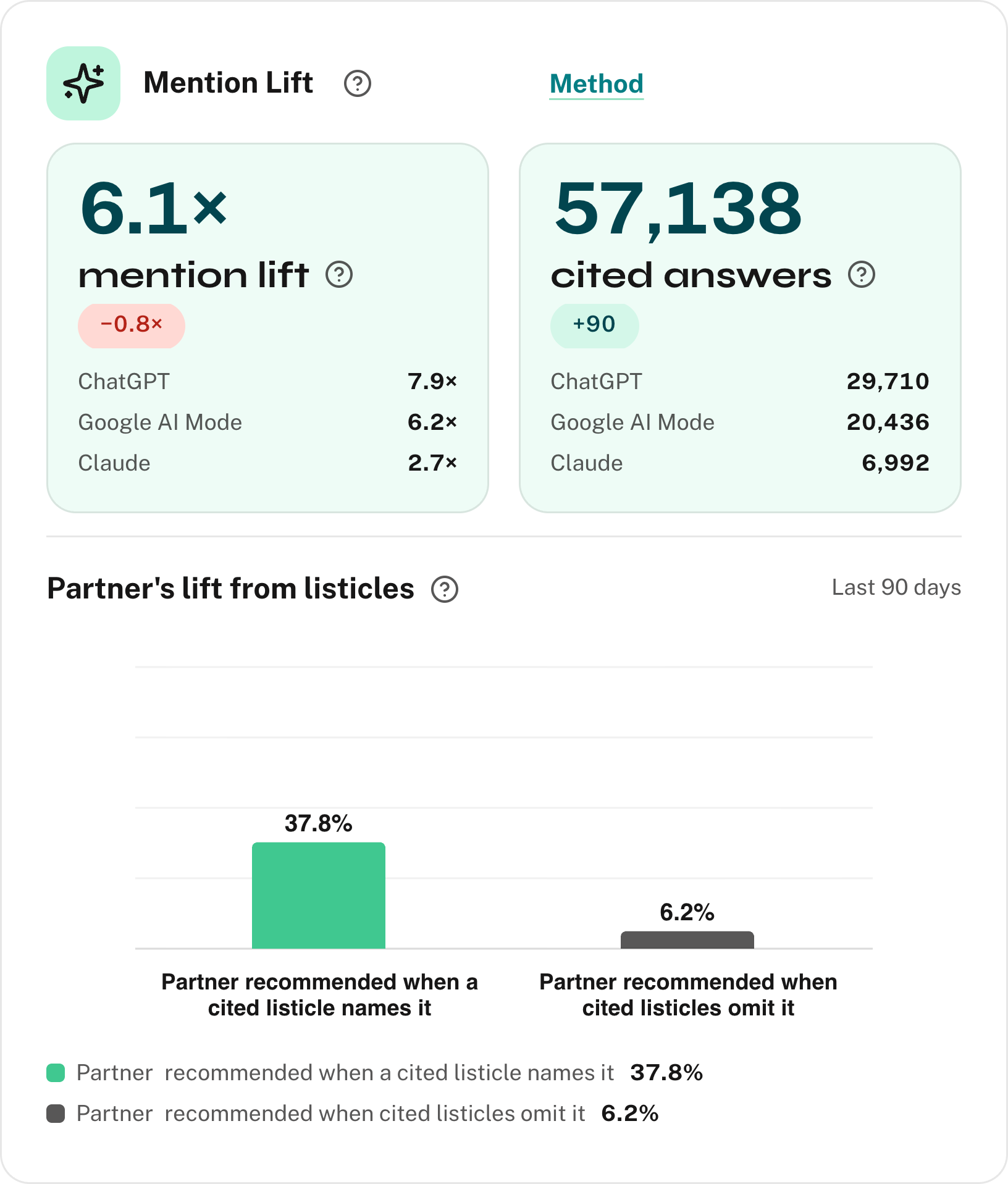
The gap was widest on ChatGPT, 7.9 times, against 6.2 times on Google AI Mode and 2.7 times on Claude. If editors tend to add brands that AI answers already name, the card would look the same, so it cannot settle cause.
The own-listicle row is the one a team controls, so it deserves a closer look. Outside studies measured what happens when a vendor’s own listicle is cited, and Scrunch held the prompt, brand and assistant fixed to test recommendations:
- 4% to 7%: the author brand’s recommendation rate without and with its self-promoting listicle cited.7
- 63.9% of the responses citing such a listicle recommended nobody.7
- 24.3% of them recommended a rival instead.7
For a team weighing its own “best X” page, that is a small gain with a real chance of handing the recommendation to a rival. Scrunch’s observational numbers look better and rest on weaker evidence. Answers citing a brand’s own listicle named the brand 39% of the time, against 19% without it, a mention rate Scrunch had not yet run through its own falsification check.7
In Kenyon Digital’s test of 116 brand-written CRM listicles, ChatGPT cited such a listicle in 68% of answers recommending a CRM. And 37.3% of the time, the brand behind the cited listicle was not mentioned at all.14 Writing the page an engine cites is not the same as being named in its answer.
Third parties carry most brand mentions, and where a brand sits on their pages matters too. AirOps’ discovery-question study measured both:
Not every mention traces to a page at all. Chen and Koudas found 46% of ChatGPT’s mentions of a brand the question did not name came with no cited page naming it.12 So measure what the answers say as well as which pages name you.
Finding the heavily cited listicles that leave you out, by hand, means reading every page your buyers’ answers cite, week after week. Enter your website below and the Listicle Inclusion Report emails you the best-of listicles ChatGPT and Google bring up for your category. It shows who is on each and how to get onto the ones that skip you. It is a free sample of the AI agent our partners get in full.
Who Writes the Listicles AI Engines Cite
Many listicles an engine cites were written by a vendor in the same category, so a buyer’s assistant can be reading a rival’s sales page laid out as a listicle. Minuttia’s August 2026 study measured how common that is:
On “X vs Y” questions, vendors’ own listicles took 65% of listicle citations on Google Search and 56% on ChatGPT.3 When a buyer compares two products by name, the page answering is often a vendor’s own, which is why a comparison page of your own matters on those questions.
Your own listicle carries a cost when it names many rivals. In Kenyon Digital’s CRM test, a brand’s own listicle naming eight or more competitors was cited while only competitors were mentioned 57% of the time, against 29% for listicles naming three or fewer.14 A long, fair roundup of your own can end up selling your rivals.
The cited listicles also share a few traits, and each one becomes a check before you approach a page:
- 77.74% of the listicles ChatGPT cited in our category carried 2026 in the title, against 60.45% on Google AI Mode, and only 0.59% of ChatGPT’s carried 2025.1
- 11 of the vendors we track were named on the median listicle we opened.1
- 35% of “best” listicles cited in Ahrefs’ data sat on low-authority domains.8
- 71% to 86% of the listicles among each model’s most-cited URLs were numbered rankings, such as “Top 5 CRM Tools”, in Evertune’s data.9
None of these traits proves why a page was cited. They describe the cited listicles, which tend to carry this year’s date, rank their entries, crowd in rivals and often sit on a modest domain.
Position in search matters too. In Minuttia’s Perplexity data, a vendor listicle found in first position was cited 85% of the time, falling to 44% at position 20.3 So the listicles that already rank for your buyers’ questions are the ones to check first. The checks below are our editorial judgment for choosing pages to approach, and no study has tested them:
Before you approach a cited listicle
- It turned up in your buyers’ answers in at least two separate weeks
- Someone other than a direct rival wrote it
- It carries this year in its title (a title date is not proof of an update)
- It already names your rivals, and its editor accepts additions
- It ranks in search for the question your buyers ask
- Your entry, if there is one, shows your current price and features
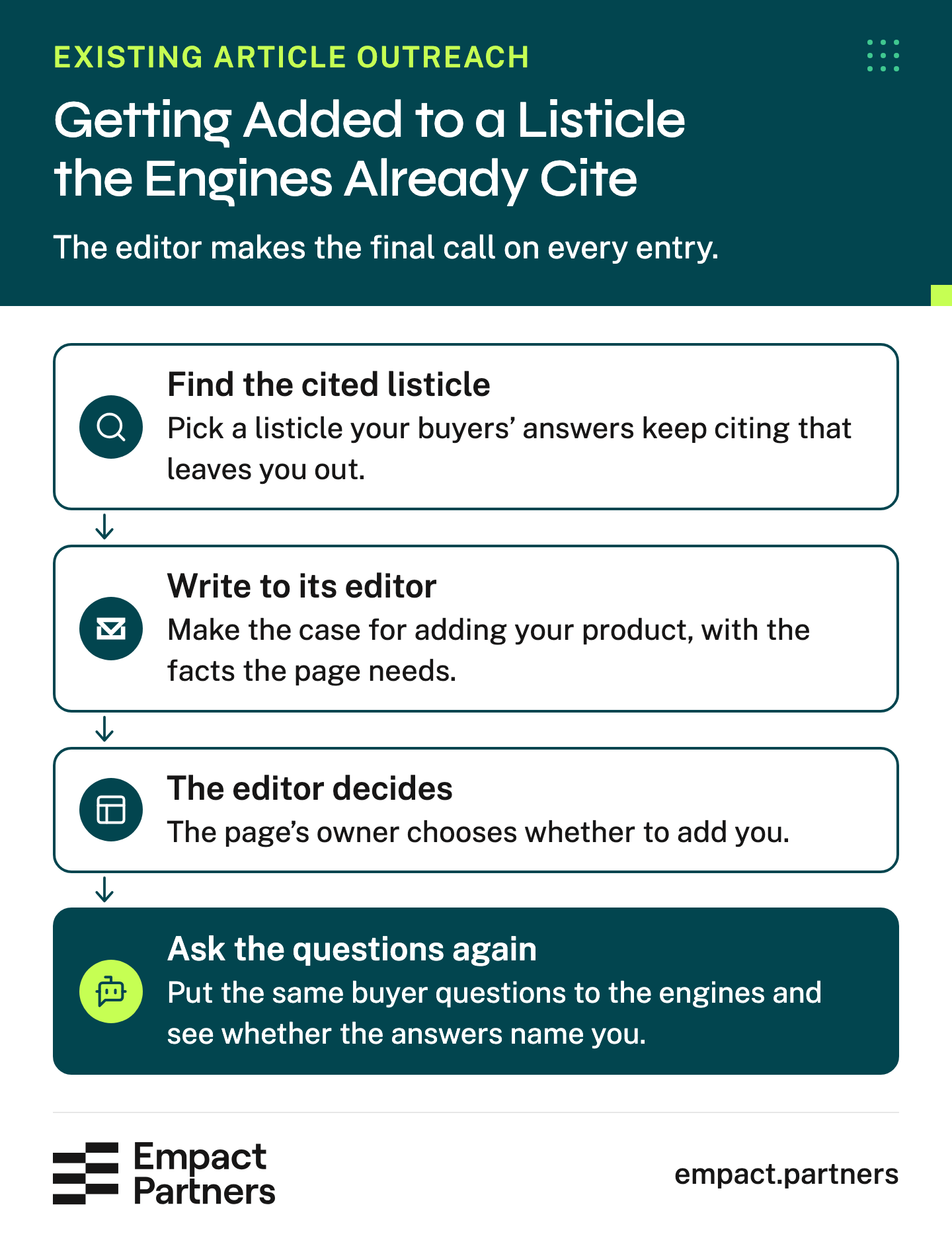
Once a listicle passes those checks, getting onto it means asking its editor to add you, the approach called existing article outreach. You write to the editors of pages the engines already cite, instead of publishing new pages and waiting for them to be cited. It runs in four steps, and the third is up to the editor alone:
Practitioners in an r/SEO thread about chasing AI citations for clients put tracking ahead of any pitch:
Tips from Reddit
How practitioners decide which cited pages to chase
Track first. Pick 10 to 20 prompts per client and run them weekly. Log who gets named and which pages are cited. Only chase the pages that show up across many prompts.
I’d also separate citations from recommendations. Getting a client’s website cited as a source isn’t necessarily the same as having the business recommended.
What to Measure Before Paying for Listicle Placements
Before any listicle budget, count how many of the most-cited listicles in your category’s answers name you, engine by engine. In our category, a vendor that a cited listicle included was named in about half of ChatGPT’s answers, and a vendor the cited listicles left out in fewer than one in ten. Track that count beside how often the answers name you, qualified pipeline and cost. A count of placements tells you nothing about revenue on its own.
These figures cannot settle cause. Our Panel shows vendors on cited listicles named far more often, in one B2B software category over eight weeks. The vendors that win places on those listicles may be the ones the engines already favored. Each outside study measured its own engines, questions and period, so each share describes its own sample, and your category needs its own count.
For your category, we would start with the most-cited listicles that leave you out, since in our data a vendor was named least often when the cited listicles skipped it. One senior GTM consultant would own that outreach and be on your calls. Your team would get four things from the work:
- The listicles your buyers’ answers return to again and again on ChatGPT, Google AI Mode and Claude, from the mention engine, a tool we built to find them
- A note to the editor of each one worth approaching, arguing why your product belongs on it
- Every placement we win, tracked in that same engine
- A weekly count of the answers that name you on each engine, set beside the placements as they go live
Frequently Asked Questions
Are listicles really the content AI search cites most?
It depends on the denominator. Two large studies of every citation put listicles at about 17% to 22% of what engines cite, while a study of the most-cited URLs per model put them at 63%. In the software category we measured, listicles were a seventh of ChatGPT’s citations and a quarter of Google AI Mode’s. Both claims can be true at once, so ask which base a headline uses, then count your own category on each engine before setting a listicle budget.
Should we pay a publisher to add us to a best-of listicle?
None of the studies here measures the return on a paid placement, so treat an offer as a test with a baseline. First confirm the listicle appears across several weeks of your buyers’ answers and on more than one engine, and that it already names your closest rivals. If it passes, ask your buyer questions again once the entry is live and compare your named rate before and after. A listicle that never appears in the answers gives you nothing to measure.
Should we publish our own “best X” listicle?
It can give an engine your side of a comparison, with real risk attached. In Scrunch’s controlled test, the author brand was recommended in about 7% of responses citing its own listicle, up from about 4%. Close to two thirds of those responses recommended no one. Kenyon Digital saw long self-written listicles backfire more often than short ones. If you publish one, rank on stated criteria, treat rivals fairly, say who wrote it and keep the field short.
Does being on a cited listicle make ChatGPT recommend us?
Our Panel cannot show that. Vendors that a cited listicle included were named far more often than vendors the cited listicles left out, and the gap held for every vendor we could compare with itself. The engine may still pick listicles that include a vendor because it was already leaning toward that vendor. Treat a placement as a chance worth measuring, and record the named rate on fixed questions before and after.
Which cited listicles should we approach first?
The ones the answers come back to. In our category, a third of the listicles ChatGPT cited appeared in one answer in eight weeks, and together they carried about one percent of its listicle citations. The most-cited tenth carried three quarters. Rank the listicles by how many answers cite them. Keep those cited in several weeks and on more than one engine, and move the ones that leave you out to the top.
How do we find the listicles AI engines cite for our category?
Write down the questions your buyers ask that do not name your brand, such as the best tools for a job or alternatives to a named rival. Ask them on ChatGPT, Google AI Mode and whichever other engines your buyers use. Record every cited page, mark which are listicles and repeat weekly, because answers change from run to run. The Listicle Inclusion Report on this page does a first pass from your website.
How long does a listicle placement keep working?
No study here measured that directly. In Profound’s study, comparison, listicle and review pages that stayed in the answers lost half their peak citation rate in about four weeks at the median. Whether upkeep extends a placement is also unknown, so check each entry every month or two. Most cited listicles in our category carried this year in their titles, so after each yearly update, confirm your entry kept your current price and features.
Why does ChatGPT cite our competitors’ comparison pages?
On questions that name products, vendors’ own pages carry much of the evidence. Minuttia found vendors’ own listicles took 56% of ChatGPT’s listicle citations on “X vs Y” questions, and 42% of its citations on alternatives questions went to the software companies’ own sites. If a rival publishes a clear comparison page and you publish none, the engine has their side of that comparison in their words and none in yours.
Do listicle placements send traffic to our site?
The click volume is not measured in these studies. In BuzzStream’s study, about one brand mention in fourteen on prompts asking for the best tools in a category came with a link to the brand’s own page, so most mentions carry no link to follow. Measure listicle work first by naming and recommendations on the questions you track. Then follow AI-referred sessions and the pipeline they open, in a separate column of the same report.
Is Google AI Mode different from ChatGPT on listicles?
In our category it leaned on listicles more. Listicles were 27.63% of Google AI Mode’s citations against 14.16% of ChatGPT’s, and 74.59% of its answers with sources on “best” or “top” questions cited one. On AI Mode, most vendors we could compare were also named less often when the cited listicles skipped them than in answers citing no listicle, a pattern ChatGPT barely showed. If your buyers use Google, give the AI Mode listicle share its own count.
How do we know whether listicle work is paying off?
Before outreach starts, count how many of the most-cited listicles name you on each engine, how often the answers name and recommend you on the questions you track, and the pipeline from AI-referred visitors. Repeat the count each month with unchanged questions. Placements and naming are early signals, and pipeline against its cost is the result. If naming rises and holds for months, that is a good sign, though not proof the listicles caused it.
Sources (15)
- Empact Partners, "Empact Panel, category A" (2026)Empact Partners' own data↩1↩2↩3↩4↩5↩6↩7↩8↩9↩10↩11↩12↩13↩14↩15↩16↩17↩18↩19↩20150,300 unbranded buying answers in one B2B software category on ChatGPT, Google AI Mode and Claude, 2 September to 21 October 2026; every cited page classified, 663 cited listicles opened. Re-checked 12 November 2026.
- Empact Partners, "Empact Panel, category A, weeks collected the same way" (2026)Empact Partners' own data↩1↩2↩3↩4↩5ChatGPT 2 September and 7 October, Google AI Mode 30 September and 21 October, Claude over seven weeks, 2026. Re-checked 12 November 2026.
- Minuttia, "Self-Promotional Content Data Study" (2026)↩1↩2↩3↩4↩5↩6↩7↩85,983 software brands in 196 categories, 686,749 citations, August 2026. Read 13 November 2026.
- Empact Partners, "Empact Panel, category B" (2026)Empact Partners' own data↩112,000 answers in a consumer finance software category, 15 September to 25 October 2026. Re-checked 12 November 2026.
- Seer Interactive, "The Listicle Window Is Closing in AI Search: 30% Decline MoM" (2026)↩1↩2↩3Read 12 November 2026.
- Wix Studio AI Search Lab, "The Content Types Most Cited by LLMs" (2026)↩1↩2Read 12 November 2026.
- Scrunch, "What Happens When You Crown Yourself #1: Inside Thousands of Listicles and Their Impact on AI Answers" (2026)↩1↩2↩3↩4↩5Read 12 November 2026.
- Ahrefs, "Do Self-Promotional ‘Best’ Lists Boost ChatGPT Visibility? Study of 26,283 Source URLs" (2025)↩1↩2750 ChatGPT prompts. Read 12 November 2026.
- Evertune, "AI Search Loves Listicles: What 25,000 URLs Reveal About Citations" (2026)↩1↩2↩3Search Engine Land, 2026. Read 12 November 2026.
- The HOTH, "Why AI Cites Listicles More Than It Cites You" (2026)↩1↩2Read 12 November 2026.
- BuzzStream, "How AI Mentions and Cites Your Brand (New Study)" (2026)↩1Read 12 November 2026.
- Mahe Chen and Nick Koudas (University of Toronto), "What Drives AI Citations? Content, Retrieval and Model Knowledge in Generative Engine Optimization (GEO)" (2026)↩1↩2arXiv:2610.15033, 2026. 158,099 answers with 468,037 citations in two markets. Read 12 November 2026.
- Profound, "The Half-Life of an AI Citation Is 11 Days" (2026)↩1Read 12 November 2026.
- Kenyon Digital, "The Listicle Backfire Study: I Tested 116 Brand-Authored Listicles in ChatGPT" (2026)↩1↩2Read 12 November 2026.
- AirOps, "The Influence of Offsite Signals in AI Search" (2025)↩1Read 12 November 2026.
Keep reading
Statistics 48 AI Search Citation Statistics
See which pages AI answers cite, why your own site is only part of the picture, and where to focus your SaaS visibility budget.
Statistics 37 Reddit Statistics for SaaS: Search, AI Citations and Spam
37 Reddit statistics for SaaS teams: Google first pages, AI citations and spam bans, each with what it means for a Reddit budget.
Statistics 45 SaaS SEO Statistics
45 figures on what organic search is worth to a SaaS company, and where AI answers about software get their sources.