
Should Your Team Write LinkedIn Articles for AI Search?
Check whether your buyers’ AI engine cites LinkedIn, then write the article under the right name and track it every week.
On this page
- Check Whether Your Buyers’ AI Engine Cites LinkedIn
- Sort the LinkedIn Pages the Engines Cite
- Give Each Question to the Person Who Made the Decision
- Get the Substance in a Recorded Interview
- Write the Article So an Engine Can Restate It
- Track the Cited Page Every Week
- Give Publishing an Owner
- Frequently Asked Questions
Empact Newsletter
One email a month on what is working in AI search and SaaS go-to-market.
Your executives post on LinkedIn every week, and they still never appear in the AI answers your buyers read. Most people will tell you to post more, and to post as people rather than as the company page.
That advice skips the first question, which is whether the AI engine your buyers use cites LinkedIn for their questions at all. Getting a company named and quoted in answers from ChatGPT, Google AI Mode and the like is called generative engine optimization, or GEO, and LinkedIn is only one of the places it happens.
Empact Partners helps SaaS companies get their experts quoted in AI answers through GEO, and LinkedIn is one place that can happen. Whether it belongs in your plan depends on what your buyers’ engine already cites.
Check Whether Your Buyers’ AI Engine Cites LinkedIn
The studies people quote average LinkedIn across many industries. Semrush’s study ran 325,000 prompts across twelve industries in January and February 2026. ChatGPT Search cited LinkedIn in 14.3% of its responses, Google AI Mode in 13.5% and Perplexity in 5.3%.1 Inside a single software category the share can sit far lower, and it changes from one category to the next.
The numbers below come from the Empact Panel, our record of what Google AI Mode, ChatGPT and Claude tell our partners’ buyers each week, with every answer saved beside the pages it linked. We keep partners anonymous, so each panel below is a letter. On six partners’ panels, this is how often answers that cited any source cited linkedin.com:2
Scroll horizontally to see all columns when the table is wider than this page.
| Partner panel | Google AI Mode | ChatGPT | Claude |
|---|---|---|---|
| Partner A | 6.4% | 10.0% | 0.1% |
| Partner B | 3.0% | 0.0% | Not asked |
| Partner C | 1.7% | 0.9% | 0.0% |
| Partner D | 1.2% | 0.0% | Not asked |
| Partner E | 0.8% | 0.1% | Not asked |
| Partner F | 0.5% | 0.1% | Not asked |
Semrush counted all responses and the panels count answers that cited a source, so the two sets of figures do not compare directly. Still, in five of the six categories Google AI Mode drew on LinkedIn more often than ChatGPT did. The exception is Partner A. There, most LinkedIn citations pointed at LinkedIn’s own product pages, and ChatGPT cited LinkedIn most.
Your category could sit anywhere on that table. For a quick first look, the free AI Visibility Report tries 100 buyer questions from your market on ChatGPT and Google AI Mode, then shows how often the answers name you against your rivals and which pages they cite:
To answer the LinkedIn question itself, run the check on your own buyer questions before anyone writes:
Check LinkedIn on your own buyer questions
Write the buyer questions.
Use the ones your sales calls already hear, in the words a buyer would type.
Ask each engine separately.
Put the same questions to each engine several times a week, since the pages an engine links to shift between runs of the same question.
Log every cited address.
Record every page each answer cites, whether or not it names your company.
Count the LinkedIn answers.
Divide the answers citing linkedin.com by the answers that cited any source, and keep answers with no source in a count of their own.
If LinkedIn barely appears for the engine your buyers use, stop there. LinkedIn still reaches people directly, but the citation work belongs on the sites your buyers’ engine cites instead.
If LinkedIn does show up, the next step starts from the LinkedIn addresses you logged.
Sort the LinkedIn Pages the Engines Cite
Every LinkedIn citation is an address, and the part right after linkedin.com, such as /pulse/ or /in/, says what kind of page the engine chose. Sort the addresses you logged by that part:
Scroll horizontally to see all columns when the table is wider than this page.
| Address starts with | What the page is | What to check |
|---|---|---|
| /pulse/ | A long-form article under a person’s name | Whether it answers the buyer’s question, and who wrote it |
| /posts/ or /feed/ | A feed post from a person or a company | Whether the answers still cite it the following week |
| /in/ | A person’s profile | Whether the answer was checking who someone is |
| /company/ | A company page | Usually a firm the answer already named |
| Anything else | LinkedIn’s own pages: products, help and topic pages | Whether LinkedIn itself sells into your category |
On the partner panels the sort came out differently by category. Across the five panels outside Partner A, the 1,155 LinkedIn citations split like this:
On Partner A’s panel, about three in four LinkedIn citations went to LinkedIn’s own product, hiring, help and topic pages. Most of LinkedIn’s share there was LinkedIn describing its own product, which no member of your team can write.
A team in that position, or one whose engine barely cites LinkedIn, gets more from the other pages the answers cite. The playbook below walks through spotting the cited pages that leave your product out and what it takes to get onto them:
Outside Partner A, articles drew the most LinkedIn citations. If the answers cite LinkedIn articles for your question too, open them and read them as the competition. Those are the pages a new article will be read against, so plan to answer the question more exactly than they do, from better evidence.
Give Each Question to the Person Who Made the Decision
Choose the author by what they can show. The right person for a question made the decision the buyer is asking about and can say what happened. Often that is a product lead or the head of customer success, and a title or a follower count is no reason on its own.
Whether to publish as people also depends on the engine. Semrush also sorted 89,000 cited LinkedIn addresses by who published them. Members published 59% of the pages cited by ChatGPT Search and Google AI Mode. Perplexity leaned the other way, with company pages at 59%.1 If your buyers use Perplexity, keep publishing on the company page as well.
Once you know the engine, write each question down with the details that decide who answers it and where it goes out:
Assign each question before anyone writes
- The buyer question, in the buyer’s words
- The person who made the decision behind the answer
- The decision itself, and what happened after it
- What that person is cleared to publish
- Where it will be published, their profile or the company page, and on what date
If nobody on the team made the decision behind a question, leave the question unassigned. Without a person who made the decision, the article is likely to repeat what the cited pages already say.
Get the Substance in a Recorded Interview
The person who made the decision rarely has time to write it up, so the substance comes out in conversation. Book an hour, record it, and work through the same brief each time:
The interview brief
- The buyer’s question, read out in the words a buyer types
- What they chose when this came up in their own work
- What they rejected, and the reason they would give a peer
- What happened, with any number they are cleared to publish
- The names, figures and companies cleared for print
- The case where their answer would be wrong
Practitioners on r/b2bmarketing put the executive’s own input first:
Tips from Reddit
What practitioners say about the executive’s part
A smart executive will make time to really work with their ghost and feed the content.
What's actually worked better for us is recording short video messages where the exec shares a genuine take on something happening in our space.
A writer or an AI agent can draft from that recording, as long as a person checks the result.
Ask the named person to check two things in the draft before anything else. The decision has to be the one they made, and the evidence has to be theirs to publish. A person who reads a draft only for its tone can miss a wrong decision and end up with claims under their name they would never make.
Write the Article So an Engine Can Restate It
A transcript holds what the person knows, in the order they happened to say it. The article turns it into the answer to one buyer question. Engines tend to restate a page in their own words rather than quote it, so each part of the article has a job in keeping the meaning intact:
Scroll horizontally to see all columns when the table is wider than this page.
| Part of the article | What it carries | What goes wrong without it |
|---|---|---|
| Title | The buyer’s question or its answer, in the buyer’s words | A clever title no question ever matches |
| First lines | The answer, then who is giving it: name, role, employer | The answer arrives after three paragraphs of context |
| The criteria | For any comparison, the tests used, named before the ranking | A ranking with no reasons, which reads as a sales page |
| The evidence | The decision, what happened, a number the person can publish | Advice anyone could have written |
| The limit | Where the answer stops being true | A claim the next buyer disproves on a call |
A comparison of tools is the easiest kind of article to abuse. An employee’s ranking that puts the employer first is marketing under a person’s name, and buyers spot it quickly. State the employer in the first line and place your company where your own stated tests put it.
The format matters too. On the partner panels, cited articles came back in later runs far more often than cited posts did:
Most cited pages of either kind appeared in only one run, so a single citation proves little. A page first cited in the third run had only two chances to show up again, so these counts compare articles with posts. They cannot tell you how a new page will do. On this evidence, make the article the answer and use posts to send readers to it, unless your own check shows something different for your category.
Vlad Shvets wrote this guide and runs Empact Partners as its founder and CEO. He would spend a team’s posting hours differently:
Teams get told to post more because posting is the part they already know how to do. On our partners’ panels, few cited posts lasted past a single weekly run. I would put those hours into an article from the person who made the decision, and read it against the answers every week.
 Vlad Shvets on LinkedInOpens in a new tab
Track the Cited Page Every Week
A screenshot of your article inside an answer proves it was cited once. Whether it held is a weekly question, so keep a weekly record:
What the weekly record holds
- The question, worded the same every week
- The engine, the week and the number of runs
- Every cited LinkedIn address, or a note that there was none
- The page type and whose name is on it
- Whether your article was cited, run by run
- Whether the answer named your company, and whether it recommended it
- What new leads say on the first call, in a column of its own
Keep the citation, the mention and the recommendation apart. An engine can cite your article and recommend a competitor in the same answer. If your record lumps the three together, that answer looks like a win when it is not.
Partner A’s citation card shows why each engine needs its own line. It counts every page on the partner’s own site that answers cited over the last 90 days, not one LinkedIn article:
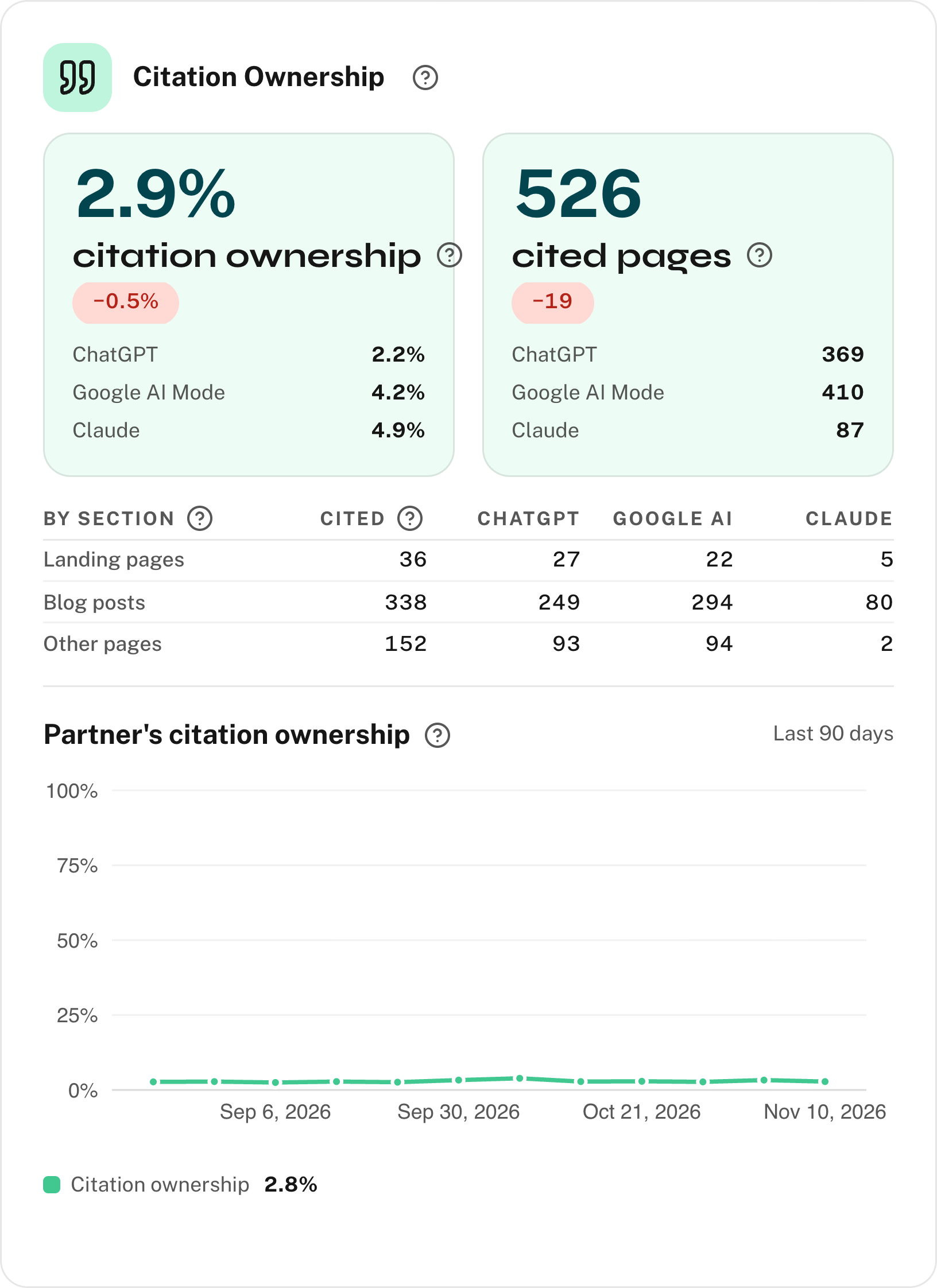
Claude cited less than a quarter as many of the partner’s pages as either ChatGPT or Google AI Mode, a gap a single total would hide. The latest weekly run also cited 19 fewer of the partner’s pages than the run before, and a drop like that tells you to check which pages fell out. Your LinkedIn record does the same job for each article.
Give Publishing an Owner
Publishing is the step most likely to stall, and our own record shows it. LinkedIn articles went on the roadmap for one B2B software partner this year. Our audit had found LinkedIn among the sources Google AI Mode cited most for its buyers, with almost nothing of the partner’s there. We drafted two for named people, checked every claim and delivered them.
Neither was published. The LinkedIn articles came off the roadmap when the partner decided to run its own social channels, with both drafts finished and waiting on the people whose names they carried.
Before anyone books the interview, name who will publish the article and on what date.
Someone on your side has to own that step, and the publishing date belongs in the plan next to the interview date. With the date set first, the steps run in this order:
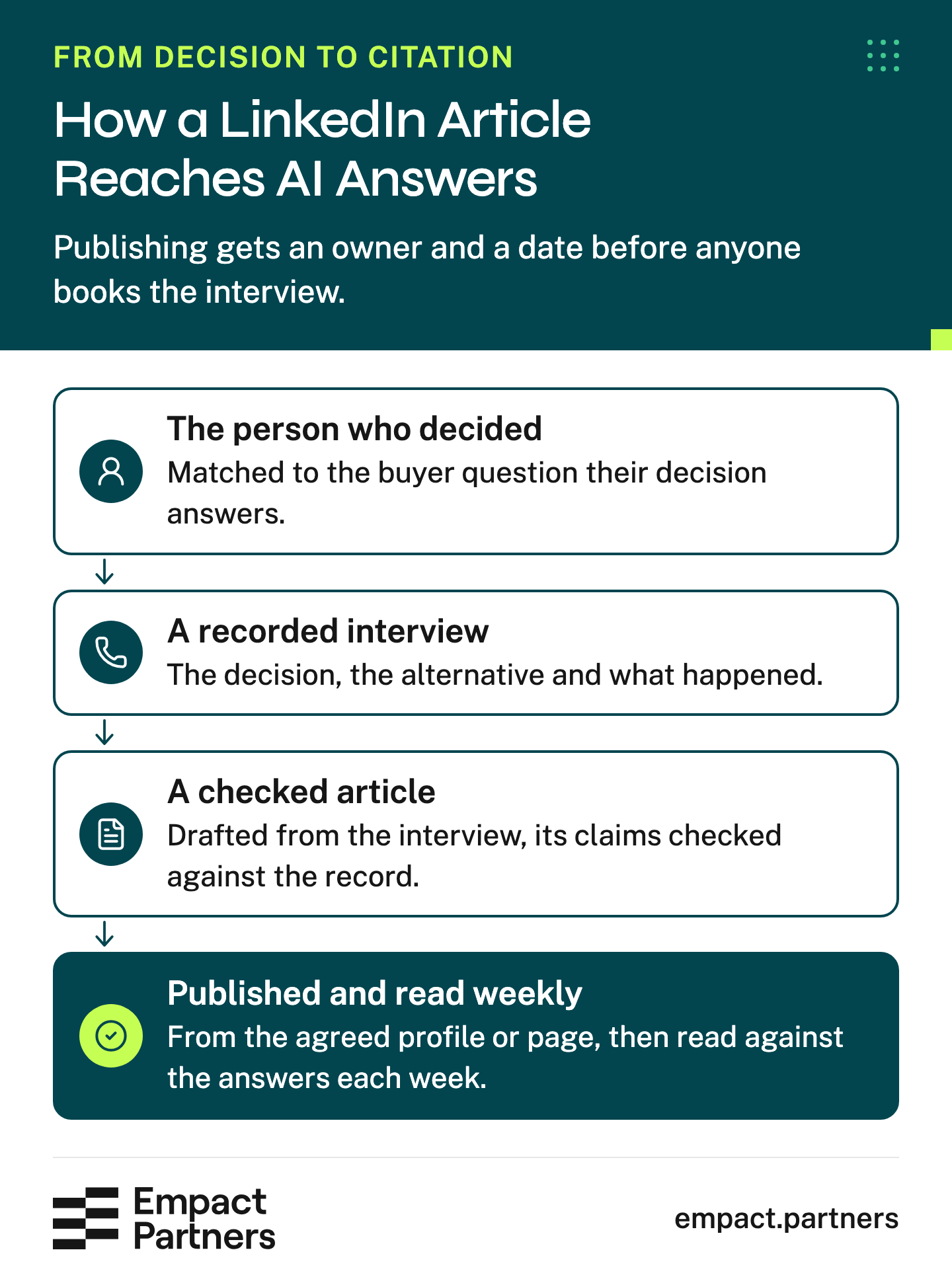
One person can make a start on the left-hand column. The right-hand column is standing work that someone has to own for months:
Scroll horizontally to see all columns when the table is wider than this page.
| To start, one person on your team | For months, someone whose job it is |
|---|---|
| The check on your own questions, engine by engine | The weekly record, read every week |
| The sort of the cited LinkedIn addresses | The next interview, and the one after it |
| The first interview and the first article | The publishing date each named person keeps |
With us, the first check is what your buyers’ engine cites, and LinkedIn goes on the plan only if it shows up there. A senior consultant owns the plan, and the work under it covers four things:
What a partner gets from us
- A weekly record of which pages the engines cite, question by question
- Regular reports on which pages those answers cite, where every recommendation comes with the first step to take
- Articles our Content Marketing team writes with your own people
- Mentions on the other sites those answers cite, such as the best-of listicles in your category
Whoever runs the rest, agree each publishing date with the person whose name the article carries, because that is the step our partner’s two articles never reached.
Frequently Asked Questions
Do AI search engines cite LinkedIn articles?
Some do. In Semrush’s early-2026 study across twelve industries, ChatGPT Search cited a LinkedIn page in 14.3% of its responses and Google AI Mode in 13.5%. On six of our partners’ panels, counting only answers with a source, the share ran from 0.5% to 6.4% on Google AI Mode and 0.0% to 10.0% on ChatGPT, and outside one category articles were the most cited LinkedIn pages. Your own weekly check decides it for your buyers.
Should our executives post more or write long-form articles?
For citations, articles came back more often on the partner panels. Of 379 LinkedIn articles cited over four weekly runs, 24 were cited in every run. Of 461 posts, only 5 were. Posts still have a job, which is sending readers to the article. Most cited pages of either kind appeared in only one run, so judge the work on what holds across weeks, never on a single sighting.
Do personal profiles get cited more than the company page?
Content published by people beat company pages on most engines, but not all. In Semrush’s study, Perplexity drew 59% of its LinkedIn citations from company pages, while the other engines leaned to members, at 59%. Profile pages themselves were rarely cited on the partner panels, 64 of 8,953 LinkedIn citations, and member citations went mostly to articles and posts. Keep the company page current, and put the citation effort where your buyers’ engine looks.
Which AI engine cites LinkedIn the most?
The leading engine varied by category on the partner panels. Google AI Mode drew on LinkedIn more than ChatGPT did in five of six categories, and ChatGPT led only where most LinkedIn citations pointed at LinkedIn’s own product pages. Claude cited LinkedIn in 3 of 4,796 answers with a source on the panels that ask it. Industry averages hide that spread, so if your buyers mostly use one engine, its share on your own questions is the figure that matters.
How many LinkedIn articles should we publish?
There is no fixed number. Start with the buyer questions where your engine already cites LinkedIn and where someone on your team made the decision behind the answer. One article per question, written from an interview and published on a set date, is enough to learn from. Add the next one when the weekly record shows whether the first held, and drop questions where LinkedIn never appears.
Can a ghostwriter or an AI tool write the articles?
Yes, from a recorded interview with the person whose name goes on it. The writer or the agent drafts, someone checks every claim against the record, and the named person approves the decision and the evidence. What fails is a draft written without their input, since their decision and evidence are what the cited pages lack. It should go out from the profile or page you chose for that question, on a date the named person has agreed to.
Can an employee’s article rank their own company first?
Only where their stated tests put it there, and only with the employer named in the first line. An employee’s comparison that crowns the employer reads as marketing to buyers, and it undercuts the trust the person’s name is meant to carry. Name the criteria before the ranking, apply them honestly, and place your product where those criteria put it, even when it lands second for a particular use case.
How long does a new LinkedIn article take to get cited?
No one can tell you reliably. Our panels record which pages kept their citations over four weekly runs, and the wait before a first citation varies because each engine refreshes its sources on its own schedule. Publish, log the date, and read the same questions every week. If the article is still uncited after a couple of months, compare it with the pages the answers do cite and rewrite the parts that lose.
How do we know whether the LinkedIn work pays off?
Track four things on separate lines. Record whether the article was cited, whether the answer named your company and whether it recommended you, and ask new leads on the first call where they first heard of you. A citation alone shows no pipeline, and a lead you cannot trace to a citation should not be counted as a LinkedIn win. Review the four lines together each quarter and decide then whether LinkedIn earns more of the team’s hours.
What if our buyers’ engine barely cites LinkedIn?
Then LinkedIn stays a way to reach people directly, and the citation effort moves to the sites your buyers’ engine cites instead. Even on the partner panel where LinkedIn showed up most, nine in ten answers with a source cited no LinkedIn page. Start with the addresses your check keeps logging week after week, such as a review site, a comparison listicle or one of your own pages. Repeat the LinkedIn count every quarter, because the share can move.
Sources (2)
- Margarita Loktionova, Semrush, "We Analyzed 89K LinkedIn URLs Cited in AI Search: Here’s What Drives Visibility" (2026)↩1↩210 March 2026.
- Empact Partners, "LinkedIn citations on six partner Empact Panels" (2026)Empact Partners' own data↩1↩2↩3the last four weekly runs on each panel (loaded 18 October to 13 November 2026), ChatGPT and Google AI Mode on all six and Claude on two, answers with any cited source, LinkedIn addresses sorted by path; read 13 November 2026.
Keep reading
GEO How to Get Your Documentation Cited in AI Search
Find which docs need work, fix access problems and give your team a clear plan for answering buyers in AI search.

GEO How to Choose a GEO Consultancy Whose Numbers You Can Check
One week of AI answers can show a brand flat, up 17 points or down 52. Four requests test whether a GEO proposal can prove its results.

GEO Does Google's AI Search Guide Justify Cutting Off-Site Work?
Use the pages AI Mode cites to decide where your SaaS team should focus website fixes, outreach and community work.