
When Cited Listicles Deserve Your Link Budget
Which listicles AI engines cite for software buyers, what our Panel data shows about listicles and links, and which ones to pitch.
 Leon ClaassenWith
 Vlad Shvets
On this page
Empact Newsletter
One email a month on what is working in AI search and SaaS go-to-market.
Before next quarter’s link budget is signed off, find out which comparison articles your buyers’ AI answers cite. Then test part of that budget on getting your product onto the ones it belongs on. Ask ChatGPT, Google AI Mode or Claude for the best software in a category, and the answer leans on “best X” articles that rank a dozen products side by side. Those articles are called roundups or listicles.
A place in one of those listicles puts your name on a page the engine reads. A new backlink strengthens your own site instead, and a shortlist answer may never open it. We measured this in one B2B software category, on the “best”, “top” and “alternatives to” questions where buyers ask for a shortlist, not on how-to or brand questions. If your category has no comparison worth pitching, the job becomes publishing a fair one yourself.
Empact Partners gets SaaS products onto the listicles AI answers cite. In this work, called mention building, we find the listicles ChatGPT, Google AI Mode and Claude keep citing and write to each editor about adding the product. The numbers below come from that tracking.
Which Software Listicles AI Engines Cite in One Category
We measured this with the Empact Panel, a tool we built for our partners. Every week it sends ChatGPT, Google AI Mode and Claude the questions that a partner’s buyers type, then stores each answer with the pages behind it. That shows us which vendors the engines name and where they read about them.
For one partner’s B2B software category, it ran a fixed set of buyer questions on 30 September and again on 7 October 2026. None of the questions named a vendor.
The Panel kept all 37,800 answers: 18,000 from ChatGPT, 18,000 from AI Mode and 1,800 from Claude 1. The chart shows how often each engine reached for a comparison article.
How Often Each AI Engine Cited Comparison Articles
One B2B software category, Sep 30 and Oct 7, 2026: 16,500 ChatGPT, 17,426 AI Mode and 1,800 Claude answers with a citation. Shares are floors.
View the data
| Label | Answers with a citation that cited a comparison article | Comparison articles' share of all citations |
|---|---|---|
| ChatGPT | 45.6% | 14.8% |
| Google AI Mode | 75.4% | 38.4% |
| Claude | 98.4% | 79.4% |
Every engine reached for comparison articles often in this category. Of the answers that cited anything, Claude’s cited at least one in 98%, AI Mode’s in three of every four, and ChatGPT’s, the lowest of the three, in almost half. Read those shares as floors, because pages the Panel could not classify were left out of the count.
Vendors in More Cited Listicles Were Named More Often
For the 50 vendors competing in that category, we counted the cited comparison articles that included each one, engine by engine, and looked up each vendor’s domain rating.
Then we checked each measure against how often each engine named the vendor 1. Picture the 50 vendors sorted twice, once by the measure and once by how often an engine named them. The chart scores 1 when the two orders match exactly, and the closer a score sits to 0, the less the two orders have in common.
How Closely Listicle Count and Domain Rating Tracked Naming
Rank correlation with each engine’s naming rate (1 would be the same order), 50 vendors, Sep 30 and Oct 7, 2026
View the data
| Label | Cited comparison articles including the vendor | The vendor's domain rating |
|---|---|---|
| ChatGPT | 0.64 | 0.29 |
| Google AI Mode | 0.56 | 0.32 |
| Claude | 0.44 | 0.09 |
A fair objection is that vendors with stronger backlink profiles may also sit in more cited listicles, since big brands tend to have both. In this category the two did rise together, so we held each measure level in turn and checked the other.
With backlink strength held level, vendors in more cited listicles were still named more often on all three engines, scoring 0.48 to 0.60 on the chart’s scale. With listicle count held level, backlink strength scored between −0.26 and −0.05, and none of those scores showed a reliable difference 1. One category cannot prove the pattern holds everywhere. Before moving budget, count the same two measures against naming on your own buyers’ questions.
With listicle count held level, backlink strength no longer told us which vendors the engines would name.
That doesn’t make links useless. Here is the case for keeping the whole off-page budget on them, set against what the same run found about the sites the cited listicles sit on:
Pros
- Links still lift your Google rankings, and Google’s AI Mode builds on Google Search
- Outreach aimed at strong sites reaches much of what Claude cites: 42% of the citations Claude gave to listicles went to sites rated 70 or above 1
Cons
- Outreach sorted by publisher domain rating misses much of what ChatGPT cites: 43% of its listicle citations went to sites rated below 30 1
- A link to your own site does not add your name to the comparison page the engine reads
Ahrefs’ larger study points the same way on links. Across 75,000 brands, its researchers found only very weak correlations between a brand’s link metrics and how often three AI systems mentioned it. Mentions of the brand elsewhere on the web correlated strongly 3. Ahrefs counted mentions anywhere on the web, and a place in a cited listicle is one kind of mention.
So the first budget question is which cited listicles already name your rivals and leave you off, and the second is how to get onto them. Your team can work through the second with the free playbook below. It covers earning a place on the best-of listicles ChatGPT and Google AI Mode draw on when a buyer asks which tool to pick.
How to Pick the Listicles Worth Pitching
Citation counts tell you which listicles the engines read. Whether your product belongs in any of them is a separate question, and it is the first one every editor asks. Paying for a slot does not answer it either, since a place in front of readers who would never buy the product does nothing for you. So screen every cited listicle for fit before it goes into your outreach queue or anyone writes to its editor.
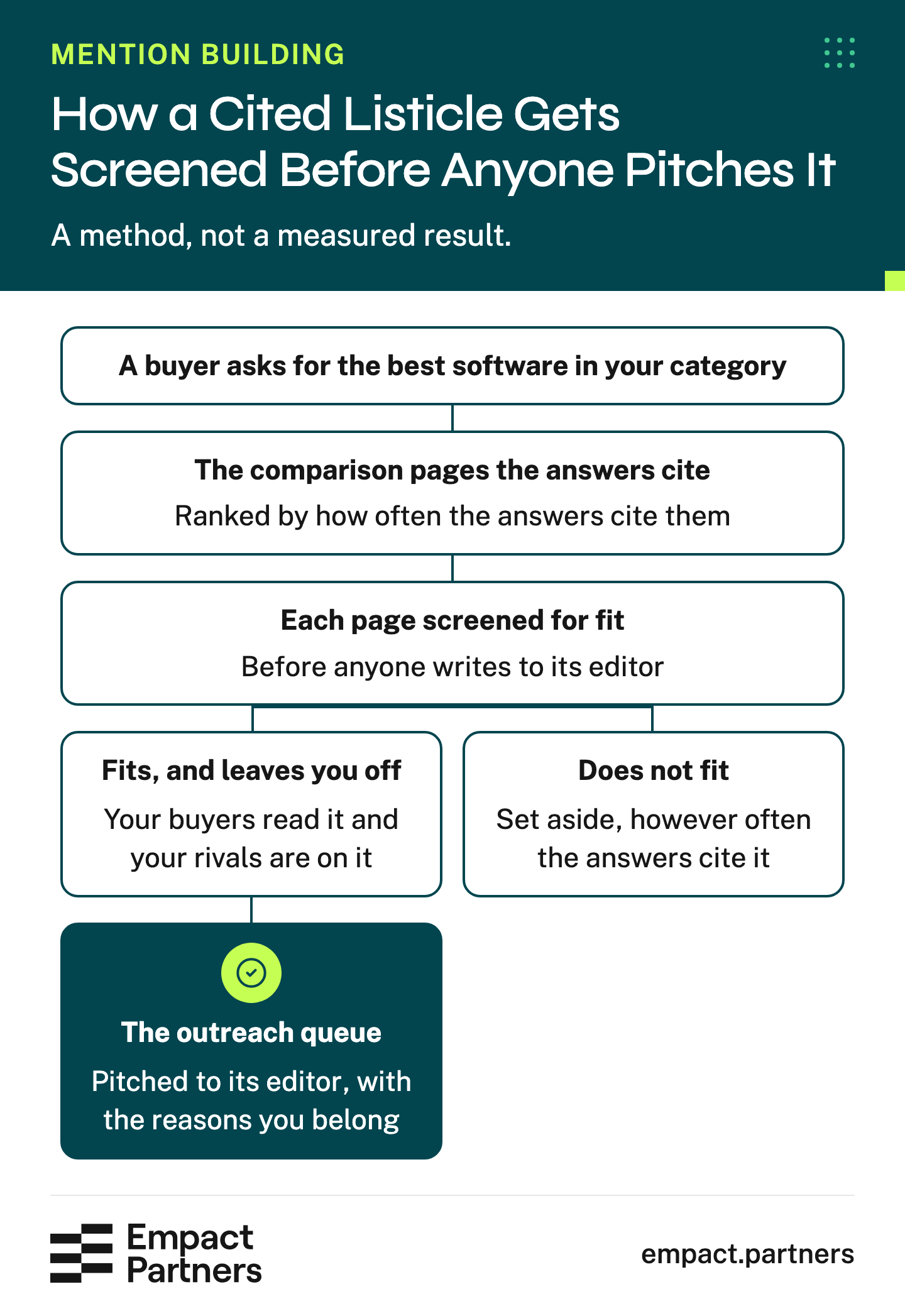
Run four checks on each listicle before you write to its editor:
Before anyone writes to an editor
- The listicle covers your category and the question your buyer asked
- Its readers are the kind of company that buys what you sell
- It names your competitors and leaves you off
- Someone keeps it current, and that person can be reached
Those checks need something to run on: the cited listicles in your category and who already sits in each. The free report below finds them. Enter your website, and it returns the best-of listicles AI engines and Google surface for your category, who is in each and how to get in. It previews an agent we run in full for partners, one that finds the listicles their buyers see.
What Listicle Outreach Involves and How Long It Takes
The plainest route is called Existing Article Outreach. You ask the editor of a page that already ranks and already gets cited to add your product, so nobody writes a new guest post. That page’s publisher earned its links and its ranking long ago. A single yes from its editor puts your product on a page the engines already read. The work runs in this order:
How the outreach runs
Ask the engines.
Every week, put your buyers’ shortlist questions, worded without any vendor’s name, to ChatGPT, Google AI Mode and Claude.
Record the cited pages.
Note every comparison article the answers cite, with your product marked in or out of each one.
Rank them.
By how many answers cite each. In this category about 300 different listicles were cited on each engine. ChatGPT’s ten most-cited took about a third of its listicle citations 1, which says where to start, not how many to chase.
Screen them.
Run the four fit checks and set aside every listicle your product does not belong in, however often it is cited.
Ask the editors.
Write to each editor and explain why your product belongs, starting with the listicles that name your competitors and leave you off.
Check the answers.
Each week, see whether the engines name you more often on the same questions.
The record from step two also shows who the cited listicles name, which is where step five starts. Here is that view for a different partner, in another category, over the last 90 days. The Panel card below orders its rivals by the share of the category’s qualifying listicles that name each. The top rival is named in 36 of them, about two in three. Seven rivals rank ahead of the partner, which is named in 15.
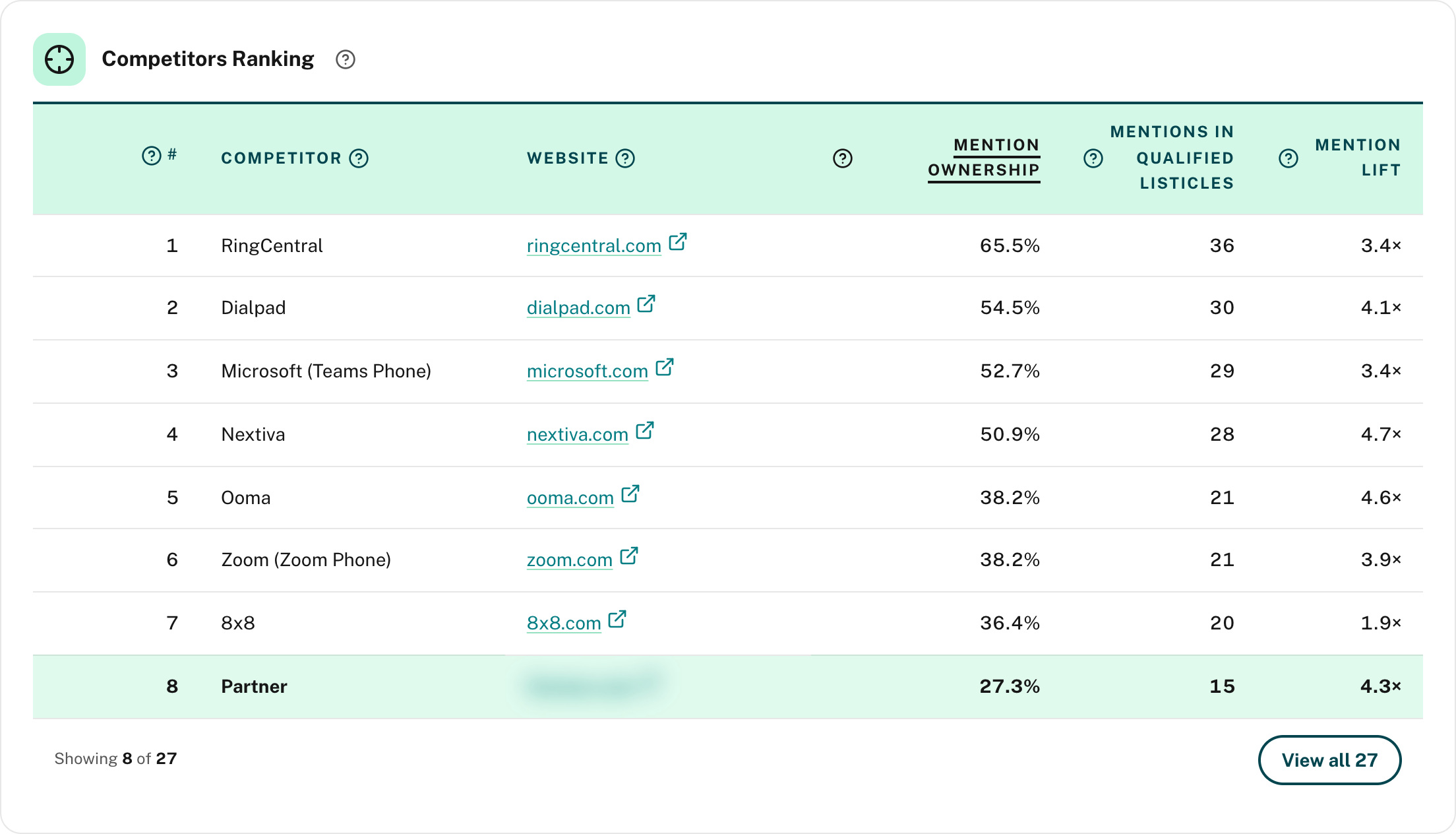
The card ranks vendors. The pages to screen and pitch first sit behind it: the cited listicles that name those seven rivals and leave the partner off.
Each listicle changes only when its editor refreshes it, on a schedule nobody outside that publisher controls. That is why this work is planned in quarters, and why a promised placement date deserves doubt. Leon Claassen, the senior GTM consultant who wrote this post, sums up the budget case:
Once you know which listicles your buyers’ engines keep citing, you know where the test money should go. A guest post buys a link to your own domain. A place in a cited listicle puts your name on the page the engine is already reading, and I only chase that place when the product genuinely belongs there.
 Leon Claassen on LinkedInOpens in a new tab
So before the budget is fixed, run your buyers’ shortlist questions through the engines, record the comparison articles the answers cite, and screen them for fit. Where the listicles that pass already name your competitors and leave you off, start part of next quarter’s outreach there. Judge it by how often each engine names you on those same questions.
To test this on your own budget, we would start with the cited listicles in your category that name your rivals and leave you off. A yes on those changes what buyers read. Before an editor hears from us, we check that your product fits the page. Only then do we write to that editor about why it belongs. Each placement is logged, and every week we compare the log with how often ChatGPT, Google AI Mode and Claude name you on the same questions.
Frequently Asked Questions
Should we stop building backlinks if AI engines cite listicles?
No. Links still help your pages rank on Google, and Google’s AI answers draw on its search results. What our numbers question is putting the whole off-page budget into links when your gap is a shortlist that leaves you out. Keep the link work that protects your rankings, move a measured slice into earning places in cited listicles, and compare how often each engine names you before and after.
How can we see which listicles AI engines cite for our category?
Write down ten to twenty questions your buyers ask without naming a vendor, such as “best X for Y”. Put each to ChatGPT, Google AI Mode and Claude several times over a few weeks, and record every page each answer cites. One run proves little, because answers shift from run to run. The listicles that keep coming back across questions and engines are the ones to look at first, and a spreadsheet is enough for that first pass.
Is it worth paying for a spot in a best-software listicle?
Rarely as a first move. Buying the slot leaves the fit question open, since the listicle’s readers still have to want your product. No engine promises to name a sponsored entry, and the entry can vanish when the contract ends. Before paying, ask how sponsored places are labelled and how long they stay up. A listicle whose editor would add you on merit is the better target, because that place has no contract to run out.
What if nobody has written a comparison of our category yet?
Check first. Run your buyers’ questions through the engines and look for listicles under other names: alternatives pages, category reviews, “tools for” posts. If there really is nothing worth pitching, publish a fair comparison yourself. Include your rivals, their prices and who each one suits, so editors and engines have a page to draw on. Then watch for the first independent listicles and approach those editors as they appear.
Why does listicle outreach take quarters rather than weeks?
Because the editor sets the pace. An editor who agrees to add you may wait for the page’s next planned update, and some editors never reply at all. Plan in quarters, judge progress by placements won and by naming on the same weekly questions, and be wary of anyone who promises a placement date. Listicles that already name your competitors are the natural first asks, since their editors already cover your category.
Do listicles written by a competitor count?
They count in the sense that engines cite them, and in software categories vendors publish plenty of the cited listicles. A competitor’s listicle rarely adds you, and when it does it usually ranks you below its own product. Weigh it lower than an independent publisher’s listicle cited in the same answers. Spend outreach time on it only when that publisher has a record of naming rivals fairly.
How many listicles should we try to get into?
There is no target number. In the category we measured, ChatGPT cited close to 300 different listicles. Its ten most-cited carried about a third of its listicle citations, and the rest were spread thin. Start at the top of your own ranking with the listicles that pass the fit checks. Go further down only while new places keep raising how often the engines name you on the same weekly questions.
What do editors need before they add a product?
Facts they can check without chasing you: what the product does, who it suits, current pricing, and what it does that the products already included do not. Editors who test tools usually want a trial or a demo account. They also need one person on your side who answers their questions within a day or two. A note that corrects an outdated line on their page, such as a price or a retired feature, often lands better than a bare request to be added.
Can a listicle that ranks well on Google still be ignored by AI engines?
Yes. Ranking and being cited are separate things to check. A page can sit high on Google for a “best X” search and rarely appear in ChatGPT’s or Claude’s answers, since each engine runs its own searches. Before pitching a listicle because it ranks, confirm that it appears in the answers your buyers get. Once a listicle passes the fit checks, its place in your queue comes from how often the answers cite it.
How do we tell whether listicle outreach is paying off?
Track three things on separate lines. The first is live placements, checked monthly to confirm each page still names you. The second is how often each engine names you on the same weekly questions, against the weeks before. The third is referral visits from the listicles and qualified opportunities in your CRM, recorded on their own. Give it at least a quarter, because a single placement rarely moves the numbers alone.
Sources (3)
- Empact Partners, "Empact Panel run for this article" (2026)Empact Partners' own data↩1↩2↩3↩4↩537,800 answers from ChatGPT, Google AI Mode and Claude across two weekly waves (30 September and 7 October 2026) in one B2B software category, 50 vendors, publisher and vendor ratings read from Ahrefs on 16 October 2026.
- Ahrefs, "Domain Rating: What It Is & What It’s Good For" (2024)↩1
- Ahrefs, "Top Brand Visibility Factors in ChatGPT, AI Mode, and AI Overviews (75k Brands Studied)" (2025)↩1
Keep reading
Mention Building Mentions vs Backlinks: Where Should Your SaaS Budget Go?
Audit every page that names, links to or is cited for your brand, then put next quarter’s mention and link money where the gaps are.

Mention Building How to Find the Software Roundups AI Engines Cite
Find the roundups AI answers cite, check whether they name your SaaS product, and choose which editors to approach.
Mention Building Is a Guest Post, Link Placement or Paid Placement Worth It?
Check a guest post, link placement or paid listicle spot by its exact page, its AI citations and its terms before spending budget or time.