36 SaaS Category Competition Statistics and AI Shortlists
SaaS category statistics on crowded markets, short AI answers and the evidence to check before changing your positioning.
 Leon ClaassenWith
 Vlad Shvets
On this page
- Highlights
- How Many Products a Software Category Holds
- How Fast New AI Categories Fill Up With Unreviewed Products
- How Many Products Make a Buyer’s Shortlist
- How Many Buyers Start Software Research in an AI Chatbot
- How Many Vendors AI Answers Name in Small and Crowded Categories
- How Often the Same Vendors Come Back in Crowded Categories
- Which Pages AI Answers Cite in Crowded Categories
- What Our Category Run Does Not Show
- How to Choose Between Creating, Narrowing and Joining a Category
- Frequently Asked Questions
Empact Newsletter
One email a month on what is working in AI search and SaaS go-to-market.
On 28 October 2026, G2 listed 2,505 products in its customer relationship management (CRM) category. The same day, across nine answers from ChatGPT and Google AI Mode to three CRM buying questions, the engines named 11 different vendors.1 One number counts listings and the other counts companies, so they are not a like-for-like pair. Still, a buyer reading those nine answers would meet 11 names, where the directory page shows 2,505.
CRM was one of 113 software categories we asked about, from niche to crowded, with ChatGPT asked each question twice. In the 110 that print a listing count on G2, the answers named about the same number of vendors whatever the category’s size, so a crowded category did not get more names.
For SaaS companies in crowded categories, Empact Partners gets the product named in AI answers like these, among the few names a buyer meets. That also takes clear positioning, a message that tells buyers what your product does best.
Highlights
- 99 products in the median G2 software category and 358 in its AI group, so a directory usually files you among a hundred names or several hundred.2
- 2.7 products on the average technology buyer’s shortlist in TrustRadius’s 2026 survey: about three places for the whole category to compete for.3
- 51% of B2B software buyers told G2 in March 2026 that they start software research in a chatbot more often than in Google, up from 29% eleven months earlier.4 So for about half of these buyers, a chatbot is now the more usual first stop.
- 14 different vendors, the median named across a category’s nine answers in our run, in small and crowded categories alike, so a bigger category did not get more names.1
- 2.5 vendors named per 100 listings in the median category of 250 or more products, against 39.3 under 50, because the names stayed at about 14 while the listings multiplied.1
These figures come from different studies and populations, so they do not trace one buyer’s path, but each points the same way. A directory field runs to a hundred names or more, the buyers TrustRadius surveyed compared about three, and the answers in our run named about as many vendors in a crowded category as in a niche one. So the size of your directory category says little about how many rivals a buyer weighs.
How Many Products a Software Category Holds
On 28 October 2026 we read the listing count on G2’s own category pages for a random draw of 813 of its 1,895 software categories, and 729 of them print a count. A buyer browsing a typical G2 category meets about a hundred names, and most of the reviews sit with ten of them:
Spread across all 729 categories that print a count, the sizes look like this:
How Many Products a G2 Software Category Holds
813 drawn at random from G2’s 1,895 software categories, the 729 printing a count
View the data
| Label | Value |
|---|---|
| 0 to 9 | 5 |
| 10 to 49 | 168 |
| 50 to 99 | 194 |
| 100 to 249 | 222 |
| 250 to 499 | 97 |
| 500 to 999 | 32 |
| 1,000+ | 11 |
GetApp files software differently and prints a count beside every category. Its middle category comes out in the same range as G2’s:
Scroll horizontally to see all columns when the table is wider than this page.
Both counts are listings. A product filed in three categories counts three times, and many listed products have no reviews at all, so a listing is not an active rival. The count tells you the field the directory files you in, and the field a buyer would seriously weigh is much smaller. That directory field is still worth checking first, and Leon Claassen, the author here and a senior GTM consultant with Empact Partners, explains why:
I would check which category you are filed in before planning any visibility work. The filing decides which products a directory ranks you against, and in half of G2’s categories that means a hundred or more.
 Leon Claassen on LinkedInOpens in a new tab
The field around that filing can change fast, because G2 keeps opening new categories and they fill quickly.
How Fast New AI Categories Fill Up With Unreviewed Products
G2’s own counts show how fast AI software has filled its directory. As of July 2026, its 111 AI categories listed 30,274 products, 630% more than a year earlier.6 So a count of AI listings taken last year is worth redoing before you plan against it.
More of G2’s new categories are AI-native each year. Of the 103 categories it created between September 2025 and September 2026, 41 were AI-native, against 28 of 70 the year before and 5 of 88 the year before that.7 The map of categories a positioning plan relies on can change within a year:
New G2 Categories and How Many Were AI-Native
Categories G2 created each year to September. AI-native means AI, agent or model in the name
View the data
| Label | Categories G2 created | AI-native among them |
|---|---|---|
| Year to Sep 2024 | 88 | 5 |
| Year to Sep 2025 | 70 | 28 |
| Year to Sep 2026 | 103 | 41 |
In the AI-native categories G2 has examined, most listings have no reviews yet. In the 12 G2 examined for reviews, 3,297 of 4,292 listed products, 77%, had no verified review on G2 in September 2026. In Help Desk the share was 34%, in CRM 47% and in SEO Tools 60%.7 In a young category, a product with even one verified review is already in the minority, so a handful of reviews sets it apart from most of the names on the page.
One category shows the pace. G2’s Answer Engine Optimization category, for tools that track and improve how a brand appears in AI answers, held 7 products in March 2025 and over 150 by January 2026.8 By September 2026 it listed 623, 417 of them with no verified review,7 and on 28 October our census read 698.2
A position chosen against that category in early 2025 was chosen against a field about a hundred times smaller than today’s. For positioning, that means a directory count goes stale within months. In September, two in three of this category’s listings still had no verified review.
How Many Products Make a Buyer’s Shortlist
However fast a category’s listings grow, the buyer’s side of the count stays small. The review site TrustRadius asked 1,862 technology buyers in January 2026 about the software or hardware they had bought in the previous year. Their average shortlist held 2.7 products, 3.2 for high purchase prices, and 83% shortlisted three or fewer.3 For a vendor, that means about three places to compete for.
In the same survey, 67% bought the product that was their first choice when they drew up the shortlist, and 79% already knew the name of the product they went on to buy before their research began.3 The two shares measure different things, and the survey does not say how the groups overlap. The 79% alone means a vendor the buyer had never heard of won no more than 21% of purchases, about one in five.
Only 13% bought a product that was neither an established leader nor a niche product for one segment, by the buyers’ own description.3 So in this survey, few purchases went to a generalist challenger, and for a vendor that is not on a buyer’s shortlist yet, Leon’s advice starts with the chatbot answers:
A shortlist of about three names leaves little room for a company the buyer meets late. If more of your buyers now start in a chatbot, the first thing to check is whether those answers name you at all, before you spend on anything that assumes they do.
Leon Claassen on LinkedInOpens in a new tabHow Many Buyers Start Software Research in an AI Chatbot
G2 surveyed 1,076 B2B software buyers and decision-makers in March 2026. Of them, 51% said they now start software research in an AI chatbot more often than in Google, against 29% in April 2025:4
Buyers Who Start Software Research in a Chatbot More Often Than in Google
Share of B2B software buyers, G2 surveys, April 2025 and March 2026
View the data
| Label | Value |
|---|---|
| April 2025 | 29% |
| March 2026 | 51% |
In the same survey, 69% ended up with another vendor than the one they first planned to buy, after advice from a chatbot. One in three bought from a vendor unfamiliar to them beforehand, and 85% rate a vendor higher when a chatbot mentions it in a recommendation.4
These figures are what buyers told a review-site company, and none is a measured purchase. Taken at face value, an unfamiliar vendor won one purchase in three among G2’s buyers, and the 69% suggests chatbot advice is one way such a vendor gets in. The 85% says a mention in an answer already counts in a vendor’s favor.
G2’s June survey of 1,038 decision-makers adds a view of the shortlist itself:
The survey reports that gap as an association and gives no reason for it. Buyers who took recommendations from a chatbot stayed with their first shortlist more often, and the survey does not say whether other vendors joined it later. If the pattern holds for your buyers, the first shortlist is the one to be on.
Each AI answer in our run named only a few vendors. The median ChatGPT answer named 5 products and the median Google AI Mode answer 6,1 so a buyer who starts from one answer starts from about five or six names. The run behind these figures, and behind the sections that follow, worked like this:
How Many Vendors AI Answers Name in Small and Crowded Categories
110 of the 113 categories print a listing count on G2, and their 989 answers are the base for every figure by size. Across a category’s nine answers, the engines named a median of 14 different vendors, and 14 in each size band. The category’s size showed no relationship to that count,1 so a product in a crowded category competes for about as many named places as one in a niche.
Vendors Named Against Category Size
Median G2 listings and vendors named across nine answers, by listings band, 110 categories
View the data
| Label | Median products listed on G2 | Vendors named across nine answers |
|---|---|---|
| Under 50 | 35 | 14 |
| 50 to 249 | 113 | 14 |
| 250 or more | 569 | 14 |
Listings grow with the category and the names do not. In the median category under 50 listings, the answers named about 39 vendors for every 100 products listed. At 50 to 249 listings the ratio fell to 12, at 250 or more to 2.5, and in the six categories of 1,000 or more to 0.8.1
Companies named and products listed are different units, so this is not the share of listed products that appeared. What it does show is how many more listings stand behind each named vendor as a category grows.
Summed category by category, the answers named 1,600 vendors against 31,308 listings. Buyers find vendors in other places too, so these figures say only who appeared in the answers we sampled. Within those answers, the three most-named vendors took a median 45.8% of a category’s mentions, about the same in every band.1
In our run, three companies took close to half of a typical category’s mentions.
Our run was a one-day snapshot. The Empact Panel, a tracking tool we built, shows the same concentration over months. Each week it re-runs a partner’s buyer questions on the three engines we cover, ChatGPT, Google AI Mode and Claude, and logs the brands each answer names.
For one SaaS partner in a crowded category, shown here without its name, the Panel ranks 16 brands by share of voice, each brand’s part of all the brand mentions in the answers, with brands named first counting for more. Over the last 90 days the top three took over 60% of it between them:
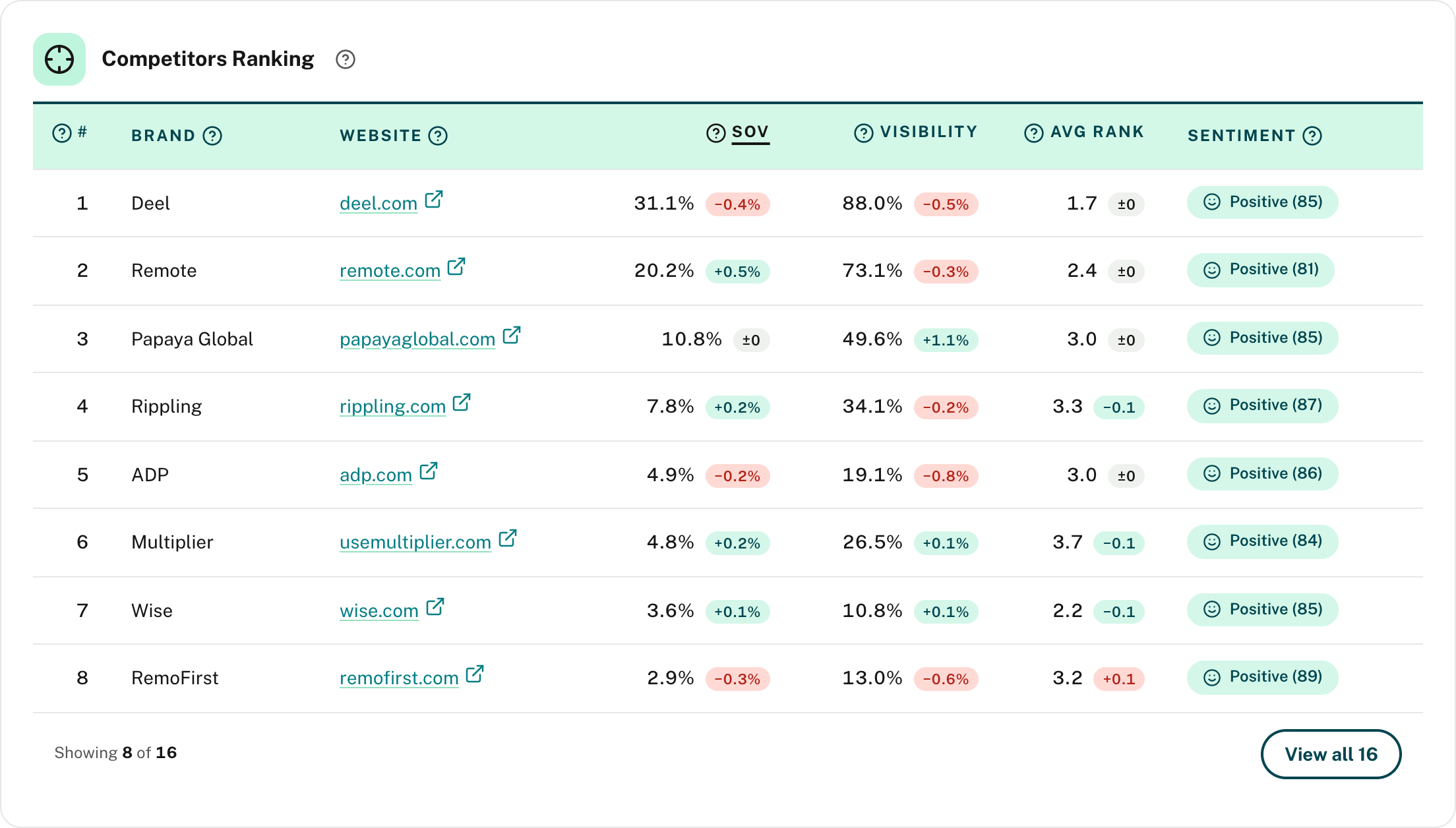
Visibility, the next column, counts how often a brand appears at all: of the answers that name any tracked brand, 88% name the leader. The partner is not among the eight brands the card shows, so a useful next step is to read the answers to each of its buyer questions and see where it is missing. The card covers one category over 90 days and does not show why the leaders hold their places.
Leon draws the same lesson for any founder thinking of narrowing:
Before deciding whether to narrow your category, find out how many names the answers to your own buyers’ questions hold, which of them come back week after week, and whether yours is one. That count tells you more about where you stand than the number on the directory page.
Leon Claassen on LinkedInOpens in a new tabHow Often the Same Vendors Come Back in Crowded Categories
Our run measured how much the names in a category’s answers overlapped, three ways. In 91.4% of categories of 250 or more listings, at least one vendor appeared in all nine answers, against 84% at 50 to 249 and 68% under 50:1
Categories With at Least One Vendor in Every Answer
Share of categories per listings band (25, 50 and 35 categories), 28 Oct 2026
View the data
| Label | Value |
|---|---|
| Under 50 | 68% |
| 50 to 249 | 84% |
| 250 or more | 91.4% |
Asked the same question twice on the same day, ChatGPT named a median 80.4% of the same vendors again, from 77.1% in the smallest categories to 82.2% in the crowded band. Between the two engines the overlap was lower. Of all the vendors either named for a question, both named 50.5% in the median category of 250 or more listings, 41.7% under 50 and 71% in the six of 1,000 or more.1 So checking one engine misses many of the names the other gives.
Directory pages tell a different story. In our census the first product on a G2 category page holds a median 15.8% of reviews, from 23.6% in categories of 10 to 49 products to 8.1% in categories of 500 to 999.2 So a crowded category looks more open on its directory page, where the leader’s share of reviews shrinks, than in the answers, where the same few names kept coming back.
In crowded categories the answers on 28 October agreed more, across engines and across repeats. One day of agreement does not show the names are fixed. It is a reason to read your own category’s answers over several weeks before you act on them, which needs the same questions every week and a steady way to score what comes back. Our playbook on measuring AI visibility walks through both, starting from 100 buyer questions:
Which Pages AI Answers Cite in Crowded Categories
When the same names keep coming back, the next question is where the answers get them from. Our run classed every cited page as a vendor’s own site, a directory, a community such as Reddit or YouTube, or a publisher, and one answer can cite several kinds.
In categories of 250 or more listings, 47.6% of Google AI Mode answers cited a community page, against 25.3% at 50 to 249 and 9.5% under 50. Answers citing a publisher rose from 39.2% under 50 listings to 51.4% at 250 or more:1
What Google AI Mode Cites, Small Against Crowded Categories
Answers citing at least one page of each kind: under 50 listings, then 250 or more
(Reddit, YouTube)9.5%47.6%
View the data
| Label | Under 50 listings | 250 or more listings |
|---|---|---|
| Vendor's own site | 89.2% | 88.6% |
| Publisher | 39.2% | 51.4% |
| Directory | 31.1% | 36.2% |
| Community (Reddit, YouTube) | 9.5% | 47.6% |
In a crowded field, AI Mode’s answers pointed more often to pages the vendors did not write. A vendor’s own site was cited in 88.8% of AI Mode answers, between 88.6% and 89.2% in every size band, against 41.4% of ChatGPT’s. With web search on, 42.9% of ChatGPT’s answers cited nothing at all, against 0.9% on AI Mode.1
For close to half of those ChatGPT answers, there was no cited page to work on. Where an answer does cite pages, buyers pay attention to them:
What Our Category Run Does Not Show
Every figure from the run and the census above has limits worth knowing before you plan around it:
- Sample: our 110 categories were chosen by hand to run from niche to crowded, so a pooled figure describes them. Each got three questions in US English on one day, ChatGPT twice and Google AI Mode once, for 989 answers, one short of the full 990. The figures for the largest categories rest on six of them.
- Census: the G2 count is a random draw of 813 of the 1,895 software categories, and the distribution covers the 729 that print a count, so these figures describe a sample of G2’s categories. GetApp’s count covers every category.
- Reading: a model read the products out of each answer, checked by hand on a sample. Products were then grouped under their company by name, so a company could occasionally be counted twice, or two companies counted as one.
- Cause: all of it is association. Crowded categories’ answers repeat their names more often and cite more community pages, but the run cannot say why, or that a company placed on those pages will be named.
How to Choose Between Creating, Narrowing and Joining a Category
The figures so far bear on one decision, where your product competes. Before you change it, run these checks on your own category:
Before you reposition or narrow your category
- How many products your directory category holds, and how many of them have verified reviews
- Which buyer questions your product answers best, in your buyers’ own words
- How many vendors the answers to those questions name, and whether you are one of them
- Which kinds of page those answers cite: vendor sites, directories, communities or publishers
- Whether the pages they cite carry your customer results, reviews or comparisons, and how those compare with your rivals’
- The same questions asked over several weeks, before any decision
Positioning comes down to three options, and each needs its own proof and its own test:
Scroll horizontally to see all columns when the table is wider than this page.
| Option | When it fits | The proof it needs | How to test it |
|---|---|---|---|
| Create a category | Buyers describe a need that no category on the directory names | Buyers asking for that need in their own words | Ask the engines the need as a question and see whether any vendor already owns the answer |
| Narrow it with a qualifier | A segment or use case where you beat the general leaders | Customer results in that segment, on pages the answers cite | Track the qualified questions weekly beside the broad ones |
| Compete inside it | Your proof already holds up against the leaders | Reviews, comparisons and listicle placements as strong as theirs | Watch whether the answers to the category’s main questions start to name you |
If your choice points to a different directory category, and one exists, move your listing there, because that is the group of products the directory ranks you against. Nothing in our run shows that a narrower position gets a product named more often, so treat it as a test.
Founders argue the same choice on Reddit. Two r/SaaS threads, on positioning among a flood of AI rivals and on narrowing a general tool, drew replies that start with the customer and end with checks you can run this week:
Tips from Reddit
How founders choose where to compete
Narrow down to a specific niche. Get really focused. Who is your customer? What pain are you solving for them? How can you do this better than general solutions that solve for the wider market?
Start with the users who already get the most value from it rather than choosing a niche based on market size.
You dont necessarily have to change the product itself to niche down. Just build two separate landing pages with copy tailored to each specific group and see which one converts better before you lock in your roadmap
If I type in best _________ (whatever your space is) on ChatGPT, copilot, claude, or Gemeni, do you even pop up?
The drawing puts the checks and the choice in the order you would run them:
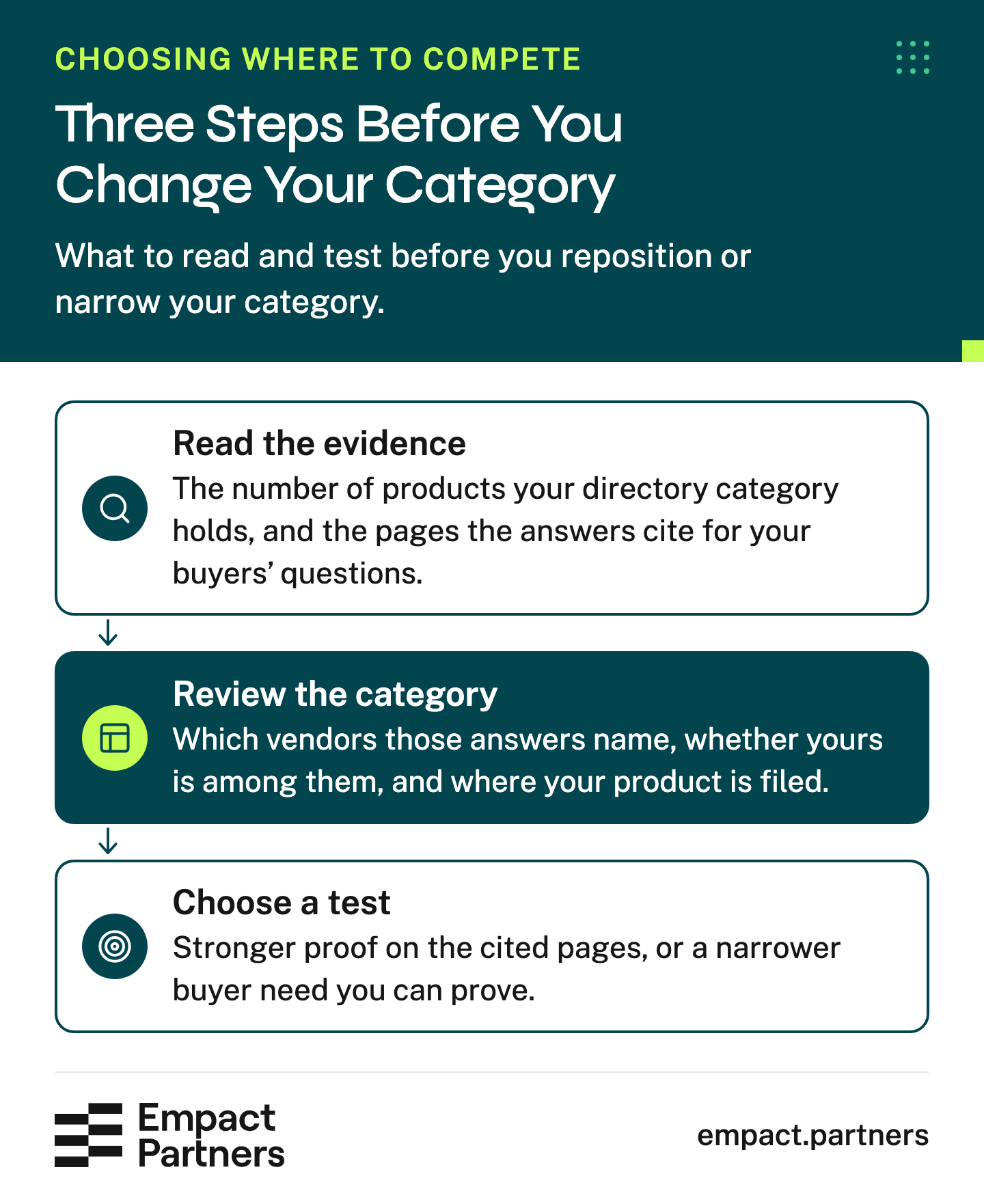
Whichever test you pick, ask the same buyer questions you asked before the change and compare the answers.
Once you know which buyer questions you compete on, the pages the answers cite are the part you can change, and Empact Partners would start there. The first are the pages that compare your rivals and leave you out. An editor can add you to a listicle, and a new reply can name you in a Reddit thread.
In a crowded category those pages include the listicles the engines cite, Reddit threads where buyers compare tools, and directory profiles, and the mix of sources differs from one engine to the next. The work covers those pages, your own site and a weekly reading of the answers:
What the work includes
- A note to the editor of each best-of listicle the answers keep citing, with the reasons your product belongs in it
- Helpful replies in the cited Reddit threads, naming your product only where it answers the question
- Your own product and comparison pages made easy for an AI engine to read and quote, with the proof that sets you apart from the category leaders up front
- A weekly check, engine by engine, of whether the answers to those questions name you and cite those pages
A placement on a cited page does not prove new pipeline by itself. The weekly reading shows whether the engines start naming you and citing those pages, and whether deals follow is a separate question. The AI Citation Gap Report below previews, for free, the agent behind that first step. From your website, it picks out cited pages that mention your competitors without you, sorts them by kind of page and says how to get onto each:
The report shows where the answers leave you out. Deciding what to do about it, whether to win those pages, narrow the category or both, is the harder part.
Frequently Asked Questions
Should we change the category we are listed in on G2?
Not on the directory count alone. The filing sets the field G2 counts you against, so settle your positioning first and change the filing to match. Ask the engines the buyer questions where your product has proof, and see which category’s vendors the answers name. If those vendors sit in a narrower category than yours, moving the listing is worth testing. If they sit in yours, stay and get your results onto the pages the answers cite.
Is a smaller category easier to get named in AI answers?
Our run does not measure a company’s chance of getting named. It shows every size band got a median of 14 names, on one day across hand-picked categories, so a small category had fewer listings competing for about the same number of names. Before you move, check that buyers ask questions that fit the narrower field. A niche that buyers never ask about produces few answers for anyone to appear in.
How many vendors do AI answers name for a software category?
Taken one at a time, ChatGPT’s answers in our run named a median of five products and Google AI Mode’s six. Across a category’s nine answers, three questions with ChatGPT asked twice, the engines named 14 different vendors at the median, in small and crowded categories alike. To get your own number, ask your three most common buyer questions on both engines, repeat ChatGPT once, and count the distinct vendors.
How many products make a B2B buyer’s shortlist?
About three. TrustRadius found an average of 2.7 products on a technology buyer’s shortlist in January 2026, rising to 3.2 for expensive purchases, and 83% of buyers kept three or fewer. For planning, assume your product competes for one of about three places. Assume too that the buyer often knows the eventual winner early, since 79% already knew of the product they ended up buying before research began.
Do B2B buyers really start software research in AI chatbots?
About half say so, across chatbots as a group. The share for ChatGPT alone is not reported. G2’s March 2026 survey of 1,076 buyers put the share who begin in a chatbot ahead of Google at 51%, against 29% eleven months earlier.
The figure is self-reported and comes from a company that runs a review site, so treat it as a direction. Your own data is the check: ask new customers where their research began, and watch sessions referred by ChatGPT, Claude and other chatbots as a rougher second signal.
Why do AI answers keep naming the same vendors?
Our run measured the repetition and did not establish its cause. Asked the same question twice on one day, ChatGPT repeated a median 80.4% of its vendors, and the two engines agreed more often in crowded categories than in small ones. For a newcomer, one answer tells you little about your position. Read the same questions across several weeks and on both engines before you decide anything, and keep each week’s answers to compare.
Do G2 reviews help us get named in AI answers?
No study cited here measures that effect. In G2’s survey, 45% of buyers called review-site citations the most confidence-inspiring signal in an AI answer. In our run, Google AI Mode cited a directory in 31.1% of small-category answers and 36.2% of crowded ones. And in the 12 AI-native categories G2 examined, 77% of products had no verified review. Reviews are worth having for the buyers who read them. Treat any effect on naming as something to measure.
Should a company in a crowded category invest in Reddit first?
Only if the answers to your buyers’ questions cite Reddit. In our run, 47.6% of Google AI Mode answers in categories of 250 or more listings cited a community page such as Reddit or YouTube, against 9.5% in small categories. ChatGPT cited no page at all in 42.9% of its answers. Pull the cited pages for your own questions first. If threads appear in most of them, Reddit earns a test. If directories or listicles lead, start with those.
When does creating a new category make sense?
When buyers describe a need that no category on the directory names, and you can show proof for it. A new category can fill with listings quickly: G2’s Answer Engine Optimization category went from 7 products in March 2025 to 623 by September 2026, though a listing is not an active rival.
Before you commit, check that buyers ask for the need in their own words, that no vendor already owns the answers to those questions, and that your budget can carry the explaining a new category needs.
How do we know whether our category work is paying off?
Fix the buyer questions before the work starts and keep them fixed. Each week, record which vendors each engine names and which pages it cites, so you can see whether your name appears and whether the pages you worked on are among those cited. In a crowded category the names repeat a lot, so judge the trend over months. For the business result, track demos and deals from buyers who mention an AI answer, and report them apart from the visibility numbers.
Sources (9)
- Empact Partners, "AI answer run" (2026)Empact Partners' own data↩1↩2↩3↩4↩5↩6↩7↩8↩9↩10↩11↩12↩13↩14113 G2 software categories from niche to crowded (110 with a listing count), three unbranded buying questions each, ChatGPT with web search asked twice and Google AI Mode once, US English, 28 October 2026; 989 answers in the 110 categories. Re-checked 12 November 2026.
- Empact Partners, "G2 category census" (2026)Empact Partners' own data↩1↩2↩3↩4↩5↩6a random draw of 813 of G2’s 1,895 software categories, 729 printing a listing count, 28 October 2026. Re-checked 12 November 2026.
- TrustRadius, "Beyond the Hype: The AI Bubble that Isn’t Bursting (Yet)" (2026)↩1↩2↩3↩4B2B Buying Disconnect report, 2026. 1,862 technology buyers, January 2026. Read 13 November 2026.
- G2, "New G2 Research: Half of B2B Software Buyers Now Start Their Research With AI Chatbots" (2026)↩1↩2↩3↩4↩51,076 B2B software buyers and decision-makers, March 2026. Read 13 November 2026.
- Empact Partners, "GetApp category census" (2026)Empact Partners' own data↩1the product count beside each of GetApp’s 994 categories, 28 October 2026. Re-checked 12 November 2026.
- G2, "How G2 Is Bringing Accountability to AI Software Claims in 2026" (2026)↩1G2 data as of July 2026. Read 13 November 2026.
- G2 Learn Hub, "The Great Software Re-Rating: Top Categories Reshaped by AI in 2026" (2026)↩1↩2↩3↩4↩5Updated 22 October 2026. Read 13 November 2026.
- G2, "Inside the 2,000% Growth of the AEO Software Category on G2" (2026)↩130 January 2026. Read 13 November 2026.
- G2, "2026 Buyer Behavior Report: The Evaluation Maze" (2026)↩11,038 B2B decision-makers, June 2026. Read 13 November 2026.
Keep reading
Statistics 45 Gemini Citation Statistics for B2B Software Teams
Gemini citation data for SaaS teams on which pages it cites, how its answers shift and how to count your category before funding work.
Statistics 40 AI Crawler Access Statistics
AI crawler access statistics to help SaaS leaders check bot rules, firewalls and help centers before funding a site rebuild.
Statistics 13 AI Answer Brand Mention Statistics: What Shortlists Show
How many brands appear in AI answers, what buyer surveys show, and how to measure your SaaS company's visibility.