How to Build a SaaS Publication That Helps Buyers Decide
Choose your publication's focus, assign editorial ownership and connect articles to buyer inquiries.
 Leon ClaassenWith
 Vlad Shvets and
 Teddy Cipolla
On this page
Empact Newsletter
One email a month on what is working in AI search and SaaS go-to-market.
A SaaS blog can publish accurate, well-optimized posts every week, watch its traffic climb and still bring in few inquiries, while the budget keeps paying for more posts. Adding more posts of the same kind won’t fix that. Running the blog as a publication means committing to one argument about your buyers’ problem, and paying for the expert interviews, the review and the distribution that argument needs.
For some of the SaaS companies whose content marketing Empact Partners writes with their own experts, we run the whole blog as a publication. By the end of this guide, you can write the one-page argument a publication starts from and test articles against it.
What an Editorial Position Changes in Each Article
The argument goes on one page, called the editorial position. It names the buyer you write for, the problem they are trying to solve, the argument you make about it, the evidence only you can bring and the topics you will turn down. Once it exists, every proposed article gets the same test before anyone writes it, and search volume only decides between topics that pass:
Test each proposed article against the position
- It moves your argument forward for the buyer you named
- Its evidence comes from your own data, customers or experts
- The reader finishes with a next question or a product step
- It does not cover ground an existing article already covers
An article that doesn’t move your argument forward stays off the calendar, whatever its search volume.
The test only works if the position is written before the first article. That was the order at Linearity, the design software company, whose blog we run alongside its marketing team. Before the articles, two of our team spent a day working out where Linearity stood among design tools, and that research has informed the articles we have written with its team ever since.
Its founder, Vladimir Danila, describes the result in terms of paying subscribers, which is what a publication is for. He calls the blog “an in-house media machine that helps us educate, acquire, and convert users into subscribers.”
Each article that passes the test then starts as a brief that carries the position into it. For a hypothetical company that sells scheduling software to clinics, one brief might look like this:
Scroll horizontally to see all columns when the table is wider than this page.
| Brief field | Example |
|---|---|
| Buyer question | Can we cut no-shows without adding front-desk work? |
| Argument it advances | When a reminder goes out matters more than how many go out |
| Evidence needed | The company’s anonymized booking data and an interview with a clinic manager |
| Next article | What a reminder should say so patients reschedule instead of missing the visit |
| Product path | The reminder settings guide and a demo request |
| Distribution | The company newsletter, a post from its product lead and a line sales sends to prospects who ask about no-shows |
The evidence row is often the expensive part of a brief, and choosing which buyer questions get a brief at all takes judgment. Two marketers on Reddit give practical advice on both, one on paying for original research and one on deciding which readers’ questions to answer first:
Tips from Reddit
What marketers on Reddit say about choosing topics and evidence
Another really great way to get leads through content is sharing bespoke research you paid to get. This is costly, but super valuable. Particularly if it speaks to benchmark data or trend data.
One very active reader could look a lot like five people getting stuck at the same step. Both can make a good post, but I wouldn’t give them the same priority when planning content for a business.
If an article needs research you pay for, put that cost in the budget when the brief is approved. And when two questions compete for a slot, pick the one many different buyers get stuck on over the one a single active reader keeps raising.
Who Owns Each Part of a SaaS Publication
A publication runs on five decisions, and each needs an output someone can check and a person who answers for it:
Scroll horizontally to see all columns when the table is wider than this page.
| Decision | What it produces, and who owns it |
|---|---|
| The problem and the argument | The one-page editorial position, owned by the editorial lead with a founder or product lead |
| Linked buyer questions | A topic map where each article leads to the next question, owned by the editorial lead |
| Evidence | Data, customer stories and expert interviews, the source of an original angle, supplied by subject experts |
| Approval and distribution | A review step and a plan for each channel, owned by the editorial lead with each channel’s owner |
| Inquiries and their value | Inquiries traced to articles and valued with sales, owned by the marketing lead |
The table says who decides each part. The drawing follows one article through the work, from the buyer’s question to the inquiry that shapes the next brief, and shows the two steps agents can take on, drafting and the review before approval.
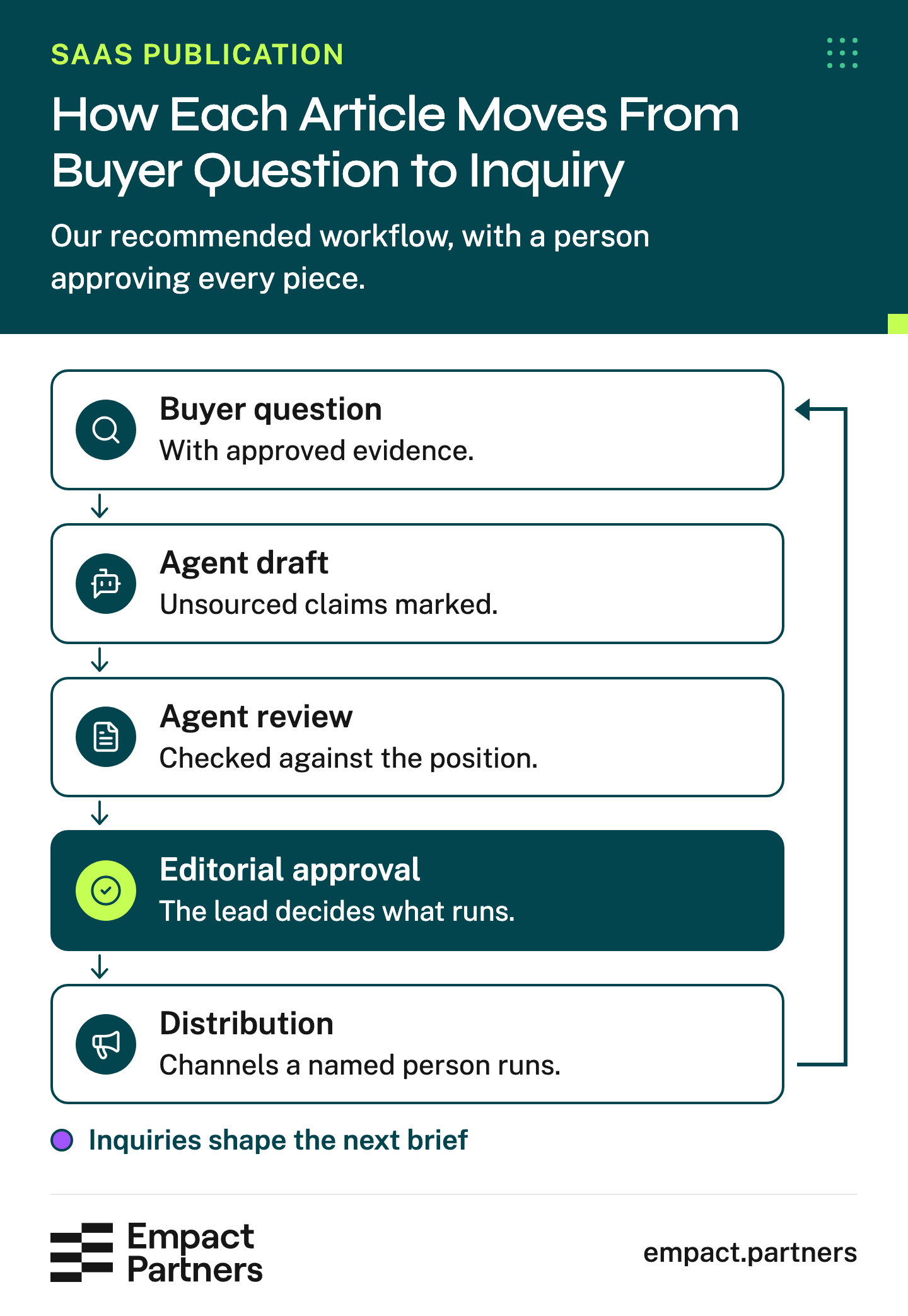
Drafting is where an agent helps, because by then people have already decided the argument, the evidence and who approves. Give an AI agent the position, the brief, the interview transcripts and the claims the company has approved. From those, it can write a first draft in the words your team already uses. It should flag every sentence those inputs don’t support instead of filling the gap.
Review agents can then read each draft against the position and the approved claims, and send back anything off-argument or unsourced before the editorial lead opens it. The lead still reads every draft, judges whether it makes the company’s case well enough to carry its name, and approves it, sends it back or turns it down.
Those checks hold a draft against your own position and claims. Before approving, the lead should also hold it against the pages already ranking for its question, and ask whether it tells buyers anything those pages don’t. Paste an article’s link into the preview below to compare it with up to eight competing pages. It shows which points are yours alone, which ones the others already make and what you could add.
Distribution belongs in the brief too, before anyone writes. The clinic brief above names its newsletter, the product lead’s post and the line sales sends to prospects, so the article reaches buyers on the day it goes live.
If your blog is like the one at the start of this guide, busy with posts written for keywords, the playbook below shows how to turn it into a publication buyers return to, at a pace your team can manage.
Whether to Launch Now or Run a Pilot First
Launching a publication commits people’s time every week, so check what it depends on before you announce anything:
Launch when all of these are in place
- Evidence only your company has, such as product data, customer stories or expert views
- An editorial lead with time every week to approve or turn down drafts
- Experts who will give an interview for the pieces that need them
- A route from articles to buyers, such as a newsletter, your sales team and the channels you already run
If one is missing altogether, sort that out first. If you have each of them for a few articles but can’t yet promise them every week, run a pilot before you commit the budget:
Run a pilot on one buyer question
Pick the question.
Choose the buying question your sales team hears most and that your evidence can answer.
Write three linked articles.
Each one answers the question the previous one raises, with a brief that names its next step.
Approve and distribute.
Have the person who would lead the publication approve all three, then send them through the channels you would use for real.
Read what came back.
Count the inquiries, ask sales which pieces prospects mentioned, and decide whether to launch.
Our senior GTM consultant Leon Claassen would watch one more thing during a pilot:
In a pilot, watch what the editorial lead turns down. If every proposed topic gets approved, the position is too broad to guide anything, and the full publication will drift the same way.
 Leon Claassen on LinkedInOpens in a new tab
How to Tell Whether the Publication Pays Off
Start with what each article costs, from the brief to the published page. In the calculator below, enter the hours each step takes, your experts’ interviews and reviews included, and what an hour of each person’s time costs:
Then set that cost against what the articles bring in, which takes more than counting inquiries. Record the articles each new contact read before they got in touch, and mark in your sales system which inquiries came through the publication. After a full sales cycle, add up the pipeline those inquiries opened and the revenue they closed, and compare it with the publication’s cost over the same months.
Report that revenue as influenced by the publication, since sales calls, ads and referrals worked on the same deals. Report reading history separately, because it only shows the publication was on a buyer’s path. Ask sales which articles prospects mention on calls, since that catches what the tracking misses.
Your team can run everything in this guide on its own. We would begin by auditing the archive you have now, since some older posts can argue your case once they are improved. We plan the rest over quarters rather than weeks, since the pipeline a publication opens takes at least one sales cycle to show. These parts of the work are ours:
What we do for your publication
- Interviews with your experts for the evidence each article needs
- Articles our writers draft with your team, with AI agents helping from research to first draft
- Ongoing improvements to the posts already on your blog
- Standing reports on how each article performs, to set beside the pipeline your sales system records
Frequently Asked Questions
Do we need a separate website for our publication?
Not at the start. Give the publication its own name and section on your company site. Buyers can then move from an article to your product pages in one click, and search engines credit your main domain. A separate site adds design, hosting and promotion work before you know the argument holds. Consider it once the publication has an editorial lead, a returning readership and a reason to look independent of the product, such as covering the whole category.
Who should own a SaaS publication?
One editorial lead with the authority to turn drafts down, including drafts from senior people. That lead writes the editorial position with a founder or product lead, approves every piece and decides which buyer question the publication answers next. Subject experts supply interviews and review their own claims, but they shouldn’t run the calendar. Without a single owner, the publication drifts back to whatever each team wants published that month.
What goes into a one-page editorial position?
Name the buyer by role and company type, and the problem that brings them to you. State your argument about that problem in a sentence a competitor could disagree with. Then add the evidence you can offer that others can’t, such as product data or customer access, and the topics you will decline. Review the page with sales each quarter, since the questions buyers bring to calls show whether the argument still fits.
What should the AI agent never do in a publication?
The agent should never publish, choose topics or decide what the publication argues. It drafts only from inputs a person has approved, such as the position, the brief, interview transcripts and the approved claims. Where those inputs don’t support a sentence, it should mark the gap rather than write around it. People own the argument, the final edit and the decision to publish, because every article speaks for your company.
How many articles a month does a publication need?
Set the cadence from your slowest stage, which is usually expert interviews or the editorial lead’s approval time. If your experts can give two interviews a month, for example, plan two expert-led articles and add pieces built on your own data around them. Book the interviews before you fill the calendar. Raise the cadence once the slowest stage has kept pace for a few months, so the increase rests on what the team has already delivered.
How do we value the inquiries a publication brings?
Use your own sales data. Multiply the share of publication inquiries that become qualified opportunities by your win rate on those opportunities, then by your average contract value. The result is what one inquiry is worth on average. Check it against the deals that closed after a full sales cycle. Mark the source in your sales system from the first inquiry, because reconstructing it months later is guesswork.
What if our experts have no time for interviews?
Ask for thirty minutes on one named question rather than general help, and send the questions a day ahead. Record the call and show the expert the published piece. If even that is impossible, start with articles built on your product data and customer stories, which can show how the product is used. Articles that argue where the market is heading need an expert’s view, so hold those until an expert can give one.
Can we turn our existing blog into a publication?
Yes, and the archive is the place to start. Test every existing post against the new editorial position. Keep the ones that argue it, merge near-duplicates into one stronger page, update the ones with outdated evidence and retire the rest. Redirect what you retire so you keep any traffic it earns. Then fill the gaps in the topic map with new articles, rather than writing new ones beside posts that already cover the same ground.
Should publication articles mention our product?
Where the product answers the reader’s next question, yes, plainly and with a link. A post about cutting no-shows can show the reminder setting that does it. What hurts trust is the product dropped into every article whether it fits or not. Let the brief decide: each one names the product path, and when it has none, the article ends on the next question instead.
How do we know the publication is working before revenue shows up?
Watch the signals that come before revenue, such as returning readers, newsletter replies, sales sending articles to prospects, and prospects mentioning pieces on calls. Track how many questions on your topic map have a published answer. None of these proves revenue, so treat them as reasons to keep going while the revenue evidence builds. Set the revenue review for after one full sales cycle, so a long cycle gets a fair window.
Keep reading
Content Marketing How to Build Technical Content Developers Trust
Turn engineers' answers into technical content buyers can check, with clear ownership of interviews, drafts and reviews.

Content Marketing Hire a Content Writer or a Consultancy? Decide Who Owns the Work
Choose a writer, a senior content lead or a consultancy by the work your SaaS team needs owned, reviewed and measured.
Content Marketing Start With Expert Interviews Before You Launch a SaaS Podcast
Decide whether a podcast fits your SaaS team, who owns the work, and how expert interviews become useful buyer content.