Write Your Outbound Playbook Before You Buy An AI SDR
Before buying an AI SDR, define which emails your team would stop. See the rules, approval process and evidence to judge its work.
On this page
- Why an AI SDR Needs a Written Standard Before It Sends
- What Our Own Sales Record Showed Before We Wrote the Rules
- What the Drafting Agent Asked on Its First Run
- What the Person Approving an AI SDR’s Drafts Needs
- Why Not Buy Now and Judge the AI SDR by Its Numbers?
- When You Are Ready to Buy an AI SDR
- Frequently Asked Questions
Empact Newsletter
One email a month on what is working in AI search and SaaS go-to-market.
Your sales team says the leads are bad, and a vendor says its AI sales development rep (AI SDR) will triple your replies. Don’t sign until someone has written down whom your outbound should reach, why each of them should hear from you now, and which replies must never go out. With nothing written, nobody has a standard to reject a draft against, and the dashboard cannot tell you a draft was wrong.
The advice holds for a team that has already booked meetings from cold email by hand. A team that never has should send its first emails itself, in one segment. Some rollouts fail on the contacts chosen or on the product itself, and no rule saves those.
Empact Partners’ outbound for SaaS companies runs on signals, which means we write when something changes at the account, such as a new head of sales. We warm the sending domains and pass buyers who want a meeting to your sales team.
The record below comes from our own outreach, where we test every timing and subject-line idea before we use it for a partner. If your team can already write these rules, buy the tool and run it yourselves.
Why an AI SDR Needs a Written Standard Before It Sends
An AI SDR’s dashboard counts what the tool controls: emails sent, replies and meetings booked. None of them says whether the person should have heard from you, so a draft can be sent and counted without anyone able to call it wrong.
We learned that on our own pipeline. In March 2026 we scaled a cold outreach build of ours to 3,303 contacts. Each email was to point a company to three Reddit threads in its market, with a line on how the company fit each one. To save on model costs, the build reused one set of threads per market and rewrote the model’s lines with find-and-replace. It ran to the end, and then we read what it had made 1:
Every field was filled, so by its own measures the build had worked. The rules that would have caught a reused thread or a mangled line were written only afterwards, so it took a person reading the output to call it a failure. We tore the build down and wrote that read into the process. Before any campaign sends now, a person reads ten thread descriptions picked at random and five rendered previews, and one that reads generic or broken stops it.
If a trial is already running at your company, you can judge one of its emails before your own rules exist. Paste it into the grader below, which checks it for relevance, the ask, length and spam triggers and sends back a rewrite.
What Our Own Sales Record Showed Before We Wrote the Rules
Those rules should come from your own sales record, and ours overturned the first one we would have written. Our fastest wins all had the proposal out within hours of the first call, so the obvious rule was to send the proposal fast. Before we built our reply agent, which drafts answers to prospects for one of us to send, we read every conversation in our sales record instead. Agents did the reading, and our team decided what each finding meant 2:
Scroll horizontally to see all columns when the table is wider than this page.
| What we checked | Won or past partners (59) | Open or in nurture (142) |
|---|---|---|
| Proposal within a day of the call, where both dates are on record | 26 of 45 | 49 of 55 |
| Held a call | 53 of 59 | 72 of 142 |
| No email from us after their last message | Not comparable | 57 of 142 |
The deals still open got the fast proposal more often than the partners we won. The record cannot say whether speed helped or hurt. A rule built on the fast wins would have told an agent to send proposals sooner, and the stalled deals were already getting them fast.
Two lines are clearer. Almost every partner we won had held a call, while 70 of the 142 open deals never had one. And 57 open deals ended on a message of theirs we never answered. The reading also found follow-ups with nothing new and companies two of us had emailed within days. The rules every draft follows came from all of it and from later rulings:
Every draft we send
- Comes from one sender per company, after checking who is already in the thread
- Goes to nobody who opted out and to no company already in a deal with us
- Brings something new for that company in every follow-up
- Opens with a one-line reaction, then the answer or the thing of value, one ask, and only the sender’s sign-off after it
- Answers a price question in the email itself, in the sender’s voice
A reply-drafting agent loads rules like these for every draft, so each answer starts from what the sellers decided. Where the rules leave a case open, it flags the gap instead of guessing, and a person sends, changes or holds the draft. The calculator below works out what that saves from the replies your sellers write by hand today.
Outbound Reply Drafting ROI Calculator
What Reply Drafting Could Save Your Outbound Team
Saved Per Year
$15,000
300 hours handed back, after $1,200 a year to run it
- Hours Handed Back
- 300 hours a year
- Agent Running Cost (Estimate)
- $100 a month
- Payback Per $10,000 Of Build
- 8 months
On these numbers, each reply costs $2.13 instead of $6.30, the agent saves $15,000 a year after its own running cost, and every $10,000 of the build is earned back in 8 months.
The example is a hypothetical SaaS team writing 300 replies and follow-ups a month. Each takes 7 minutes by hand or 2 to check as a draft, at $54 an hour, and the agent costs $100 a month to run. That saves $15,000 and 300 hours a year, so each $10,000 of build pays back in 8 months.
The $54 starts from $36.76, the May 2025 median hourly pay of US wholesale and manufacturing sales reps 3. It adds benefits, since wages are 68.5% of what employers spend on a full-time private-industry worker 4. Use your own inputs, because at a saving of zero or below the agent never pays back.
What the Drafting Agent Asked on Its First Run
On the afternoon of 23 October 2026 we pointed the drafting agent at our own open deals, with the rules we had by then loaded. Its instruction was to ask instead of guessing whenever the rules did not settle a case. On 33 drafts it asked 111 questions 5.
What Our Drafting Agent Asked On Its First Run
111 questions across 33 follow-up drafts, our own open deals, 23 Oct 2026
who sends it29
or send with it28
whether to raise it24
is still true17
or end it10
write at all3
View the data
| Label | Value |
|---|---|
| Who gets it, who sends it | 29 |
| What to offer or send with it | 28 |
| Which price stands, whether to raise it | 24 |
| Whether a fact is still true | 17 |
| How to word or end it | 10 |
| Whether to write at all | 3 |
Only 17 asked whether a fact was still true. The other 94 asked somebody to decide, and the hardest exposed faults in our own setup:
- Our playbook told follow-ups to restate the packages offered, while our send checks, the code every email passes before it goes, refused any price the prospect had not asked for.
- One deal’s stage in our sales records said proposal, and its thread showed no proposal, call or price.
- One draft was addressed to a company’s bounce mailbox.
The first is a clash between two rules we wrote ourselves. A person reading both can follow whichever fits the email, while an agent has to stop and ask. The other two are faults in our sales records and email routing, which is RevOps work. A tool with nothing written has no reason to stop at any of them.
Specific questions were quick to settle. That night the agent gained written rules for prices, follow-ups and attachments. It also gained a rule to ask one question at most. By 01:31 the next morning a routing rule made any case the record cannot settle wait. One clash took five days: a rule said nothing may follow the ask, yet a seller’s own sign-off comes after it.
What the Person Approving an AI SDR’s Drafts Needs
Our answer to an agent that guesses was to have a person approve every send. Through October 2026, every reply and follow-up our agents wrote went out only because a named person on our team asked for it or approved it 5. Each draft lands in the company’s thread in Slack. There anyone on our team can send it, change a line, hold it or take the company over.
We did not start there. The plan on 23 October was to let the agent answer alone until a meeting was booked. That day a prospect got two emails from us, a day after “one sender per company” went into the playbook, because nothing checked the rule. By that afternoon the agent could no longer send. Rules that code can test, such as whether a promised attachment exists, went into checks every email passes in our outbound pipeline.
On their first run those checks refused 14 drafts, among them 8 claiming an attachment that was not there and 5 quoting a price nobody had asked for. By the end of October we had written five levels of what the agent may do alone, from suggesting drafts up to running whole conversations. We started on the first, and only I can raise it, since I set the levels as founder. A higher level only makes sense once the approver has something to judge against:
A person approving an AI SDR’s drafts with no written standard is approving on taste, and the next person’s taste is different. Hand the approver the document the draft came from, and every correction has somewhere to go.
 Vlad Shvets on LinkedInOpens in a new tab
Our corrections go back into the document the agent drafts from. When I ruled on 26 October that a price question gets the packages straight away, the reply guide carried it the next day. The agent has loaded it with every draft since. Here is the whole loop that rule now travels through:
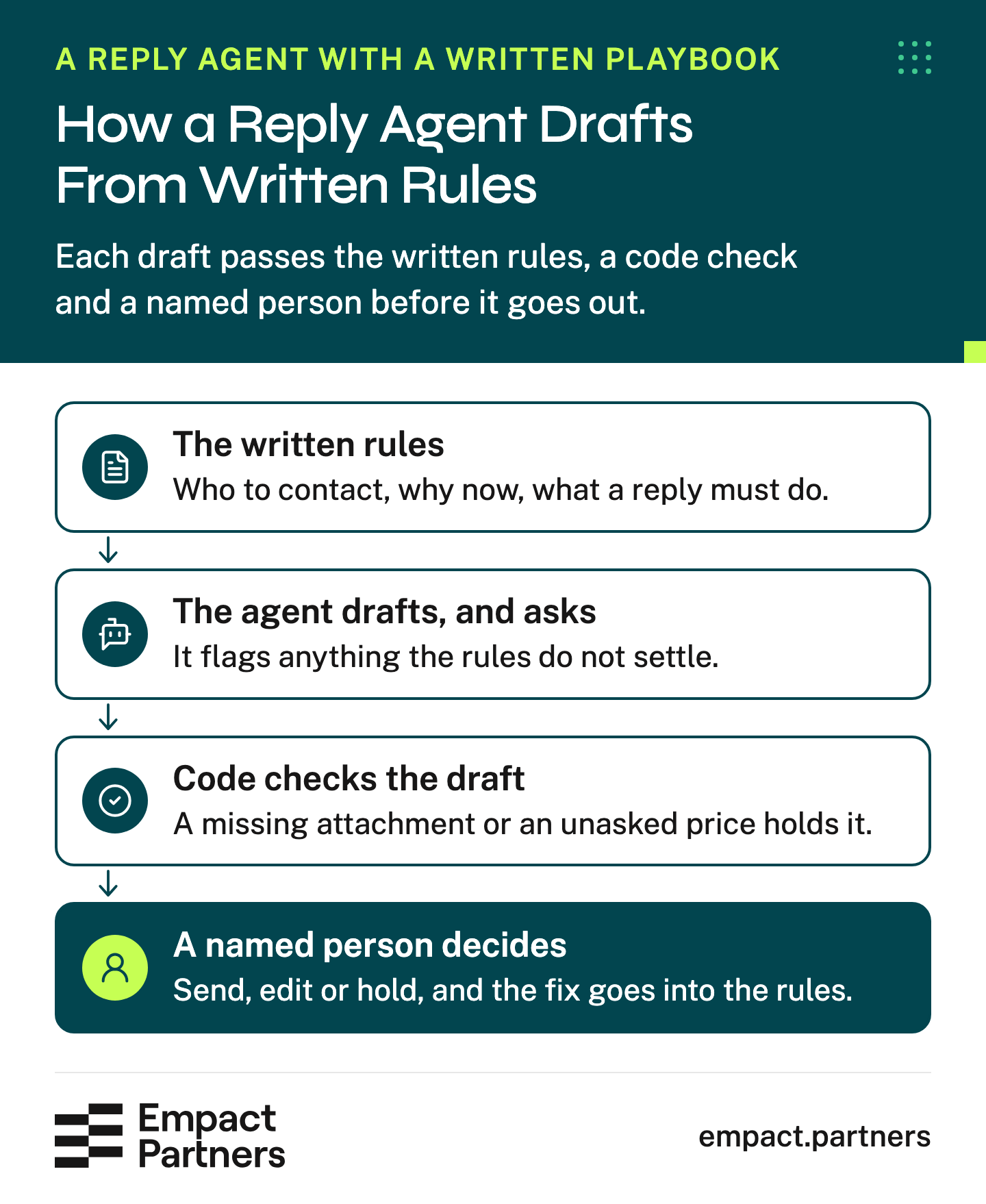
A correction written into the rules is loaded with every later draft instead of living in one person’s head. The cost is a person reading every draft. The system is too young for a before-and-after figure on hours or pipeline, so what we can show is what it stopped.
If your own team will run the reply job, start from the playbook below. It shows how to get more meetings from the replies you already receive, with an agent drafting each answer and a person sending it.
Why Not Buy Now and Judge the AI SDR by Its Numbers?
Grant the vendor its numbers, since some of these tools may well book real meetings and earn their seat. Here is the case for buying now and judging the tool by its dashboard, weighed both ways:
Pros
- Meetings may land within weeks of switching it on
- A competitor may already be running one
- Writing rules adds no pipeline while you do it
Cons
- The dashboard counts emails whether or not anyone should have got them
- Without your own earlier reply rate, a promise of three times the replies cannot be checked
- Pipeline created says nothing yet about what will close
So before any trial, write down your baseline: the reply rate and meetings booked from your own cold emails to the same segment over the last full quarter. A promise of three times the replies means something only against that number.
A pipeline count can also mislead, and ours shows how. Cold outreach was the first source of 116 of our 142 open deals, but of only 18 of the 59 partners we have won 2. The open deals are much younger, with a median first contact in March 2026 against October 2024 for the partners we won.
Some of those open deals may still close and others will be lost, and the counts cannot say how many. Until then, a pipeline full of outbound deals says little about what outbound will win. Every number a vendor reports has a limit of the same kind:
Scroll horizontally to see all columns when the table is wider than this page.
| The number | What it shows | What it cannot show |
|---|---|---|
| Reply rate | People answered | Whether you wanted that answer |
| Meetings booked and show rate | Calendar activity | Whether your team can close them |
| Pipeline created | What entered your sales records | Whether a stage means the same to everyone, or where it came from |
| Deals closed, by source | Recorded wins by the source someone attributed | Whether the tool caused them, whether they were profitable, or whether the source is right |
When someone selling B2B SaaS asked r/sales whether to pull the plug on a weak AI SDR, two sellers answered this way:
Tips from Reddit
From sellers answering a buyer about to quit an AI SDR
To build on this, I use AI to provide me company/prospect briefs that I can vet quickly and then use as a basis for an email or to inform my call with stakeholders.
People have become used to the AI personalisation, and its not real or value added personalisation, just a rough guess at who your company sells to or something similar.
The first keeps a person vetting what the AI produces, and the second describes what buyers get when nobody does. We would change our minds if a team with nothing written saw its AI SDR’s meetings close at the rate of its own people’s, over a full sales cycle. That alone would not prove the cause, but if it is your team, keep going.
When You Are Ready to Buy an AI SDR
None of this says never buy one, and one segment of written rules is enough to start. The first test of readiness fits in a sentence:
An AI SDR is worth a trial once someone on your team can reject one of its drafts and name the written rule it broke.
Before the contract, write three answers for that segment, in the order an email meets them: whom it goes to, what it opens on, and what you would never send in reply.
For one segment, before the contract
Write who you would refuse.
The company already in a deal with a colleague, the person who asked not to hear from you, the segment that has never closed.
Write why this person, now.
For everyone left after the first step, write the fact you would open on and what it has to do with your offer this quarter.
Write which reply you would stop.
With the opening settled, name the replies that must never go: the claim nobody can check, the price nobody asked for, the second email to someone already talking to a colleague.
Then run a trial in which a person reads every draft against those answers before anything sends. Price the replies in the calculator above. If the drafts pass and the saving holds, buy the tool. If nobody can write the answers, an agent can surface the questions but cannot make the decisions. A tool given no rules sends its guesses at whatever volume you pay for.
Before the first email we send for you goes out, we would write those answers for one segment from your won and lost deals. We would read the two side by side, because a sales record can overturn what a team remembers, as ours did on proposal speed. The drafting agent comes after the rules, so when a draft is rejected, you can see which rule it broke or which one is still missing:
What the work includes
- Rules for one segment, written from the deals you won and lost, before any agent drafts
- An agent that drafts replies and follow-ups from those rules
- Checks in code on every draft for what a machine can test, such as a promised attachment
- Every reply read and answered by our team
- A senior GTM consultant of ours who leads the work and joins your calls
If a vendor contract is already on your desk, test its drafts against your three answers before you sign.
Frequently Asked Questions
Do we need a full outbound playbook before we trial an AI SDR?
No. Rules for one segment are enough to start. They need to say whom to refuse, why each person should hear from you now and which replies must never go out. Run the trial with the tool drafting and a person reading every email before any send. Each draft the reader rejects for a reason the rules don’t cover is a rule you were missing, so write it down that day. Widen the trial to a second segment once the drafts stop surprising the reader.
What if our team has never booked a meeting from a cold email?
Then there is no record yet for anyone, person or agent, to write rules from. Pick one segment and send the first emails by hand, from a real person’s inbox, until you have had real conversations with buyers. Write down the objections you heard, the companies you would now leave out and the replies you regret sending. Those notes are the first draft of your rules. Buying a tool before that point pays for volume on a message no buyer has tested.
Can the vendor’s own team approve the drafts for us?
Not on its own. A vendor’s reviewer can catch a broken merge field or a clumsy line. They cannot know which companies are mid-deal with your sellers, which price you quoted last month or who asked never to hear from you again. Approval belongs with whoever owns the conversation and knows your deals, working from your written rules. If the vendor offers review, treat it as a first filter and keep your own person as the last one before anything sends.
How do we work out whether a reply agent pays for itself?
Count the replies and follow-ups your sellers write by hand in a month and the minutes each takes, then take away the minutes still spent checking each agent draft. Price the hours left at your sellers’ loaded hourly cost, meaning pay plus benefits, and subtract the agent’s monthly running cost. The rest is the monthly saving, and the build cost divided by it gives the months to pay back. If nothing is left, good drafts will not make the agent repay.
How should we judge a vendor’s claim of three times the replies?
Against your own number, measured the same way. Take the reply rate of your own cold emails to the segment the tool will work, over the last full quarter. Count only replies a seller would want, such as questions, objections and meetings. Then follow the tool’s meetings through a full sales cycle, beside the meetings your people book. A rate can triple and still be worth nothing if the extra replies are people asking you to stop.
Which mistakes in an AI SDR’s emails can code catch, and which need a person?
Code is good at facts it can test. It catches a promised attachment that is missing, a price nobody asked about, a second sender at a company a colleague covers and an address that opted out. Whether the email is worth opening still takes a person, so a person approves every email in the trial and every reply after it. For cold campaigns sent in batches, keep the code on every email and have a person read a sample as the recipient sees it.
Where do we start if our sales record is messy?
Read every conversation before you write a single rule, with the wins and the open deals side by side, noting what happened after the first call. Agents can do the reading if a person decides what each finding means. Expect the record to contradict your memory, as ours did on proposal speed. Fix the records the agent will read, too. A deal stage that says proposal with nothing behind it produces a follow-up about a document the prospect never got.
What does it mean when the agent asks questions instead of drafting?
It means your rules don’t settle that case yet, and in the first weeks it is the most useful thing the agent does. Sort the questions. One about a fact points at your records, and one asking for a decision points at a rule nobody has written. Answer each in the rules, so the next draft inherits it. Where the record cannot say who should send an email, let the draft wait. A guessed sender is how a prospect hears from two of your people.
Does your own record prove AI SDRs do worse than people?
No, and we don’t claim it does. It shows what our own sales record and drafting agent taught us about writing rules first. Better evidence would compare closed deals by source over a full sales cycle, for teams with and without written rules. Even that would not prove the cause, since teams that write rules differ in other ways too. Read this as advice on what to write and check before testing a tool, not a verdict on any one tool.
What should a trial contract with an AI SDR vendor include?
Terms that let you judge the work. Ask for a trial on one segment, with every email held for your approval before it sends. Ask for a full export of drafts, sends and replies, and for your excluded contacts to be loaded before the first email. Don’t pay per email sent during the trial, since that rewards the volume you are judging. Write success into the contract as meetings your sellers accept that reach a second call, against your own baseline.
Sources (5)
- Empact Partners, "Cold outreach build post-mortem, 8 March 2026" (2026)Empact Partners' own data↩1↩2the 3,303 contacts, the threads repeated across 40 or more companies, the 1,247 destroyed descriptions and zero sends, read on 13 November 2026.
- Empact Partners, "Sales record reading, October 2026" (2026)Empact Partners' own data↩1↩2won or past partners against open or nurture deals by call, proposal timing, unanswered last message, first source and median first contact, computed on 22 October 2026.
- US Bureau of Labor Statistics, "Wholesale and Manufacturing Sales Representatives" (2026)↩1Occupational Outlook Handbook, 2026.
- US Bureau of Labor Statistics, "Employer Costs for Employee Compensation, June 2026" (2026)↩1news release, 2026.
- Empact Partners, "Reply system records" (2026)Empact Partners' own data↩1↩2↩3the drafting agent’s questions on 23 October 2026, the send checks’ first-run refusals and every send’s requester or approver through October 2026, counted on 30 October 2026.
Keep reading
Outbound Give Your Outbound Agent Credit For The Emails It Doesn’t Send
Stop outbound agents emailing existing conversations. Record justified skips, hold failed checks and give every hold an owner.

Outbound How To Qualify Companies With AI Before You Buy Contact Data
Check each company’s own pages against written fit rules before you pay for contact data, with the scripts, the review queue and the costs.
Outbound How Long to Give Outbound Before Deciding It Works
When outbound works, kept meetings come within a quarter and revenue a sales cycle later. What to count in month one, at day 90, and after.