Yes, we use AI to make content, and we use a lot of it. Our content process is AI-native from the first keyword pull to the first draft: Claude Code runs the research, reads every page that already ranks for the topic, and writes to a house standard. Then a consultant who knows the partner’s market takes the piece over, and nothing ships until they have added what no model has and signed their name to it.
That consultant is the reason the content works. A model on its own writes the average of the pages it read, and the average already ranks, so a page built only from it has nothing to add. The consultant brings the part nobody else can publish: what the partner’s customers said on a call, the number from the partner’s own dashboard, the judgment of someone who has run this work before. That is where information gain comes from. It is also what makes a page authoritative, and it is what we have watched lift partners in search engines and in AI answers.
Empact Partners is a B2B SaaS go-to-market consultancy, and Content Marketing is one of the six workstreams we run with partners: building a publication rather than a blog, with original insight, named experts and product tutorials a competitor cannot copy. Below is how the AI half of that work runs, tool by tool, and exactly where the consultant sits in it.
Every Stage Is AI-Native, and Every Decision Has a Consultant
The process has five stages. AI does the heavy lifting in all five, and a named consultant makes the call in all five.
| Stage | What AI does | What the consultant does |
|---|---|---|
| Pick the topic | DataForSEO pulls search volume, intent and the live results page for every candidate question | Decides which buyer question this partner should own, including ones with almost no search volume |
| Read what ranks | Firecrawl turns the top pages into clean text, and Claude Code lists what they all say and what none of them says | Chooses the gap the piece will fill |
| Gather what nobody else has | Claude Code organizes interview notes, product docs and the partner’s own numbers into a brief | Interviews the partner’s experts, uses the product, and pulls first-party data |
| Draft | Claude Code writes the first draft from the brief, to the house standard | Rewrites wherever the argument is thin or the voice slips |
| Check and sign | Claude Code checks the draft against every rule in the house standard | Verifies every claim against the partner’s record and signs the piece |
Read down the right-hand column and you have the job description of the person who makes this content worth reading. Read down the middle and you have the hours it saves them.
Claude Code Is the Workbench
What it is. Claude Code is an AI agent from Anthropic that runs in a terminal, inside one folder on your computer. It reads and writes the files in that folder, runs commands, and every time it starts, it reads a file called CLAUDE.md, which is where your house standard lives. It connects to other tools through MCP, the Model Context Protocol: each tool ships a small server, and Claude Code can call it when a task needs it.
What we use it for. Research packs for a new topic. First drafts written from a consultant’s brief. Checks of a draft against the house standard before an editor reads it. Refreshes of old posts that still rank but have gone stale. Formatting a finished piece for the partner’s CMS. The pattern is the same in every case: Claude Code does the part that is reading, writing to a standard, or checking, and the consultant does the part that is deciding. Here it is checking one of my own published pieces against a house standard, quoting each sentence it doubts and the reason the rule gives:
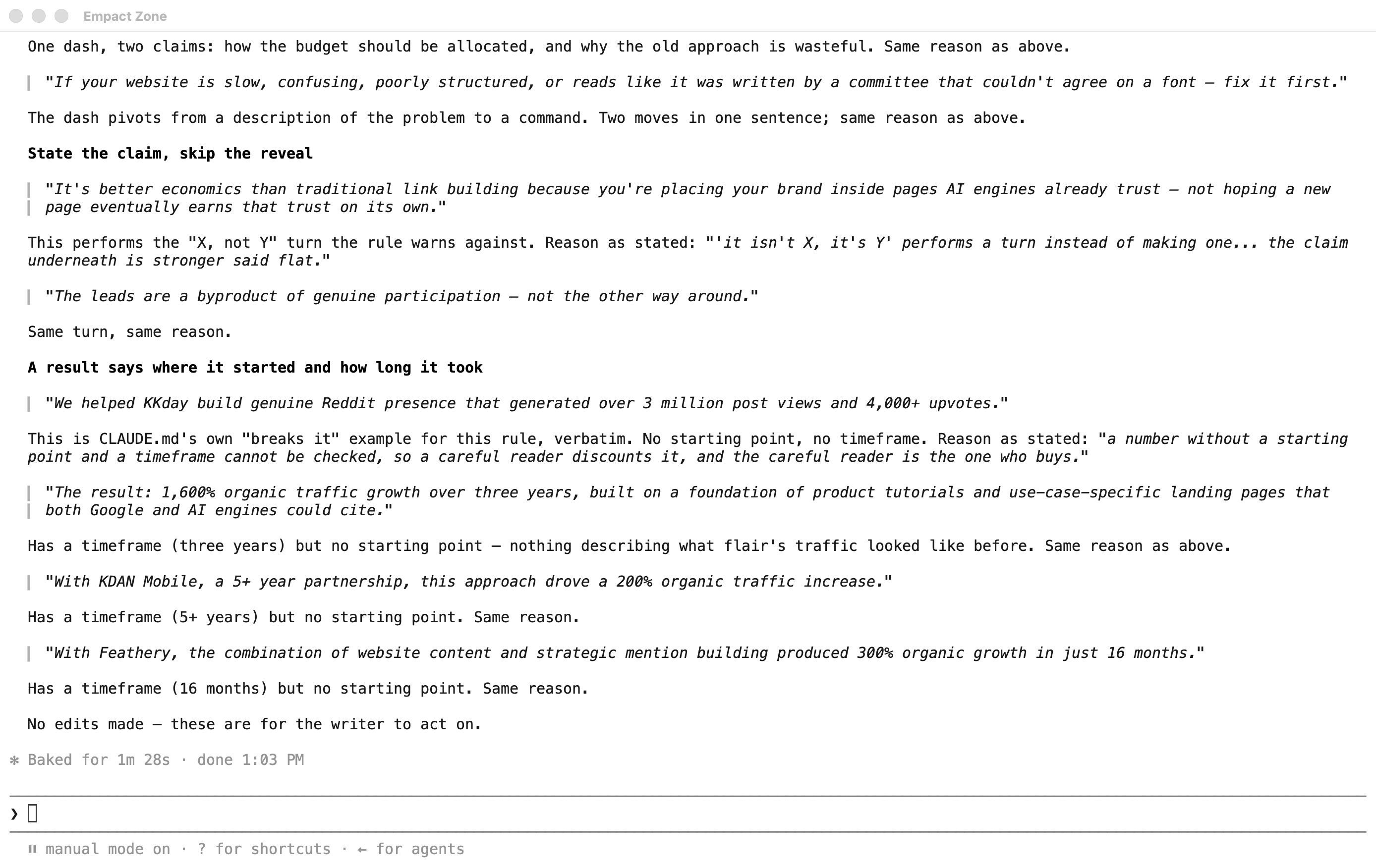
How to use it. Give each publication its own folder, so Claude Code only ever sees one partner’s material. Write the house standard before the first draft: each rule with its reason in plain words, and two real paragraphs from your own published work, one that breaks the rule and one that keeps it. Leave out word counts and length targets, because a writer, human or model, holding a target writes to the target. Then connect the research tools, so the reading happens in the same place as the writing.
The house standard is what separates a useful draft from a generic one, and it is the thing most teams skip.

.png)
Firecrawl Reads the Web So the Model Can
What it is. Firecrawl opens a web page and hands back its text without the menus, cookie banners, footers and scripts. A model reading a raw web page spends most of its attention on everything around the article. A model reading Firecrawl’s output reads only the article.
What we use it for. Three jobs, over and over. Reading the pages that already rank for a topic, so the research pack knows what the piece has to beat. Pulling a partner’s whole back catalog for a content audit, so we can see which posts deserve a refresh and which should go. Reading a product’s documentation and help center, so every product claim in a draft matches what the product does today.
How to use it. For one page, paste the address into Firecrawl’s playground and read what comes back. For many pages, connect it to Claude Code and let Claude Code decide which pages to read. Firecrawl bills in credits for each page it reads. Here it is reading a page that ranks for a topic we are writing about, product qualified leads:
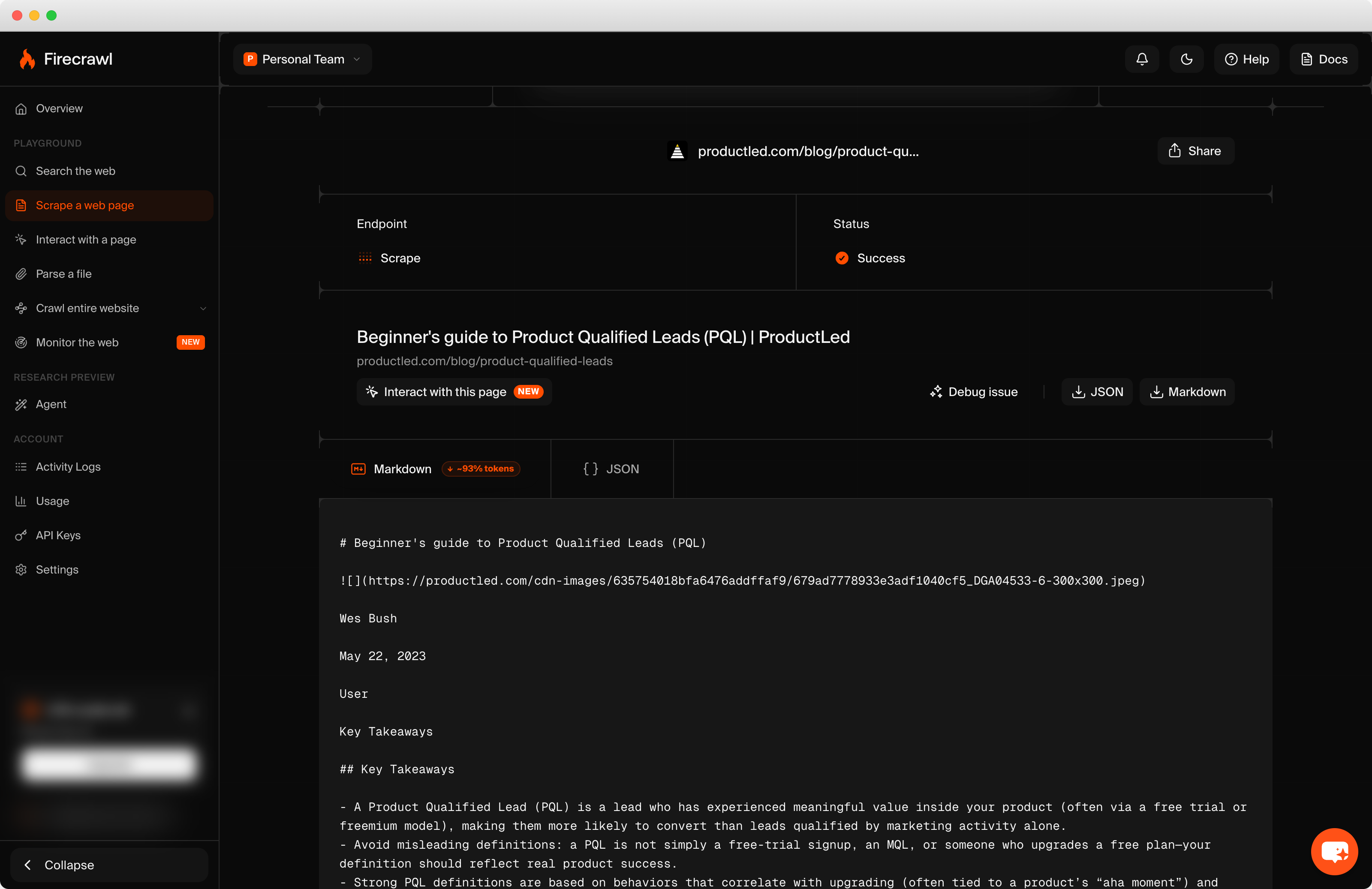
The badge beside the Markdown tab is the point: the clean text is a small fraction of what the raw page would cost a model to read.
DataForSEO Tells You What People Search, and Not Why
What it is. DataForSEO is a paid data service for search. It says how often a phrase is searched, how hard it is to reach the first page for it, what Google shows for it today, and which questions Google lists beside the results. It publishes its own MCP server, with a setup guide for Claude Code among the other clients:
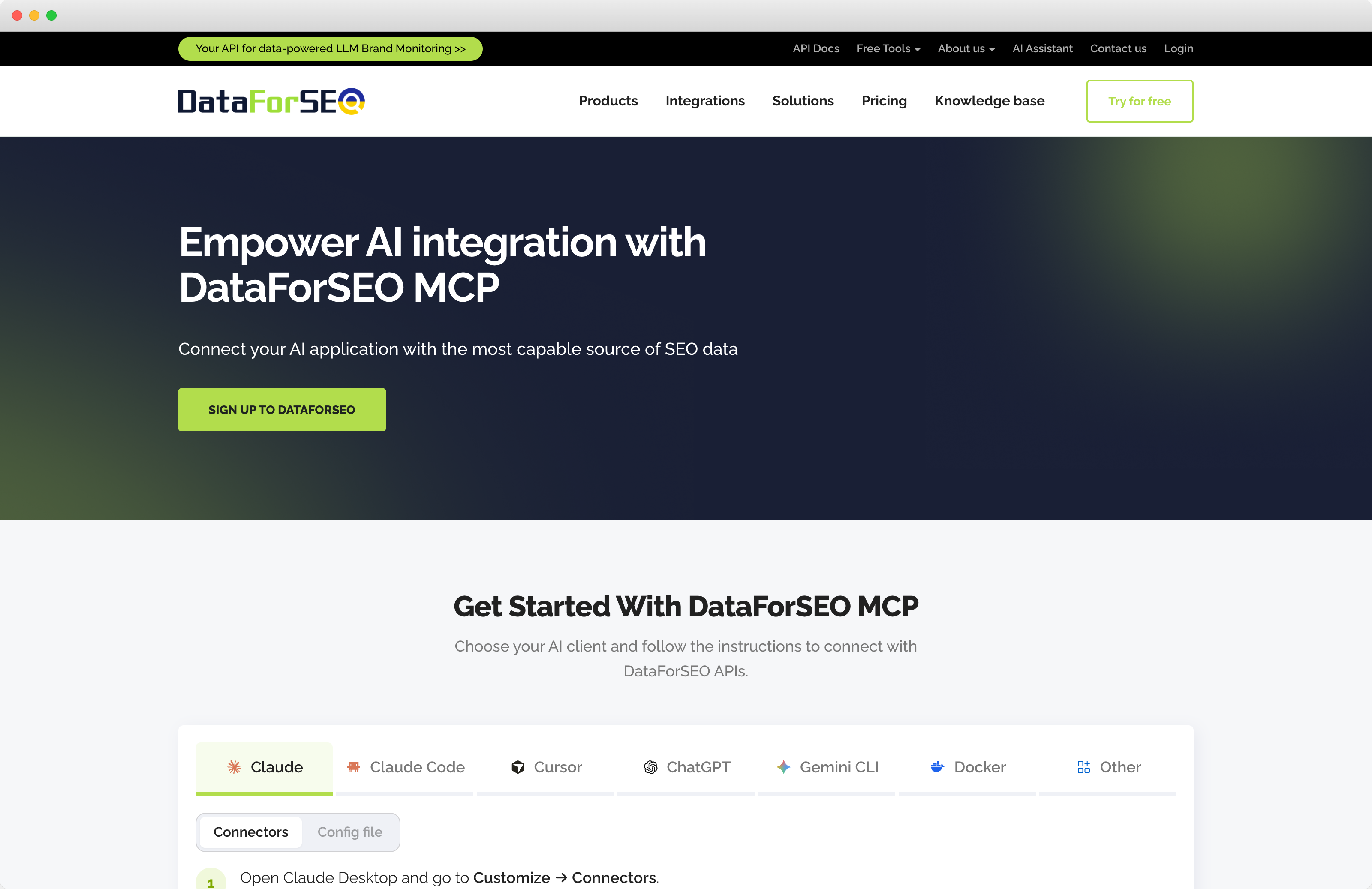
What we use it for. Choosing the topic, and understanding what a searcher expects to find before a word is written. Every number it returns means something narrower than it looks:
| In the data | What it is | What it is not |
|---|---|---|
| Search volume | An estimate of how often people type that exact phrase in a month | Demand for the product, or the number of people with the problem |
| Keyword difficulty | A 0 to 100 estimate of how hard the first page is to reach, based on the links behind the pages already there | A verdict on whether to write the piece |
| Search intent | A label for what the searcher seems to want: to learn, to compare, to buy, or to find one site | A reading of the buyer’s mind |
| The results page | The ten pages Google shows for the phrase today | The only place a buyer looks |
| People Also Ask | The questions Google shows in a box beside the results | A full list of what buyers ask |
How to use it. Connect it to Claude Code and ask for the numbers inside the research pack, next to the pages Firecrawl read. Then treat every number as a question rather than an answer. When we ran the phrase “product qualified leads”, it came back at twenty searches a month. A tool would drop that topic. A consultant who works with product-led companies knows the question behind it comes up in their pipeline reviews, just not typed into Google in those words, and writes it anyway.
The Consultant Is Why It Ranks
Everything above makes a team faster. None of it makes a page better than the pages it read, and that is the only thing that gets a page chosen over them.
.png)
Information gain is the name for what a page adds that the pages already ranking do not have. You find it by reading those pages first. Our research packs end with a section called What none of them says, and for product qualified leads it found a real split: one ranking page counts watching a demo as using the product, the other four require that somebody used it, and none of them mentions the conflict.
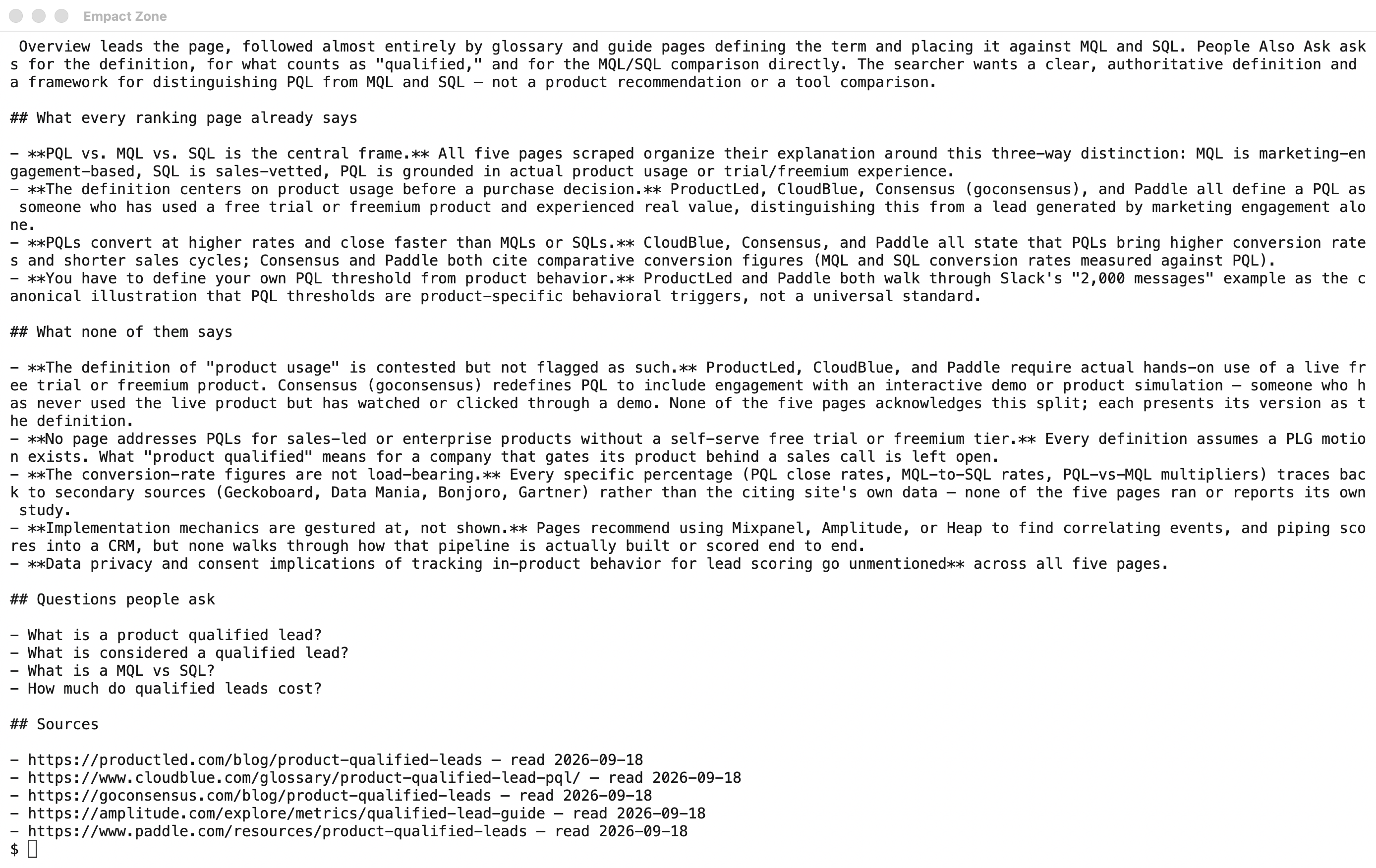
Claude Code found that gap in under two minutes. Filling it is a different job. It takes somebody who has watched a partner’s trial users stall on the second screen and can say which definition predicts a sale.
Unique information is where the gain comes from, and it never comes from the web. It comes from interviews with the partner’s experts, from their customers’ words, from their own data, and from time spent in the product. Every consultant on an Empact partnership brings it into the brief before Claude Code writes a line.
Unique content follows from that. A page carrying information nobody else has cannot read like anybody else’s page, and a named consultant who puts their name on it gives it the authority that search engines and AI engines weigh when they choose a source. Linearity shows what that looks like over years: their blog went from nearly zero to more than 250,000 monthly organic sessions across a partnership of more than five years, on more than four hundred articles written by subject-matter experts.
Relevant content is the test that comes before all of this, and it is the one AI is worst at alone. A piece is relevant when it answers a question a buyer asks on the way to a purchase, not when it matches a phrase with volume. For PDF Reader Pro, that meant product guides on high-intent document topics, written by two of our writers after an audit of hundreds of existing posts, and the published case study attributes 15–20% of monthly sales to those guides.

What You Can Set Up This Month, and What Takes Quarters
Run these four questions on the last five pieces your team published, before you touch a tool:
The tooling is the easy part, and a team can have it running this month: one folder per publication, a house standard written with reasons and your own examples, and Firecrawl and DataForSEO connected to Claude Code. What takes quarters is the part in the right-hand column of the table: the interviews every month, the partner data pulled and checked, and a named person who owns every piece and keeps the standard current as the product changes.
Running that part is most of what the Content Marketing workstream does at Empact Partners. A partnership starts with an audit of what you have already published and a roadmap, then a named senior GTM consultant runs the publication with your team, on the AI-native process above, and puts in the part the tools cannot.
If your team has the tools and the pages still read like everybody else’s, the missing piece is almost always the consultant column. Send me one article your team published this quarter, and I will tell you which of the four questions it fails and what would have caught it.