Ask an AI engine the same buying question two days running and it will not give you the same answer. We measured that in our own instrument across 43,052 consecutive-day pairs this month: on average fewer than half the brands named came back, and the brand named first changed in about half of them.
So the first thing a tool in this category has to survive is the thing it is measuring. The six below are the ones we read closely before putting one in front of a partner, and they are not six versions of one product. Each is built to answer a different question, which is the fact that decides which one you should be paying for.
Empact Partners is a go-to-market consultancy for B2B software, and one of the six workstreams we run is Generative Engine Optimization: getting a partner named in the answer when their buyer asks the category question. Qvery, first on this list, is our sister company. We say so in its entry and again here.
| Tool | Best for | What it reads | Starting price | Trial |
|---|---|---|---|---|
| Qvery | One defensible baseline number | ChatGPT, Google AI Mode | EUR 49/mo | Free trial |
| AthenaHQ | Which pages the engines read | Eleven or so models | USD 295/mo | Free, USD 25 credit |
| Scrunch AI | Whether agents can reach your pages | Curated prompt sets, agent logs | USD 250/mo | Demo only |
| Peec AI | What the engine says about you | Models by tier | USD 95/mo | Free trial |
| Profound | Which questions belong in your sample | Panel-licensed prompt data | Quoted | Limited free trial |
| Ahrefs Brand Radar | A read this week, with no setup | AI Overviews, AI Mode, ChatGPT, Perplexity, Gemini, Copilot | USD 199/mo suite | Included in the suite |
1. Qvery
Best for: a team that needs one defensible number on the board slide every month.
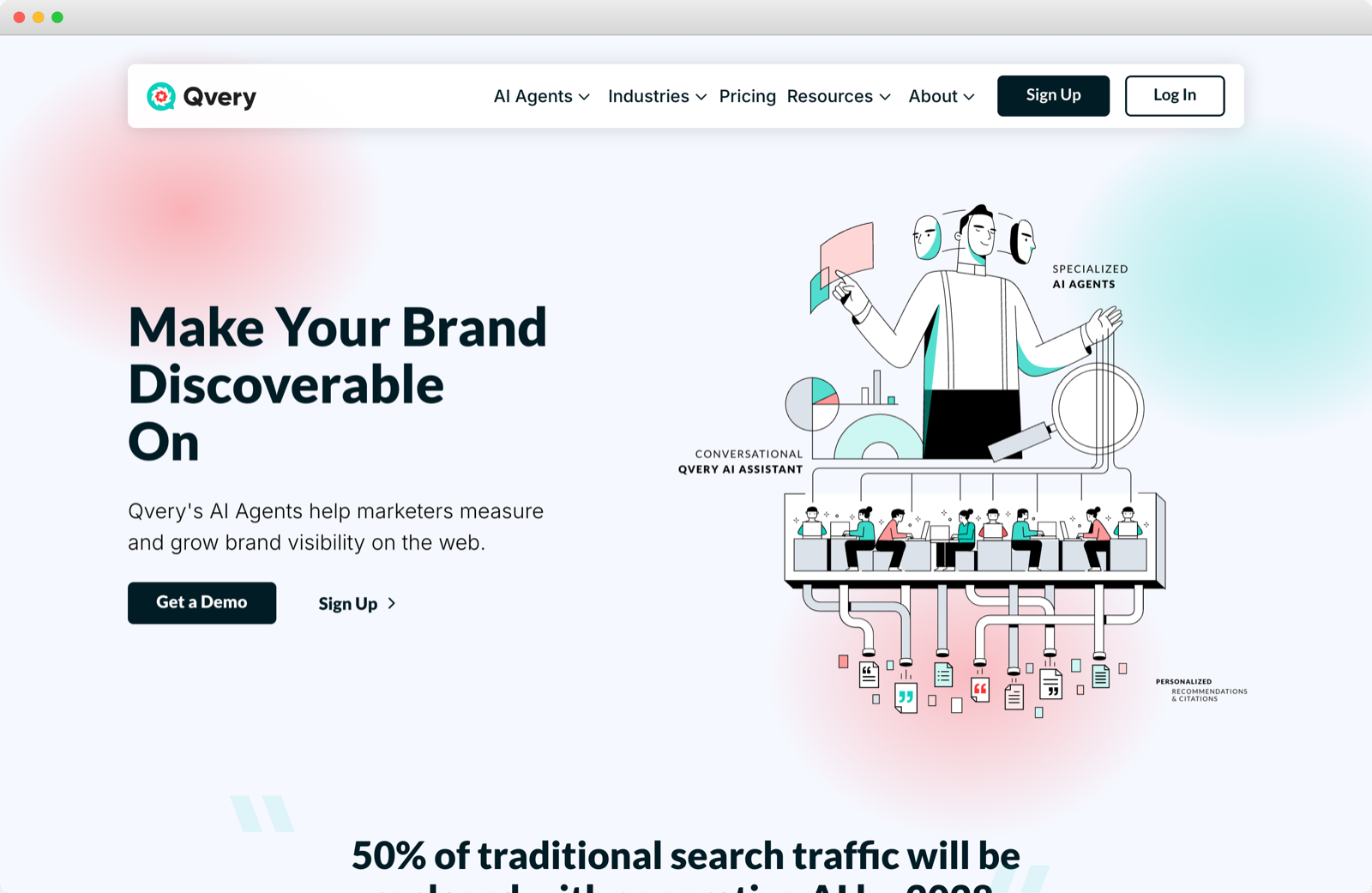
Qvery builds a question set from a brand’s own context, runs it every day across ChatGPT and Google AI Mode in more than two hundred countries, and records which brands each answer names, in what order, and every source behind it.
It reports visibility and share of voice as two numbers rather than one, which matters more than it sounds. Visibility counts whether you were named at all. Share of voice weights where you landed, and a brand named last is not a brand named first.
The knock is coverage. Two engines, not nine. If your category lives on Perplexity, that is a real gap and not a rounding error. The question set is also generated, so the number is only as honest as the questions, which is why we throw out branded prompts before a partner sees a figure.
Pricing
Pros and cons

.png)
Standout feature: Share of voice, reported separately
Most tools here report one visibility figure. Qvery reports two: whether you were named at all, and where in the answer you landed. A brand named sixth of six is not a brand named first, and a single blended score hides exactly that.
Verdict: the right first tool for a team that needs one defensible number, reported monthly, on questions its own buyers ask. Skip it if you already trust a baseline and your next question is which sources to go and earn.
2. AthenaHQ
Best for: a team whose baseline came back low and who now need somewhere to aim.
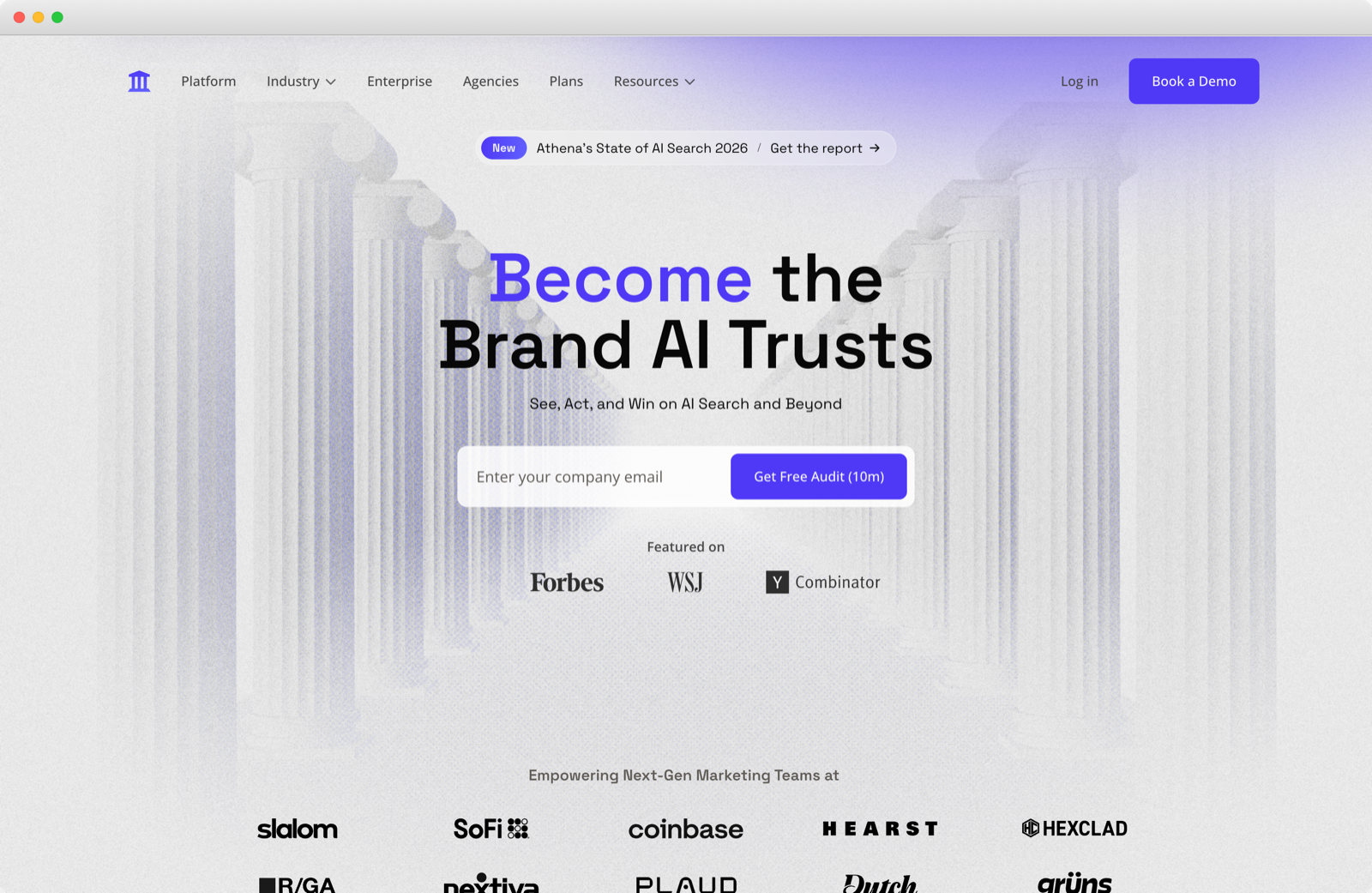
AthenaHQ runs a prompt set you own across eleven or so models, then takes every answer apart into the domains and the individual URLs that produced it. Its Sources screen is the product.
That is a different question from how you are doing, and it only makes sense once the first one is answered. A source list tells you where the answer came from, which is where the work is, because this is won off-site.
The test this one has to pass is citation weight over domain authority. In our own collection, ten domains carried a third of every citation and a hundred carried three fifths, while two in five cited domains appeared exactly once. That is the shape of a good outreach list.
Pricing
Pros and cons
What G2 reviewers say
G2 rating: 4.9 out of 5 from 47 reviews, read 20 September 2026.
“I like that I can get down to the actual response, citation, and competitor page before I accept a recommendation. That context matters when our product marketing team needs to preserve technical distinctions.” — G2 review, read 20 September 2026
“The prompt library is thin on industry-specific starting points. We built most of our tracking prompts from scratch, which is fine but it added setup time at the start.” — G2 review, read 20 September 2026
Standout feature: Content
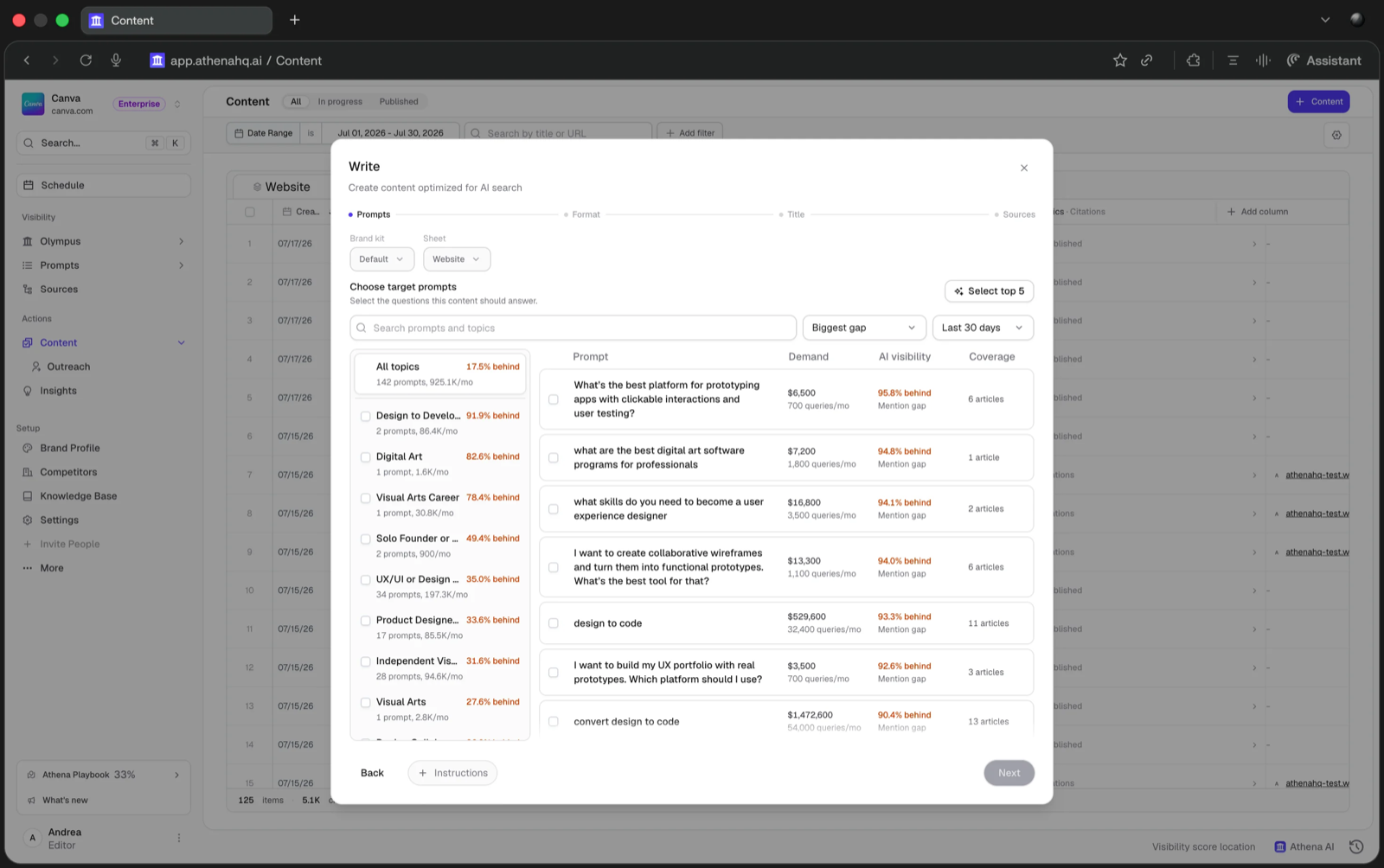
Its Content flow starts from the prompts you already track, shows the demand behind each one and how far behind you are on it, and turns the gap into a brief before a page exists. That is the shortest path from a source list to work somebody can be assigned.
Verdict: for a team whose baseline came back low and who now need somewhere to aim. Skip it if nobody on your side has the capacity to pitch, publish or earn a mention once the list exists.
3. Scrunch AI
Best for: teams with a large site, real documentation, or a security team that has been blocking things quietly.
Scrunch calls itself an Agent Experience Platform. Underneath the phrase is the one measurement on this list where you own the ground truth: it reads your own server and edge logs to show which AI agents visited, what they fetched, what they got back, and where they hit an error.
The question it owns is whether the machines can read you. That is a different failure from not being recommended, and it is the only one you can fix entirely on your own property.
Here is where a buyer goes wrong. Crawler hits are not recommendations. An engine can fetch your documentation every day and still name three competitors, because being read and being cited are separate events.
Pricing
Pros and cons
What G2 reviewers say
G2 rating: 4.6 out of 5 from 73 reviews, read 20 September 2026.
“By curating our own prompts based on traditional search demand data, we can have confidence we’re seeing the full picture.” — G2 review, read 20 September 2026
“The sales process was frustrating. Terms shifted multiple times during negotiation, pricing confirmed in writing got retracted, and the contract didn’t match verbal commitments on several points. Also, certain models are locked behind higher tiers, which wasn’t made clear upfront.” — G2 review, read 20 September 2026
Standout feature: Agent Analytics
Agent Analytics is the log-reading half, and it is why this entry exists. It tells you which agent fetched which URL, what status it got back, and where a block sent it away empty. Nothing else here reads your own server, so nothing else can answer that.
Verdict: for teams with a large site, real documentation, or a security team that has been blocking things quietly. Skip it if your site is small, open and already being fetched, in which case a log file and an afternoon get you the same answer.
4. Peec AI
Best for: teams that are already being named and are losing anyway.
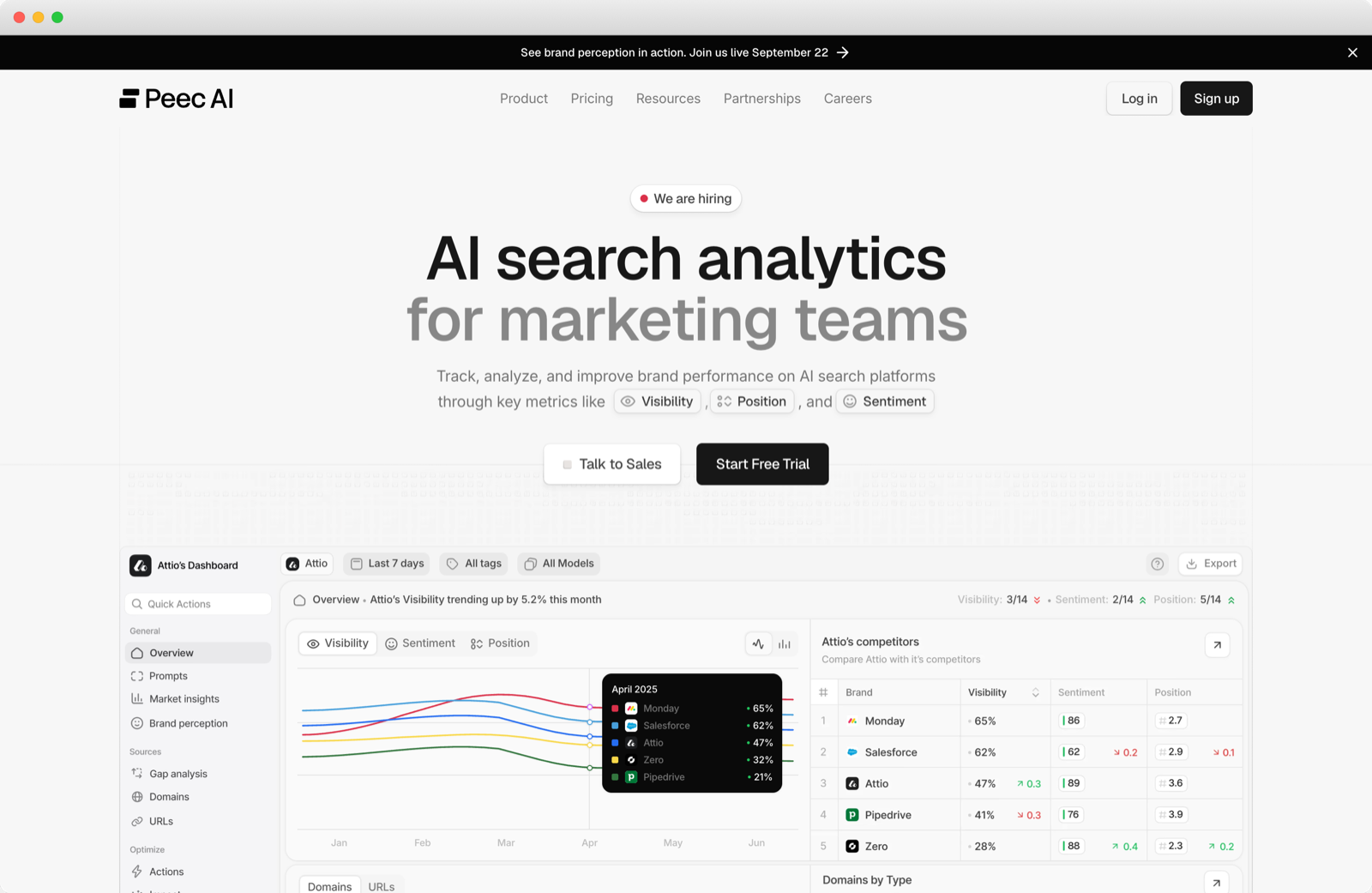
Peec runs a prompt set daily through the AI platforms’ own interfaces, which is table stakes by now. What earns it a place is Brand Perception, and inside that, its Objections view.
It asks every tracked model why someone might not choose you, repeatedly, then groups the answers by meaning so the objections that keep coming back are visible as a set. Being named by an engine that then describes a feature you do not have is worse than being absent.
The honest limit is where the objection comes from. It is the model’s theory of your weakness, built out of what the public internet says about you, rather than a survey of your buyers. Read it as a list of what you have failed to publish.
Pricing
Pros and cons
What G2 reviewers say
G2 rating: 4.7 out of 5 from 21 reviews, read 20 September 2026.
“We chose Peec.ai as our AEO platform because it has a simple, easy-to-use interface while still offering a very complete range of features. It was also the platform with the best pricing.” — G2 review, read 20 September 2026
“The onboarding guided us to create search categories, and then it suggested 50 prompts. And 40% of the prompts were overlapping with each other. That created friction because with the default prompts we were tracking items multiple times.” — G2 review, read 20 September 2026
Standout feature: Attribution history
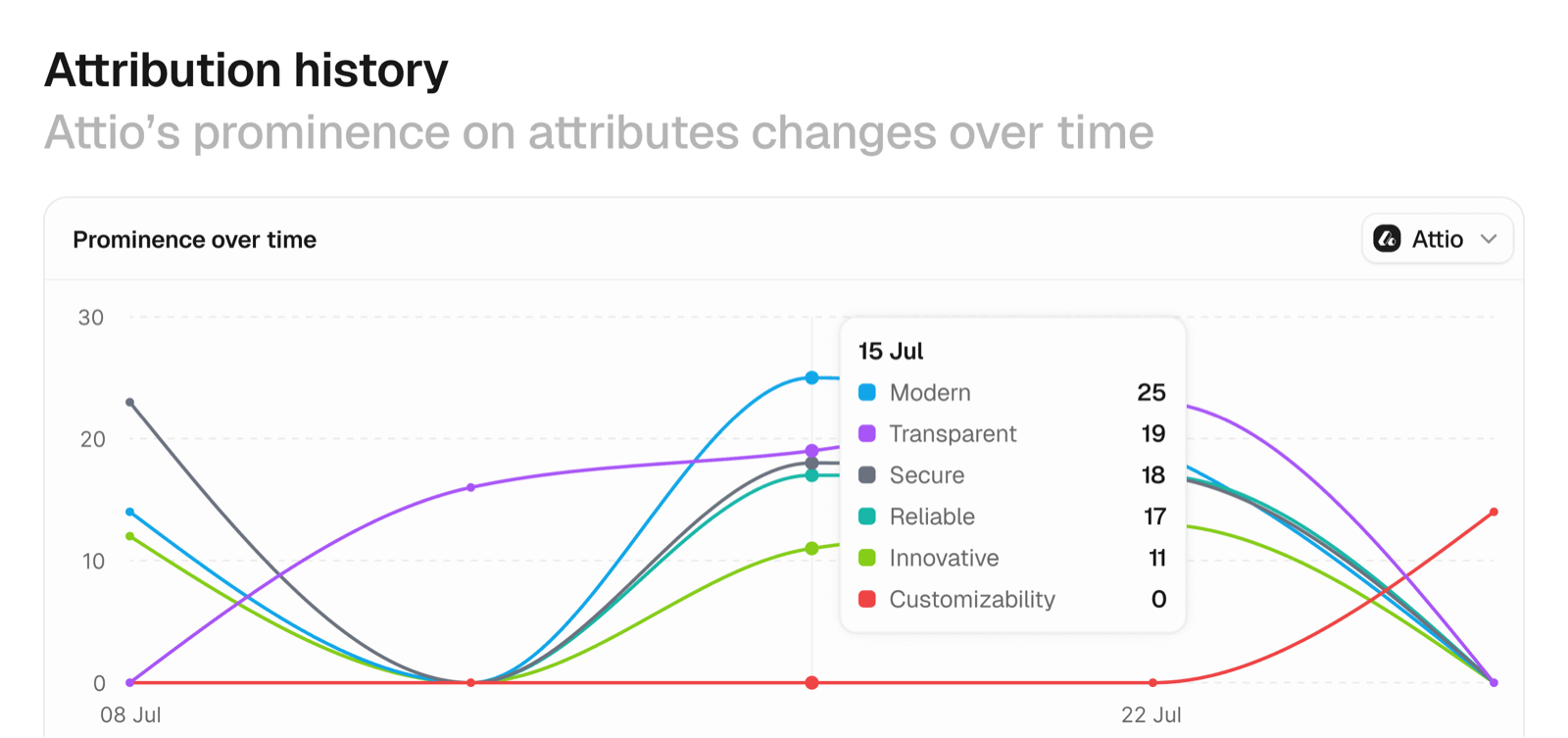
Attribution history tracks how prominent each attribute of your brand is in the answers over time, attribute by attribute, so you can watch “transparent” climb while “customizability” sits at zero for a month. That is a reading list for the content team rather than a score for the board.
Verdict: for teams that are already being named and are losing anyway. Skip it while you are invisible, because a perception report on a brand nobody mentions is a blank page.
5. Profound
Best for: teams at the scale where the question set is a program of its own.
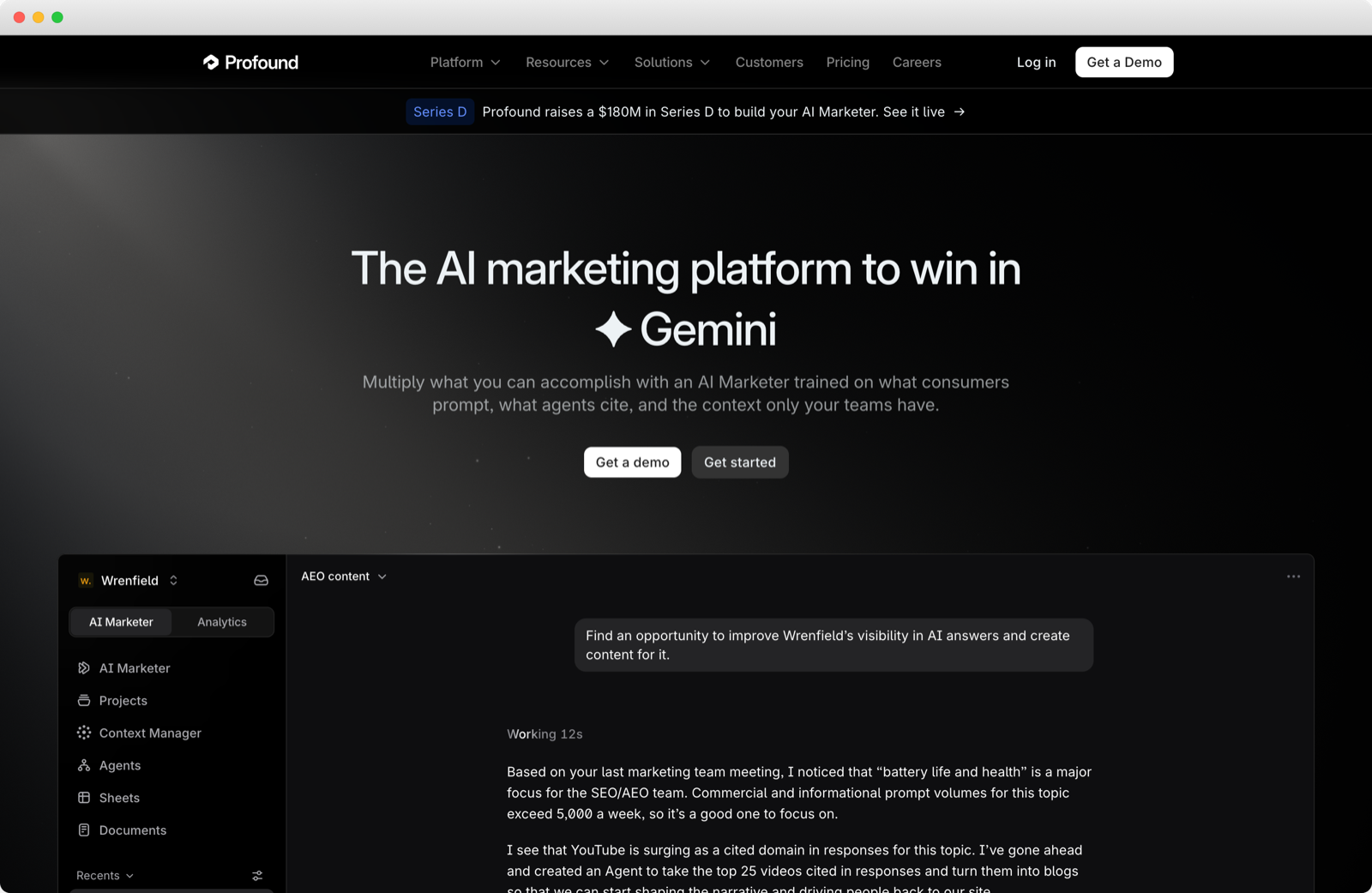
Profound licenses prompt data from double-opt-in consumer panels, corrects it statistically, and sells the result as prompt volume: the questions people put to AI assistants in your category, with trend and intent attached.
The question it owns is which questions belong in your sample, which is a real question and a different one from how you are doing on the sample you already have.
The test here is the one we care about most. Nobody outside an engine can see the prompt behind a particular citation, so any tool that appears to show you that is reconstructing. Profound is not claiming it, and the distinction matters: panel data is a legitimate estimate of what a population asks, not a window into the one buyer who found you.
Pricing
Pros and cons
What G2 reviewers say
G2 rating: 4.5 out of 5 from 1,129 reviews, read 20 September 2026.
“Before, it was all a bit of a black box. Profound has helped us quite a bit to understand how our brand appears in ChatGPT and other AIs.” — G2 review, read 20 September 2026
“It’s limited to a select number of LLMs. Given how rapidly the LLM landscape and market share are changing, it would benefit from broader visibility across the core LLMs, along with clearer insight into how they differ by model and at the country level.” — G2 review, read 20 September 2026
Standout feature: Prompt Volumes
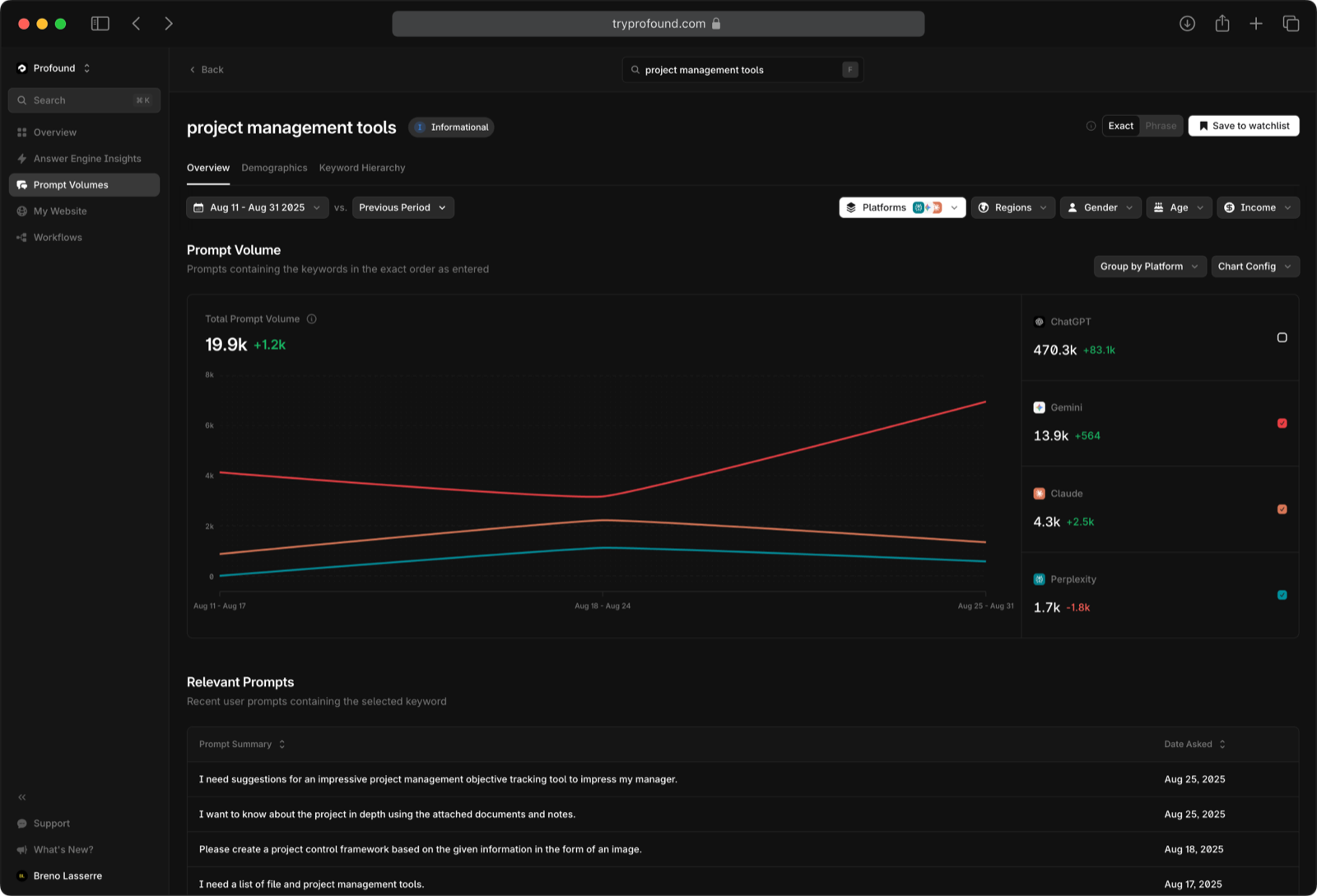
Prompt Volumes is the demand side made concrete: a category, the total prompt volume behind it split by platform, and the actual recent prompts underneath with the date each was asked. It is the AI-era version of keyword research, and it should be judged on that basis rather than as a window into your own citations.
Verdict: for teams at the scale where the question set is a program of its own, and for content planning where guessing the questions has stopped being good enough. Skip it if you could write your twenty highest-intent buyer questions from memory this afternoon.
6. Ahrefs Brand Radar
Best for: the team that already owns the suite and wants a read this week.
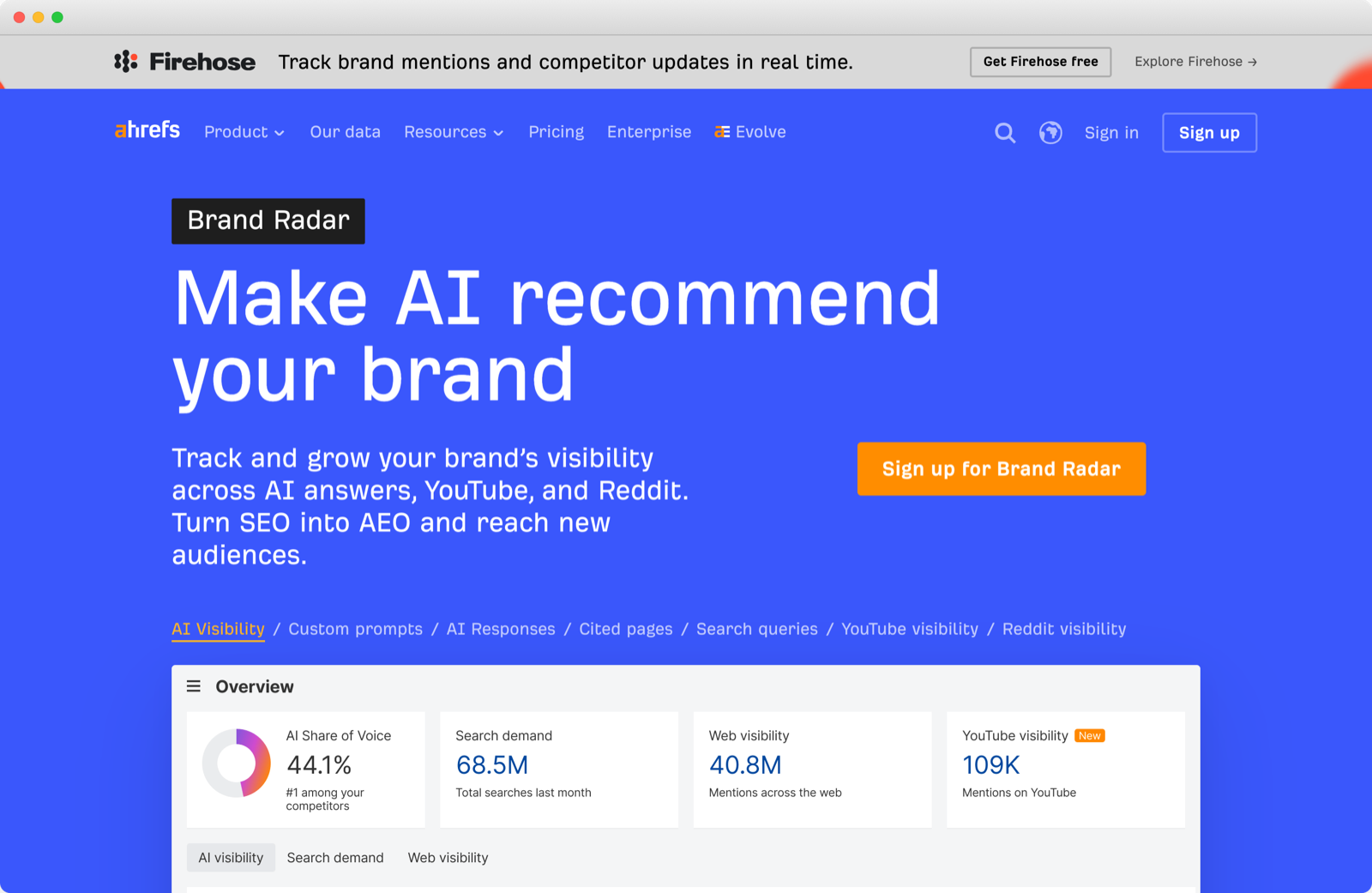
Brand Radar sits inside a suite many marketing teams already pay for, and it answers the question differently from everything above it. Rather than run questions you wrote, it searches a large index of AI answers already collected.
You type a brand, any brand, and get a picture with nothing to configure and no tracking period to wait through. That speed is why it is on this list.
The test it fails, by design, is sample ownership. You did not choose those questions, and they come from search demand rather than from what your buyers type into a chat window, which Ahrefs says plainly in its own methodology.
Pricing
Pros and cons
What users say, on Reddit and on G2
G2 rating: 4.5 out of 5 from 714 reviews for Ahrefs as a suite, read 20 September 2026.
“you’ll find it in AHREFS, I have the paid plan, not the free plan. it lists if and where you get mentioned. however to view those results you need to upgrade further.” — r/SEO, Nov 2025
“ahrefs pricing is a maze, had a client almost pull the trigger on that $199/mo before we mapped out what they actually needed and it was nearly a grand. The add-on stacking is brutal.” — r/AI_Agents, Sep 2026
“Even though Brand Radar shows multiple LLMs and supports multiple countries and languages, it’s unreliable when it comes to tracking progress over time. Every time they update the index, the metrics change retroactively, so the historical view doesn’t stay consistent. I’ve been using it for about 8 months and have noticed this across multiple brands.” — G2 review, read 20 September 2026
Standout feature: AI Share of Voice
The overview puts AI share of voice, search demand, web visibility and YouTube visibility on one screen with a mentions line per competitor, and it renders for any brand you type with no setup at all. Read it as a category average rather than as your number, which is exactly what it is.
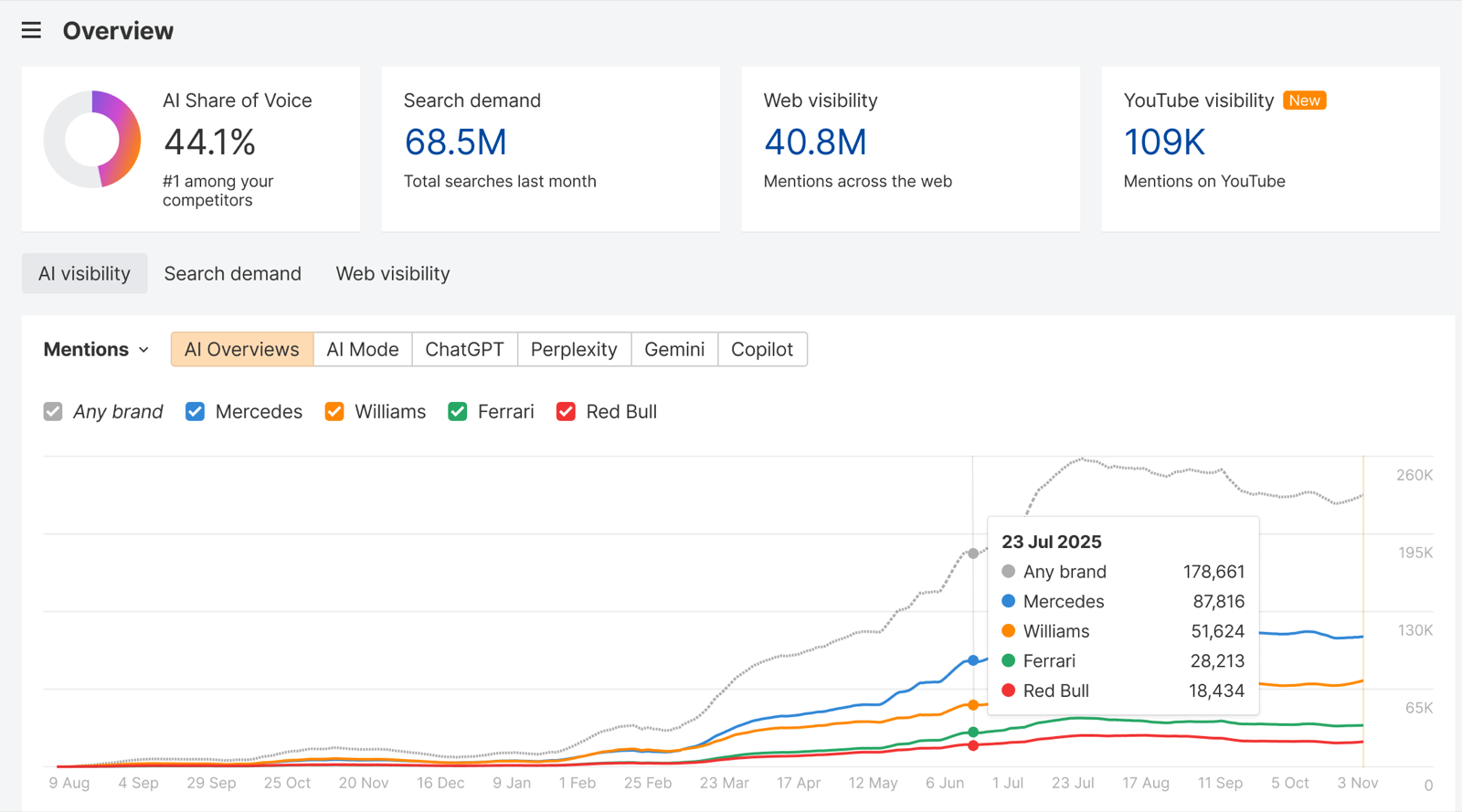
Verdict: for the team that already owns the suite and wants a read this week. Skip it as your reporting number, for the same reason you would not report a category average as your pipeline.
Which One You Should Open First
There is no ranking here because these six do not compete for the same job. Find yourself in the list below and start there.
Whichever you pick, measure the same way every month and treat the direction as more real than the number. The instrument is pointed at something that moves while you measure it, and that is true of ours as well.
That is why our GEO workstream opens on measurement rather than on a content calendar. We set a baseline first, then build the list of outside pages the engines lean on in that market, and spend the quarter getting the partner into them.
We call the work UGC plus mentions. Two inputs: the public conversation about you, and the independent pages that describe you. Between them they settle whether an engine names you at all. It takes quarters, and we say so before anyone signs.
If you need help with AI engine optimization, book a call with me and let us see if we could work together.