In January 2026, ChatGPT cited one of our partners’ own pages in 15.8% of its answers to that partner’s category questions, and named the partner in 0.8% of them.1 A dashboard that counts citations would have called that visibility. A buyer reading those answers would not have encountered the brand.
AI search visibility is increasingly reported as a single score. The figures below, drawn from our own work and from published research, examine what such a score is worth: what it counts, how far a single reading can be trusted, and whether commercial results move when it rises.
Highlights
Taken together, the findings support one conclusion. A visibility figure is real and can be improved, but in isolation it proves little. Its value depends on what is reported alongside it: a sample large enough to trust, a second reading that confirms the first, and a measure of commercial outcome.
AI Search Visibility Is The Share Of Answers That Name Your Brand
When a buyer asks ChatGPT or Google AI Mode which tools suit a task, the answer names some brands and omits others. AI search visibility measures how often a brand is among those named, across many questions and repeated runs. Four terms define the measurement:
Share of voice is a separate measure, weighted by where in the answer a brand appears, and the distinction matters once a brand is named often.
Becoming a brand the engines name is the job of Generative Engine Optimization, or GEO, one of the six workstreams Empact Partners runs for B2B software companies. The working formula is GEO = UGC + Mentions: what real users say about a brand in public, plus what independent pages say about it.
One partnership illustrates how the figure behaves over time. For a B2B software partner, we asked both engines the same unbranded category questions every day and compared January 2026 with August 2026, like for like:
The engines did not move together. Google AI Mode went from naming the partner in about one answer in forty-five to more than one in four. ChatGPT, on the same questions, reached one in fourteen. A single blended figure would have hidden a fourfold difference between the two.
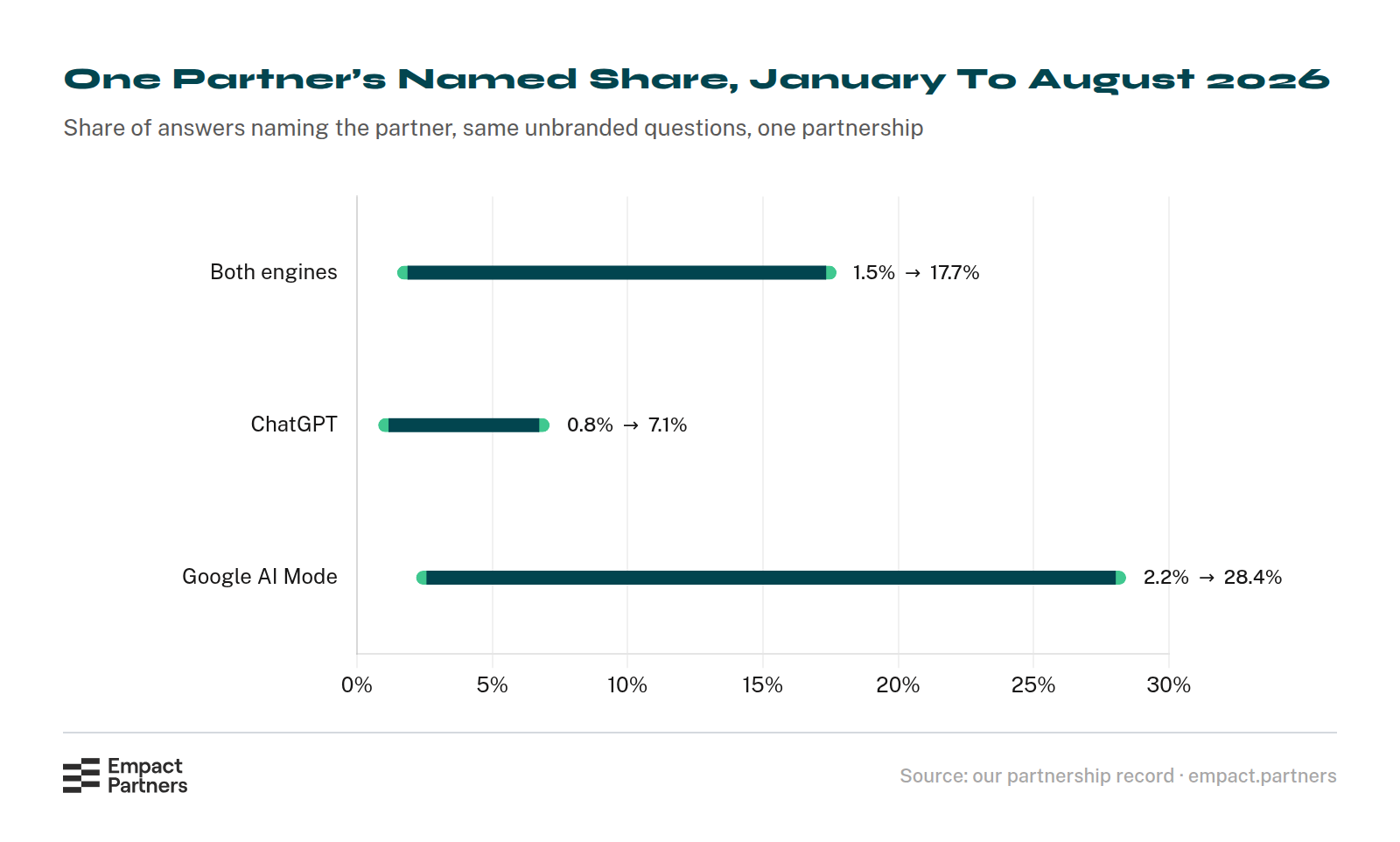
In those months the partner’s pages were rewritten to answer what its buyers ask, and it gained places on roundups in its category. We do not attribute the increase to either change. With one partnership and two changes in the same period, their effects cannot be separated.
A Citation Of Your Site Is Not A Mention Of Your Brand
The same partnership produced the figure in the opening paragraph. Alongside the answers that named the partner, we counted the answers that cited its own website:
In January the partner’s pages were being read and quoted about twenty times as often as the partner was being named on ChatGPT. Its content was strong enough to inform answers about the category, yet those answers recommended other companies.
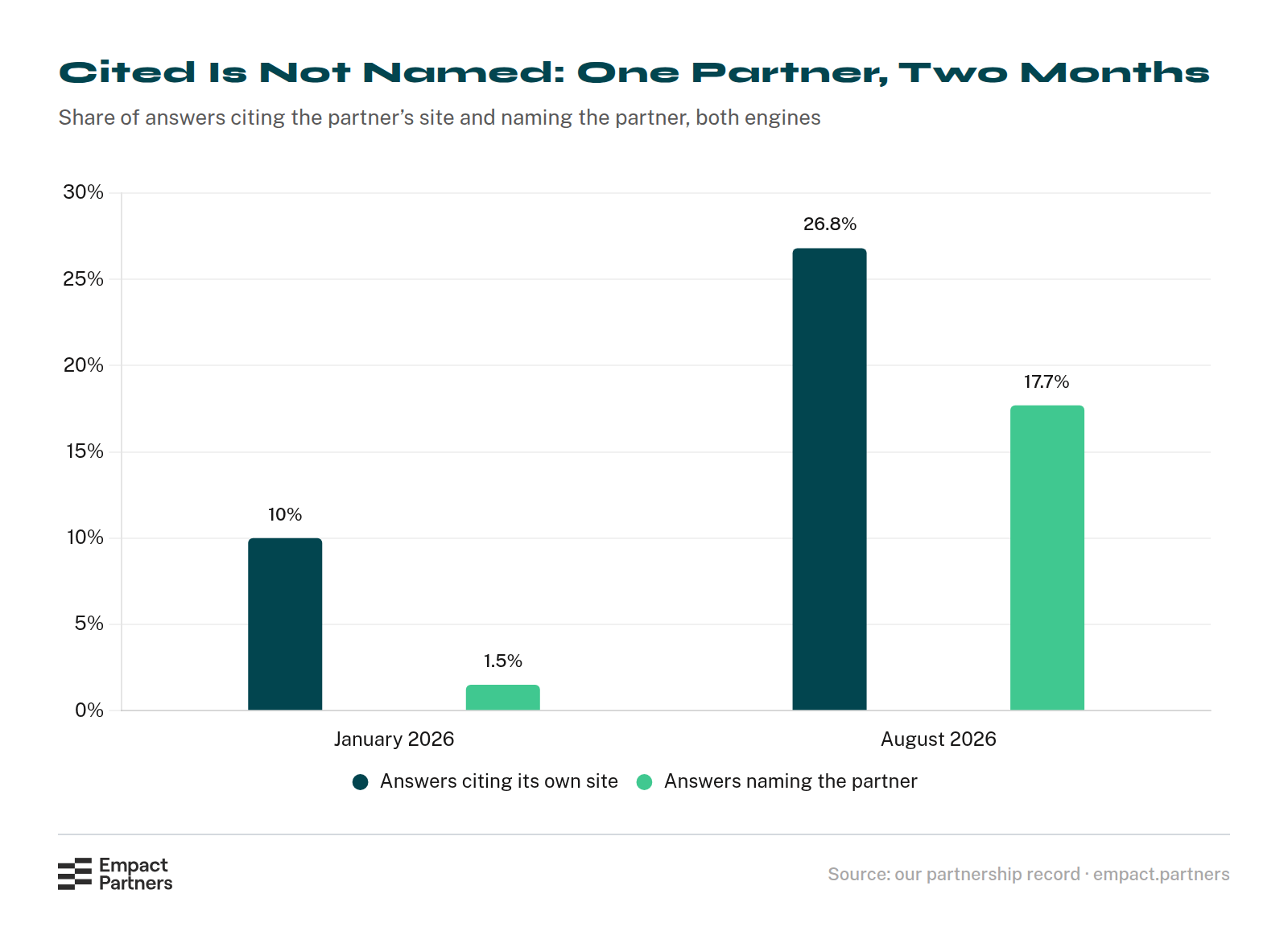
This gap is the first thing a visibility score can conceal. A tool that reports citations can show steady growth for a brand that buyers never see named. By August the two measures had converged, and most answers naming the partner also drew on its own pages.

.png)
Broader data shows that vendor pages are cited frequently. In our panel’s run of 72,000 answers in one B2B software category, software companies’ own sites took 75.9% of the citations ChatGPT gave, and 53% of those Google AI Mode gave.8 That figure covers every vendor’s site in the category combined.
A strong Google ranking does not settle the matter either. Qvery, our sister company, tracks both engines daily. Because we share ownership, weigh its figures accordingly and review the studies directly. Each is linked here and in the Sources.
Qvery set the engines’ citations against Google’s top ten results for 922 queries, one run each. What it found:
A first-place ranking therefore brings the odds of being cited to roughly even, which is well short of a guarantee.
One Reading Of A Visibility Number Can Miss By Most Of Its Value
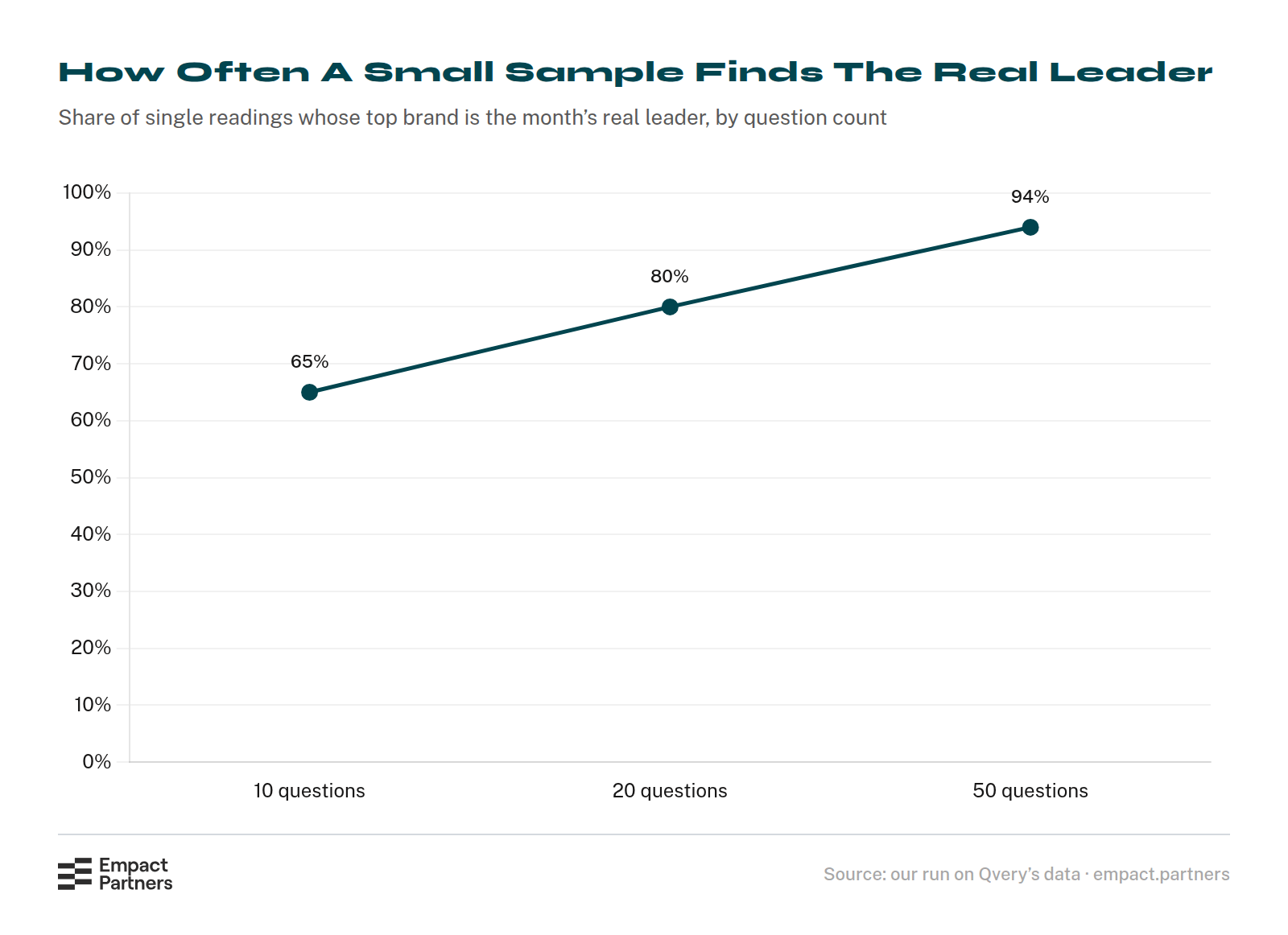
The engines rarely return the same answer twice, so a visibility figure is an estimate, and its accuracy depends on the number of questions behind it. We tested how much sample size changes the reading on 513,813 answers from the question sets Qvery tracks, January to August 2026. For brands near 10% visibility:
On ten questions, a brand whose real figure is 10% can register at almost double that or at almost nothing, with no indication of which. At fifty questions, the reading identifies the correct leader nineteen times in twenty.
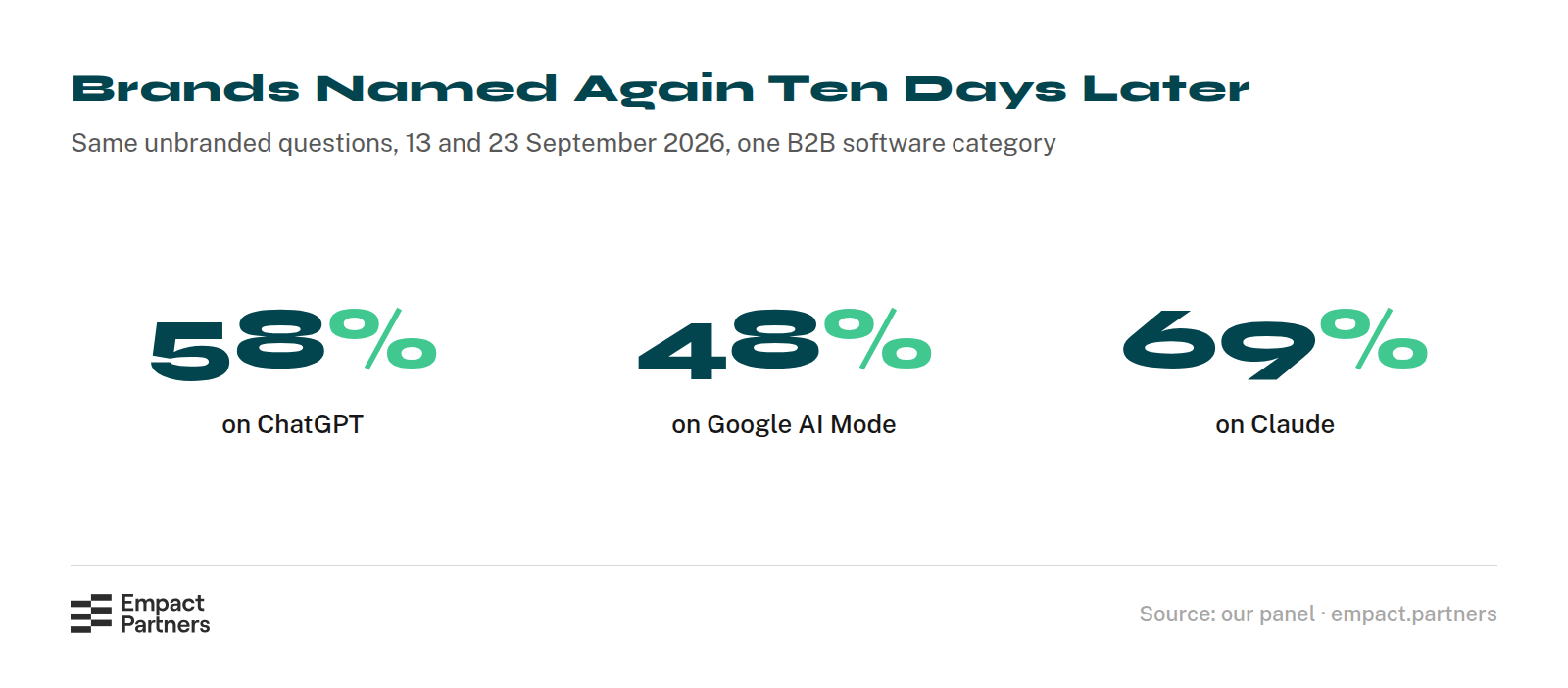
Time introduces a second source of variation. Our panel put 9,000 unbranded questions about buying software to ChatGPT and Google AI Mode twice, on 13 September 2026 and again on 23 September, in one B2B software category. Claude received 900 of them. Ten days apart:
On Google AI Mode, more than half the brands in an answer differ ten days later, as do four in five of the pages cited beneath it. A single screenshot of one question is therefore not a reliable measure.
The leading brands in a category are more stable than the rest. Qvery checked whether a category’s top five is settled by asking the same questions five times in one day. Four brands made every run’s top five in project management and two did in CRM, though 98% and 98.5% of answers named at least one brand.10
What Tracks With Being Named Is Presence On Other People’s Pages
A change in visibility has a cause. Two studies have examined which factors are associated with being named, one covering Google’s AI Overviews and one covering ChatGPT.
Ahrefs compared the web presence of 75,000 brands with how often Google’s AI Overviews mention them. A correlation runs from 0, no relationship, to 1, a perfect one:
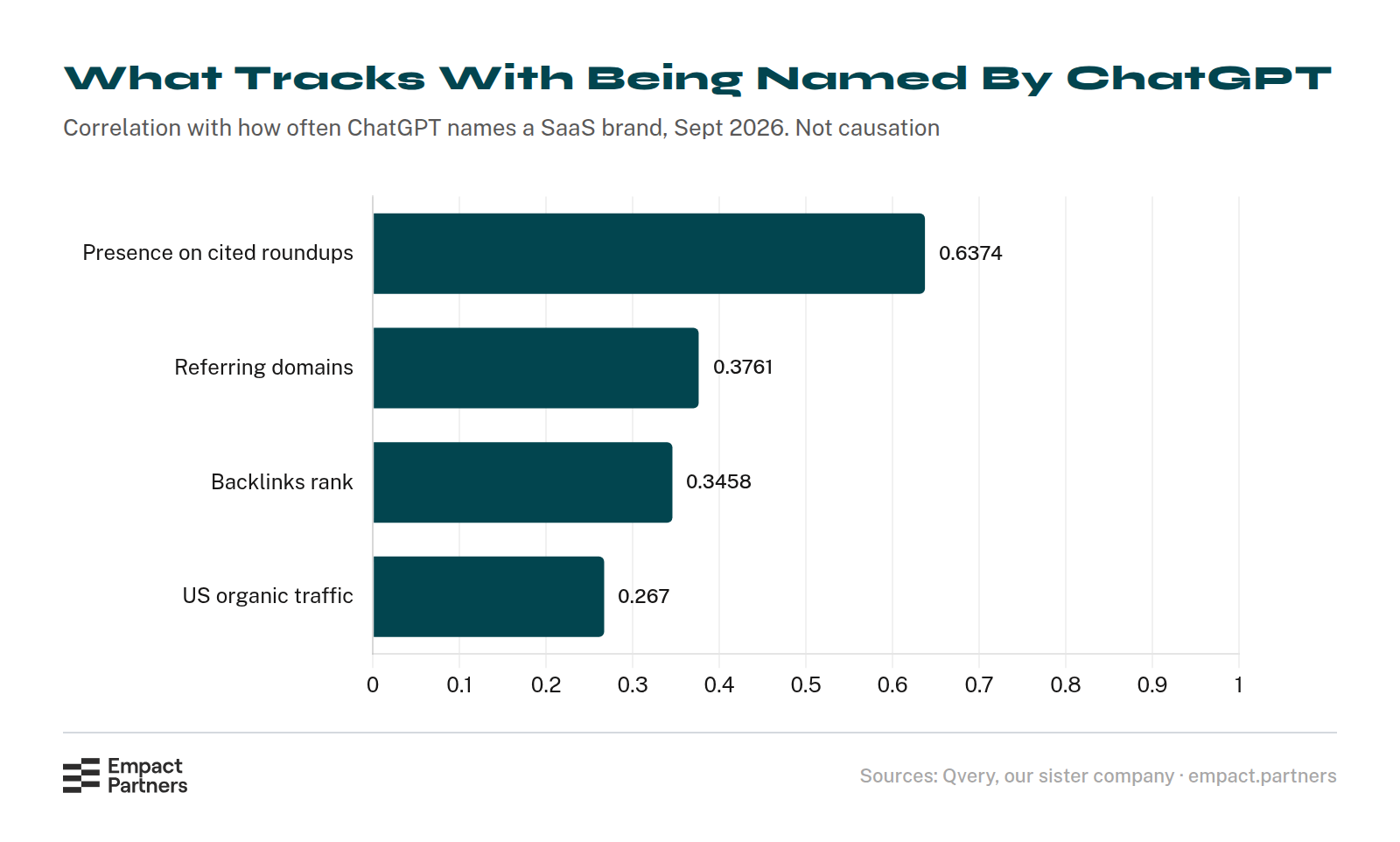
Qvery asked whether domain authority decides which software brands ChatGPT names, in September 2026. It measured how often each brand appears on the roundup pages ChatGPT cites, and set that against three authority measures:
Both studies point the same way and neither proves a cause. Brands discussed on other sites tend to be the brands the engines name, and large brands are typically both. Qvery itself cautions against moving budget on its figures alone.
Building that presence is the mentions half of GEO, and it is the slower half. The partner described above took from January to August to go from 1.5% to 17.7%, with its own pages and its place on other people’s pages both changing. Empact Partners plans that work in quarters and reports it against a baseline taken before anything starts.
A Mention Has Value Only When Something Downstream Moves
Assume the figure is sound: it counts names, rests on an adequate sample, and holds across runs. The harder question is what it is worth. The best evidence that mentions matter to buyers is a survey by G2, a software review site, of 1,076 B2B software buyers in March 2026:
G2’s figures are stated attitudes, from a company whose reviews the engines cite. The second and fourth findings belong together: buyers view a brand more favorably when a chatbot names it, and most of them also encounter inaccurate recommendations. A mention earns consideration. It does not establish trust.
Observed behavior is measured less often, and the results are less favorable. Four published studies tracked behavior after an AI answer:
| Study | What it found | What it cannot tell you |
|---|---|---|
| Pew Research Center, 900 U.S. adults on Google | With an AI summary on the page, a result was clicked in 8% of visits; with none, in 15%12 | Anything about ChatGPT, or about software buyers |
| Pew, the same study | A click on a link inside the summary in 1% of visits12 | Whether the reader remembered the brand |
| Seer Interactive, 42 organizations | Click-through of 0.7% for brands cited in the AI Overview, against 0.52% for brands not cited13 | Whether the citation caused the difference |
| Ahrefs, its own site | 0.5% of visitors came from AI search, and 12.1% of signups did14 | Whether another company would see the same |
| Ahrefs, 81,947 sites | 4 pages a visit from AI platforms, against 5.2 from search15 | Conversion, which the study did not track |
Pew adds that the session ended on 26% of pages with an AI summary, against 16% of pages without one.12 Seer’s wider trend runs the same way: click-through on queries with an AI Overview fell 61% between June 2024 and September 2025.13
Ahrefs has published two figures that point in different directions. On its own site, AI search visitors converted at 23 times the rate of organic search visitors.14 Across 81,947 other sites, those visitors bounced more often, 67.8% against 63.7%.15 One company’s signups and many companies’ bounce rates do not amount to a benchmark.
.png)
Our own record makes the same point from both sides. A three-month Reddit program for KKday, a travel marketplace, drew 3,208,973 views and 60+ explicit mentions of the brand.6 The case study prints no bookings and no revenue, so the result measures reach and should be interpreted as reach.
A specialized insurance brokerage we work with initially had the opposite experience: 100,000 Reddit views and no leads. After the program moved into smaller communities where its buyers ask questions, it generated nearly 40 qualified leads within one month.7 Fewer people saw those threads, and more of them were ready to buy.
Six Checks Tell You What Your Own Visibility Number Is Worth
These findings reduce to six questions a marketing leader can put to a dashboard, a vendor, or a consultant in a single meeting. None requires a tool.
Few reports satisfy all six, which is the reason to ask. Most of the effort in measuring AI search visibility goes into the question set and the repeat runs, the part a single screenshot omits.
Empact Partners is a consultancy that works from inside a software company’s own marketing team, and a GEO engagement opens with this measurement:
That work runs for several quarters. The figure to monitor throughout is the share of answers that name your brand in response to unbranded questions. If it rises for two quarters with no corresponding rise in commercial results, the visibility was real but the value was absent, and the plan should change.
If you have an AI visibility figure and need to establish what it is worth, book a meeting with me. We can assess together whether this is work we should take on.
Sources
- Empact Partners, our partnership record: one B2B software partner’s tracked category questions in Qvery’s data, the same unbranded questions asked daily on ChatGPT and Google AI Mode, January 2026 against August 2026, like for like. Read 12 October 2026.
- Empact Partners, our panel: one B2B software category, the same 9,000 unbranded buying questions on ChatGPT and Google AI Mode and 900 on Claude, 13 and 23 September 2026, each question matched to itself. Read 12 October 2026.
- Empact Partners, our run on the data of Qvery, our sister company: 513,813 answers to the question sets it tracks daily on ChatGPT and Google AI Mode, 22 sets, January to August 2026, random subsets. Read 12 October 2026.
- Ahrefs, “An Analysis of AI Overview Brand Visibility Factors (75K Brands Studied),” by Louise Linehan, 26 May 2025. Read 12 October 2026.
- G2, “New G2 Research: Half of B2B Software Buyers Now Start Their Research With AI Chatbots,” press release, 15 April 2026. Survey of 1,076 B2B software buyers, March 2026. Read 12 October 2026.
- Empact Partners, KKday case study: one three-month Reddit program, views and brand mentions as the public page prints them. Read 12 October 2026.
- Empact Partners, insurance brokerage case study: one partnership, Reddit views and qualified leads from its public page. Read 12 October 2026.
- Empact Partners, our panel: the same B2B software category, 72,000 answers from ChatGPT and Google AI Mode across four waves, September 2026, every citation classed by the kind of site it lands on. Read 12 October 2026.
- Qvery, “AI Engine Citations vs Google Organic SERPs: Only 13.9% Overlap,” by Vlad Shvets, 17 March 2026. 922 queries, one run each. Read 12 October 2026.
- Qvery, “Have AI Engines Already Settled Your SaaS Category’s Top 5? Check Before You Try To Break In,” by Vlad Shvets, 22 September 2026. Two categories, five same-day runs. Read 12 October 2026.
- Qvery, “Does Domain Authority Decide Which SaaS Brands ChatGPT Names? Roundups Track It More Closely,” by Vlad Shvets, 22 September 2026. ChatGPT recommendation answers, September 2026. Read 12 October 2026.
- Pew Research Center, “Google users are less likely to click on links when an AI summary appears in the results,” 22 July 2025. 900 U.S. adults, browsing from March 2025. Read 12 October 2026.
- Seer Interactive, “AIO Impact on Google CTR: September 2025 Update,” by Tracy McDonald, 4 November 2025. 3,119 informational queries, 42 organizations. Read 12 October 2026.
- Ahrefs, “Does AI Search Traffic Convert Better Than Traditional Search? For Ahrefs, Yes: 0.5% of Visitors Drove 12.1% of Signups,” by Patrick Stox, 16 June 2025. Read 12 October 2026.
- Ahrefs, “AI Visitors Visit Fewer Pages and Bounce More Often Than Traditional Search Visitors,” by Louise Linehan, 24 June 2025. 81,947 websites, May and June 2025. Read 12 October 2026.